
9. Print ads
Despite the explosion in the importance of online media, people still prefer to read dead trees. A few points to bear in mind:
- Never pay what is says on their rate card, try to get at least 25% off. You may also be able to negotiate some editorial (and you thought it was all written by the staff – pah!).
- The more ads you book, the better the rate you get.
- As soon as you advertise in one magazine, all their competitors will ring you up and try to sell you advertising.
- You can try to track the success or otherwise by using different urls, ‘where did you find out about us’ surveys or coupon codes. None of these are very reliable as customers will:
- type the product name in Google instead of typing the URL
- not answer the survey or forget where they heard about you
- forget to use the coupon
‘Advertising executives’ will tell you that someone has to see your ad 7 times before they buy your product. How very convenient for their commissions! No-one has ever been able to give me a reference to support this widely cited ‘fact’. If you have a reference, please put it in a comment at the end of the blog.
Pros: Can give a lot of exposure and some credibility. Can be reasonably targeted with a good choice of magazine.
Cons: Very expensive. Difficult to measure the effectiveness. It is easier to click on a link in a web ad than to put your magazine down, start the computer and type the URL into a web browser.
Data point: I have spent several thousand pounds advertising PerfectTablePlan in UK and US wedding and event magazines. I ran everything from small classified ads in big circulation wedding glossies to quarter page ads in lower circulation event planning magazines. I used different URLs for each ad and ‘where did you hear about us’ surveys to try to measure the results. As far as I can tell the results ranged from disappointing to dismal.
A magazine for gay women recently contacted me to ask if I wanted to run an ad in their pull-out section on ‘civil partnerships’ (the new legal partnership for gay people in the UK). I kept saying no until they offered me a quarter page ad, editorial and space to announce a competition for £60+VAT. How could I lose money on that? In the competition I offered free licences to the first 10 people to email in with the magazine name and claim them. Number of clickthroughs to site: negligible. Number of sales through published ad URL: 0. Number of emails claiming one of the 10 free copies: 0!
I think it is very tough to make print ads pay when your software is a niche app selling at only £20/$35. The economics may be very different if your software sells in huge volumes (e.g. best selling games) or has a much higher ticket price. I have also found the accounts departments of magazines to be a huge pain in the backside to deal with.
10. Forums
This is a form of guerrilla marketing where you hang out in forums that your potential customers frequent and answer relevant questions with a subtle plug for your product. Exactly what is considered acceptable varies from forum to forum. Having your product URL in your signature is usually OK. Pointing people at a relevant answer on your site may also be acceptable. Starting a thread telling everyone how great your software is is unlikely to be welcome anywhere. Using fake personas to plug your own product (sock puppet marketing) is dishonest and likely to be seen straight through by forum regulars – don’t do it.
Pros: Free. Can be very targeted and can give you a lot of useful background information about your market.
Cons: Time consuming.
Data point: I know far more about wedding receptions than any man should.
11. Free ‘lite’ versions
You can give away a free, reduced-functionality version of your software as an enticement to buy the full version.
Pros: Free advertising for your product every time someone uses the lite version.
Cons: If the lite version is useful, people won’t need to buy the full version. If the lite version isn’t very useful, people won’t want to buy the full version. Catch-22. Its a fine balancing act. Also a lite version can undermine the perceived value of the full version.
Data point: This form of promotion doesn’t appeal to me. I have a ‘crippled’ functionality trial, but that isn’t the same thing.
12. Cold calling
Cold calling is phoning people without their consent to try and sell to them. Usually done by people with written scripts and rhinoceros thick skins.
Pros: I guess there must be some or people wouldn’t do it.
Cons: Time consuming (if you are doing it yourself) or expensive (if you are paying someone to do it). In the UK you can be heavily fined for calling people who have registered with the the Telephone Preference Service.
Data point: I did a bit of cold calling of event businesses in the early days of PerfectTablePlan. I hated it and quickly decided it wasn’t worth the cost to my self-esteem. I never sold a single licence this way.
 Promotion is an essential part of successful software – hearing about something is an essential first step to trying it. Without promotion your software is the proverbial tree falling in the forest with no-one to hear it. In this series of articles I am going to talk about some of the ways you can promote your software, and the pros and cons of each. I will also discuss how effective these various methods have been for my own £20/$35
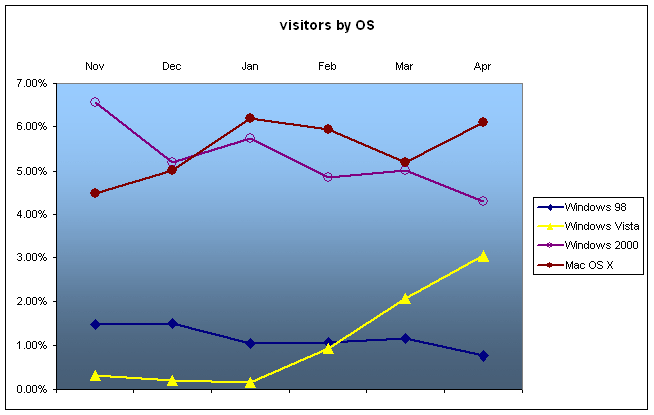
  I have put together some figures on visitors to the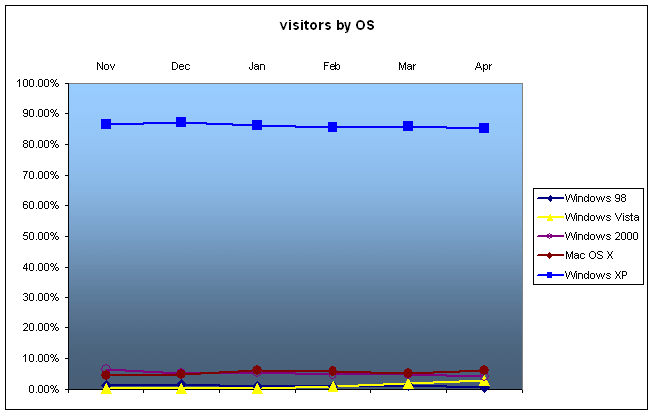
 GoogleCheckout has only recently become available to UK-based businesses such as mine. On the 20th March I took my first payment for
  Fashion is such a ridiculous business. Every year anorexic clothes horses strut up and down modelling ridiculous clothes no-one is ever going to wear. Hemlines go up or down. Various baubles are ‘in’ or ‘out’. Grey is the new black. We geeks are above all that. Comfortable in our jeans, bad haircuts and nerdily sloganed black t-shirts we know that #000000 != #0c0c0c . We care not a jot for fads and fashions. Or do we?
 Spam and phishing emails can be a huge drain on productivity for an Internet based business. I use Mozilla Thunderbird and I find the spam filtering works tolerably well. Most of the incoming spam is quietly siphoned off into a ‘Junk’ folder and there appear to be very few false positives. I supplement this with a message filter to move all emails purporting to be from paypal.com or ebay.com (99% of which are phishing emails) to a ‘Suspicious’ folder, which I check from time to time. But I still get lots of spam with embedded GIF images, which Thunderbird’s spam filter seems to be powerless to handle.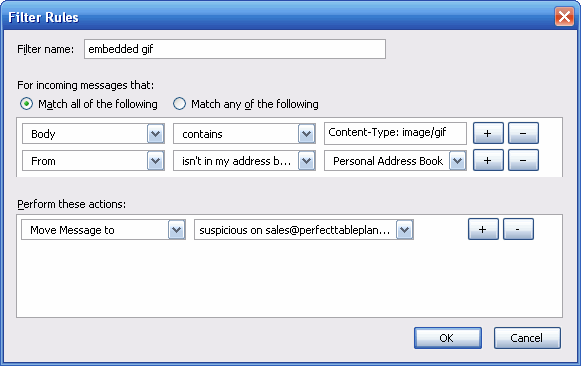
 I would guess that the majority of the software that I have written in my career has never been used. Or, at least, not used enough to justify the long hours I and my colleagues lavished on it. I am sure that I am far from unique in this. I flatter myself that the software was intuitive, well documented and robust, but we never managed to convince enough people that the software solved a real problem for them. Creating high quality software is hard, but it just isn’t enough. The software also has to be marketed effectively.
 Successful Software