Tag Archives: paid

Software upgrade economics: some real numbers

My seating planner software, PerfectTablePlan, is now at v7. Major upgrades are paid (discounted 60% compared to new licences), which means I have done 6 cycles of paid upgrades. I was curious about how long it took people to upgrade, and what percentage of sales are upgrades. So I took a few minutes to crunch the numbers direct from my licence key database, using my data wrangling software, Easy Data Transform.

Here are the number of upgrade licences I sold for each week after the major upgrade. Each release is in a different colour. The values are normalised so that the peak is the same height for each release:

Upgrade licences sold per week after a major upgrade, across 6 upgrades

That looks rather messy. So here it is with the values for the 6 upgrades summed:

Upgrade licences sold per week after a major upgrade, summed across 6 upgrades.

There is a long tail of upgrades. Even when the gap between releases was 6 years, I was still getting regular upgrade purchases.

With the v5 to v6 upgrade it took:

  • 23 weeks before 50% of the upgrades were sold.
  • 74 weeks before 75% of the upgrades were sold.

So it isn’t a neat exponential decay.

This table shows how many users actually upgraded from v5 to v6:

EditionUpgraded
Home edition12%
Advanced edition31%
Professional edition45%

Most of the Home edition purchasers are buying a licence for a one-off event, such as a wedding. So it is not surprising that they are much less likely to upgrade. But I think it also shows that less price-sensitive customers are significantly more likely to upgrade, even when the upgrade is more expensive.

This graph show the percentage of PerfectTablePlan licences sold each month that were upgrades, over the 20 year life of the product:

Percentage of sales that are upgrades per month.

You can see that upgrades are still increasingly important over time. Upgrades are worth less than new sales, so selling 80% upgrade licences in a month doesn’t mean 80% of revenue is from upgrades. However, upgrades are still an increasingly significant source of revenue for us. I’m glad I never agree to free upgrades for life.

Could I have made more sales with more frequent major upgrades? Definitely. But I was also working on other projects. And I am not out to squeeze every last penny out of my loyal customers.

Could I have made more sales with a subscription model? Possibly. But subscriptions weren’t really a thing for desktop software, when I started 20 years ago. And I never felt like making a major change to a licensing model that had worked well for me, so far.

Should I give free upgrades for life?

There are any number of different licensing models. For commercial software the main ones are:

  1. subscription
  2. outright purchase, with annual maintenance
  3. outright purchase, with free minor upgrades and paid major upgrades
  4. outright purchase, with free major and minor upgrades for life

Subscription payments and purchase + maintenance are nice, if you can get them. They give a more predictable cash flow for a business and you can generally charge a higher lifetime price than you can with a single payment. But this isn’t appropriate for all types of software. For example, it doesn’t make much sense for lower priced desktop software. Assuming subscription or purchase+maintenance isn’t an option, the question boils down to – should we charge for major upgrades?

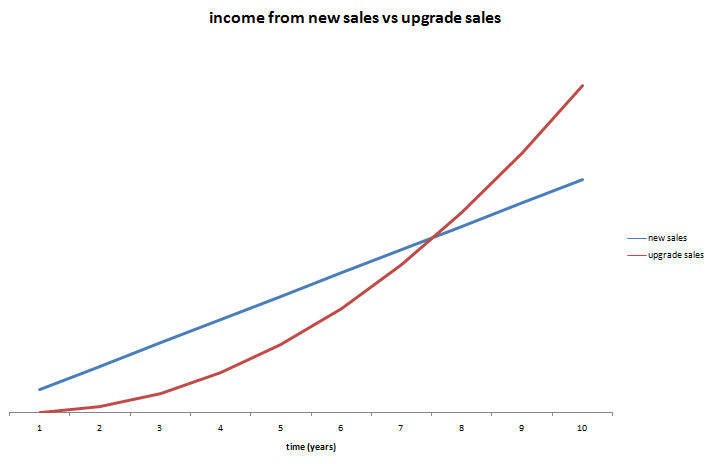
Let’s look at the numbers for a simple (contrived) example. AcmeSoft sells 1000 licences of v1 of their product in year 1, 2000 licences of v2 of their product in year 2, 3000 licences of v3 of their product in year 3 etc. Each year 50% of the customers who bought the previous version (new or as an upgrade) pay to upgrade to the latest version. The upgrade costs them 50% of the initial purchase. How much is the upgrade revenue worth? We can create a simple model in Excel:

Income new licences (blue) vs income from upgrades (red). Click to enlarge.

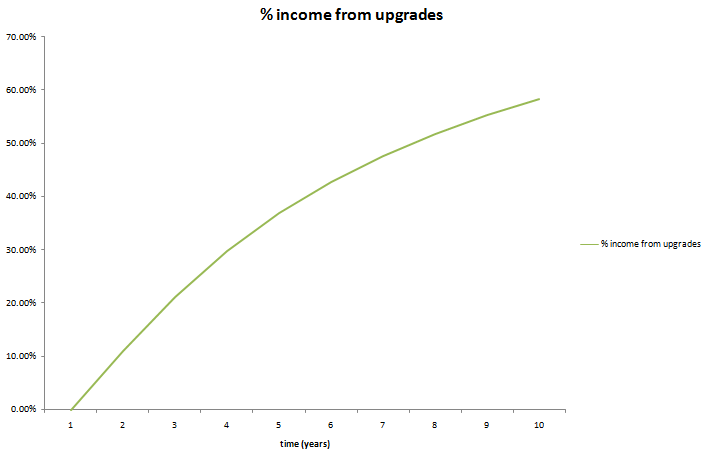
Percentage of annual income from upgrades. Click to enlarge.

In year 8 the upgrade income is actually worth more the new licence income. By year 10 upgrades are worth some 60% of yearly income for the product. If the product has a 10 year lifespan, nearly 50% of the total income from the product will be from upgrades. So it only makes commercial sense to give free upgrades for life if this will at least double the conversion ratio[1]. This seems highly unlikely. You can always try changing your upgrade policy and measure what effect it has on your conversion rate. Not much, I would guess (if anyone has tried it, I would be interested to know the results).

Even in a more pessimistic model where only 30% of customers upgrade and they only pay 30% of the new licence fee, upgrades still account for nearly 25% of total income over 10 years. You can download the spreadsheet and play with the parameters yourself.

Upgrade income becomes particularly important when:

  • A product has a long life span.
  • Customers are very likely to upgrade to a new version.
  • There is little growth in new sales.

In the worst case you could end up with a product with a huge customer base built up over a long period, but which makes very few new sales as it has saturated the market. Free major upgrades would mean that each major release is then going to result in large expense (developent and support) but very little income. Microsoft must be very happy they didn’t offer free upgrades for life on Windows or Office!

I don’t see anything unreasonable about charging for major upgrades. The vendor has to do additional work to add the new features and existing customers can choose whether the new features are worth the upgrade fee. However customers have certain (not unreasonable) expectations for paid upgrades:

  • The fact that the customer is expected to pay for major upgrades needs to be made clear before purchase.
  • Any major bugs in version n should be fixed before releasing version n+1.
  • A major upgrade should have significant new features.
  • Major upgrades should not be released more than once every 12 months.
  • The upgrade fee should be reasonable. Around 40% of the cost of a new licence seems typical.
  • There should be a grace period for free upgrades. E.g. If I buy v1 of a product on 01-Jan I don’t expect to have to pay an upgrade fee for v2 released on 02-Jan. Typically this grace period is 3-6 months.

If you are offering free upgrades for life currently, you can change your policy to paid major upgrades. But, obviously, you will need to honour free upgrades for everyone who purchases before the change of policy.

There are some, apparently successful, companies that offer free upgrades for life (Axialis for example). But I have heard many tales of small software vendors regretting their initial decision to give free upgrades for life. The easiest customer to sell to is the one you already have. If you don’t charge for major upgrades, are you leaving large amounts of money on the table?

[1]Ignoring inflation, interest etc.