

I have been experimenting with buying ChatGPT ads for my event seating assignment software. Here are the overall results from 05-Aug-2026 to 28-Aug-2026:
| Total spend on ChatGPT ads | £289.52 |
| Total clicks | 2,988 |
| Average CPC | £0.10 |
| Average time on page (Google analytics) | 7s |
| Bounce rate (Google Analytics) | 69% |
| Total installs (Google Analytics) | 14 |
| Conversion rate (click to install) | 0.46% |
| Cost per conversion | £20.68 |
ChatGPT recommends bidding somewhere around by £2 per click, but I bid between £0.15 and £0.07 and was still able to get traffic. However 0.46% is a shockingly low conversion rate. Given what I know about the lifetime customer value and install to purchase rates for PerfectTablePlan, I’m not close to making any money on these ads.
Comparing engagement with other sources in the same period:
| Metric | ChatGPT ads (paid) | Google ads (paid) | ChatGPT referrals (free) |
| Average time on page (Google Analytics) | 7s | 20s | 23s |
| Bounce rate (Google Analytics) | 69% | 46% | 39% |
| Conversion rate | 0.46% | 5.3% | 4.2% |
So the problem is clearly the ChatGPT ad traffic, rather than my website/product. It seems one of several things might be happening:
- OpenAI is charging for more clicks than they are sending.
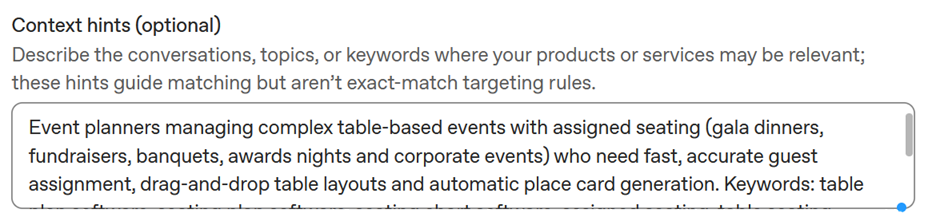
- My context hint is bad.
- My ads are bad.
- A high proportion of the clicks are from bots, not humans.
- The traffic is very badly targetted.
The clicks reported by OpenAI are close to what Google Analytics reports, so we can rule 1 out.
My context hint seems uncontroversial, so that rules out 2.
The ads are very similar to ones I have been running in Google Adwords for years, so we can rule 3 out.
I reached out to digital ad fraud expert Dr Augustine Fou, part way through the experiment, to ask him whether he thought bots might be responsible for a high proportion of the clicks. He was kind enough to help me instrument my website with fouanalytics.com. Looking at time on page, mouse movements and other metrics were able to establish that a majority of the clicks were likely humans. Here you can see the Fouanalytics analysis, with 30% showing ‘many red flags’ or ‘some red flags’ for being bots.
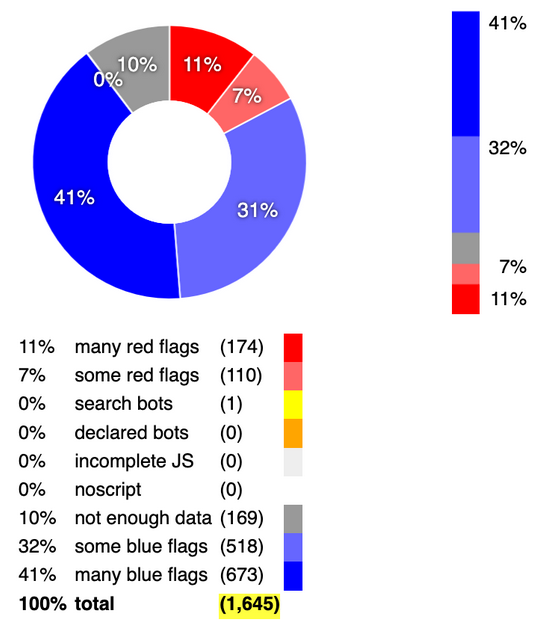
So there might be some bot traffic, but not enough to account for the terrible conversion rate. So we can rule 4 out.
That only leaves 5. The traffic is poorly targetted. This is supported by data from Fouanalytics. I wrangled the data in Easy Data Transform to get a histogram of the time on the landing page, where each bin is 1 second:
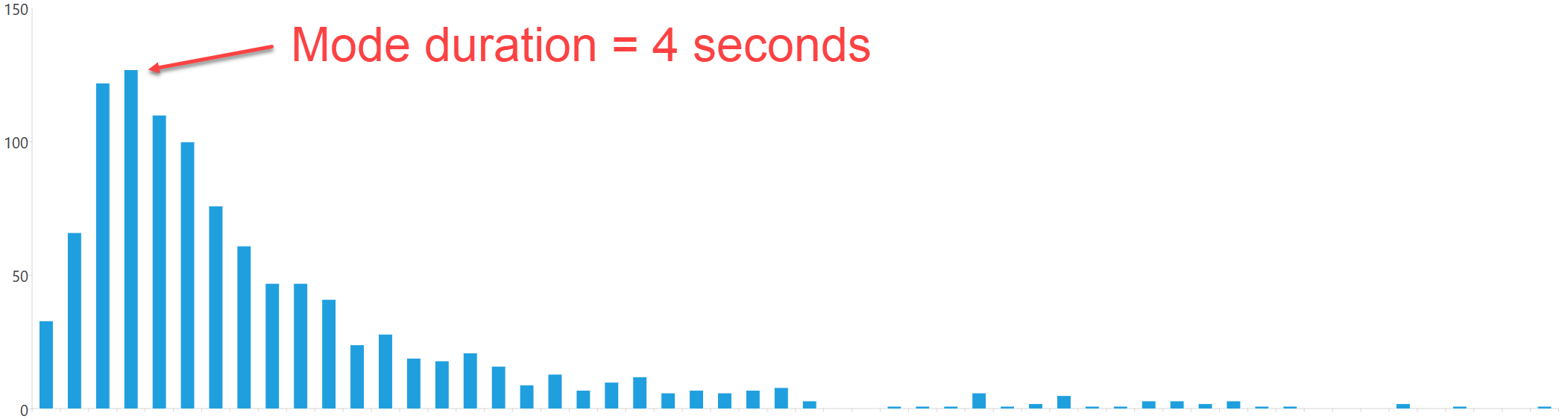
Fouanalytics also shows that 88% of the traffic moved their mouse, but only 10% clicked anything. Which is a further indication of poorly targetted traffic.
Targeting is everything when it comes to advertising. Clearly ChatGPT knows how to send me targetted traffic, because their free referrals convert an order of magnitude better than their paid ads. Maybe they are so desperate to fill the yawning void in their finances that they are generating as many paid clicks as they can, without caring too much about the quality?
I would be fascinated to know in what context they are showing my ads. But there is no way for me to find that out. Consequently, I don’t know how I can improve this conversion rate. Even if I did, I wouldn’t be hopeful about improving the conversion rate by the order of magnitude required for profitability.
Here is Dr Fou’s conclusion:
“Best practices confirmed by this experiment — always use real conversions as the measure of success. The problem with ChatGPT ads was NOT bots; it was low value visitors (ones that arrived on the landing page but did nothing else and left). It’s not entirely clear WHY these visitors are so low in value (e.g. were the ChatGPT ads simply targeted very poorly?) Invest your ad budgets in sources that not only yield more clicks to your site, but most importantly more actual conversions.” Dr Augustine Fou
(Edit: Update the Fouanalytics chart to the correct chart)
 Successful Software