
Tag Archives: openai

Archery target covered with colorful arrows in a wooded outdoor range

ChatGPT ad targeting is garbage

I have been experimenting with buying ChatGPT ads for my event seating assignment software. Here are the overall results from 05-Aug-2026 to 28-Aug-2026:

Total spend on ChatGPT ads£289.52
Total clicks2,988
Average CPC£0.10
Average time on page (Google analytics)7s
Bounce rate (Google Analytics)69%
Total installs (Google Analytics)14
Conversion rate (click to install)0.46%
Cost per conversion£20.68

ChatGPT recommends bidding somewhere around by £2 per click, but I bid between £0.15 and £0.07 and was still able to get traffic. However 0.46% is a shockingly low conversion rate. Given what I know about the lifetime customer value and install to purchase rates for PerfectTablePlan, I’m not close to making any money on these ads.

Comparing engagement with other sources in the same period:

MetricChatGPT ads (paid)Google ads (paid)ChatGPT referrals (free)
Average time on page (Google Analytics)7s20s23s
Bounce rate (Google Analytics)69%46%39%
Conversion rate0.46%5.3%4.2%

So the problem is clearly the ChatGPT ad traffic, rather than my website/product. It seems one of several things might be happening:

  1. OpenAI is charging for more clicks than they are sending.
  2. My context hint is bad.
  3. My ads are bad.
  4. A high proportion of the clicks are from bots, not humans.
  5. The traffic is very badly targetted.

The clicks reported by OpenAI are close to what Google Analytics reports, so we can rule 1 out.

My context hint seems uncontroversial, so that rules out 2.
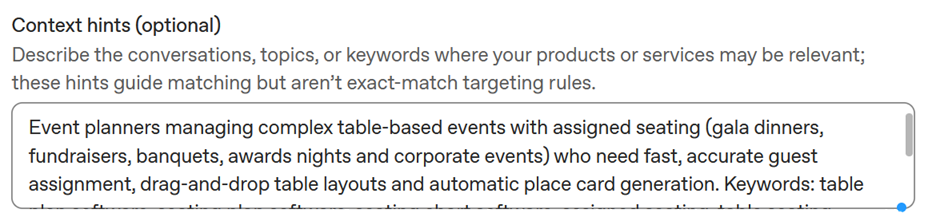
The ads are very similar to ones I have been running in Google Adwords for years, so we can rule 3 out.

I reached out to digital ad fraud expert Dr Augustine Fou, part way through the experiment, to ask him whether he thought bots might be responsible for a high proportion of the clicks. He was kind enough to help me instrument my website with fouanalytics.com. Looking at time on page, mouse movements and other metrics were able to establish that a majority of the clicks were likely humans. Here you can see the Fouanalytics analysis, with 30% showing ‘many red flags’ or ‘some red flags’ for being bots.
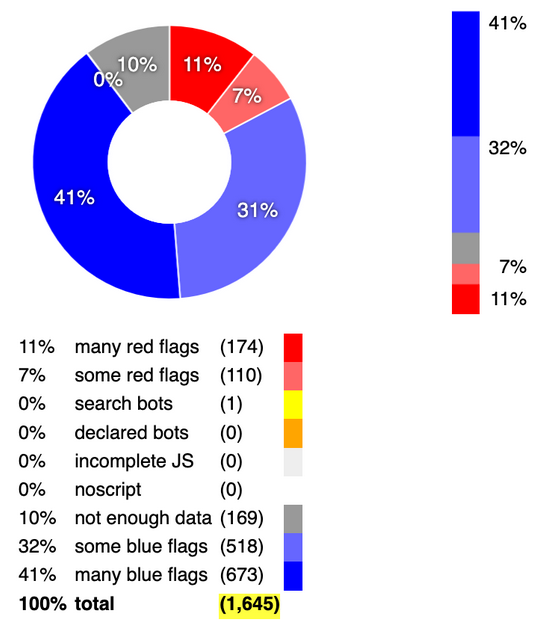
So there might be some bot traffic, but not enough to account for the terrible conversion rate. So we can rule 4 out.

That only leaves 5. The traffic is poorly targetted. This is supported by data from Fouanalytics. I wrangled the data in Easy Data Transform to get a histogram of the time on the landing page, where each bin is 1 second:
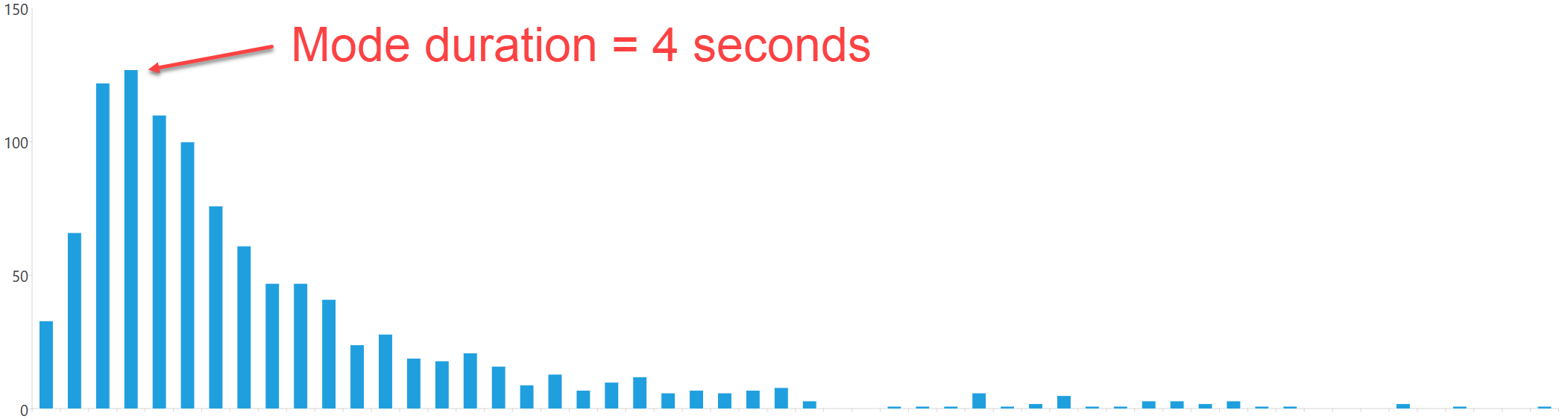
Fouanalytics also shows that 88% of the traffic moved their mouse, but only 10% clicked anything. Which is a further indication of poorly targetted traffic.

Targeting is everything when it comes to advertising. Clearly ChatGPT knows how to send me targetted traffic, because their free referrals convert an order of magnitude better than their paid ads. Maybe they are so desperate to fill the yawning void in their finances that they are generating as many paid clicks as they can, without caring too much about the quality?

I would be fascinated to know in what context they are showing my ads. But there is no way for me to find that out. Consequently, I don’t know how I can improve this conversion rate. Even if I did, I wouldn’t be hopeful about improving the conversion rate by the order of magnitude required for profitability.

Here is Dr Fou’s conclusion:

“Best practices confirmed by this experiment — always use real conversions as the measure of success. The problem with ChatGPT ads was NOT bots; it was low value visitors (ones that arrived on the landing page but did nothing else and left). It’s not entirely clear WHY these visitors are so low in value (e.g. were the ChatGPT ads simply targeted very poorly?) Invest your ad budgets in sources that not only yield more clicks to your site, but most importantly more actual conversions.” Dr Augustine Fou

(Edit: Updated the Fouanalytics chart to the correct chart)d

Three cowboys standing in a Western town street, dressed in period attire with guns.

My experience buying ads in ChatGPT: the good, the bad and the ugly

When OpenAI dropped the minimum $50k spend on their ad platform, I thought I should give it a try for my seating planner app. Perhaps I can get some cheap and well targeted clicks, before all the corporate behemoths lumber in and push up the bid prices? This is a quick summary of my initial experiences.

The good

I had to wait about a week for OpenAI to decide I was worthy to give them money. After that it was all pretty straightforward. The setup is familiar to anyone with experience of PPC (Pay Per Click) advertising: campaigns, adgroups, ads, conversion tracking.

At the campaign level you set options such as:

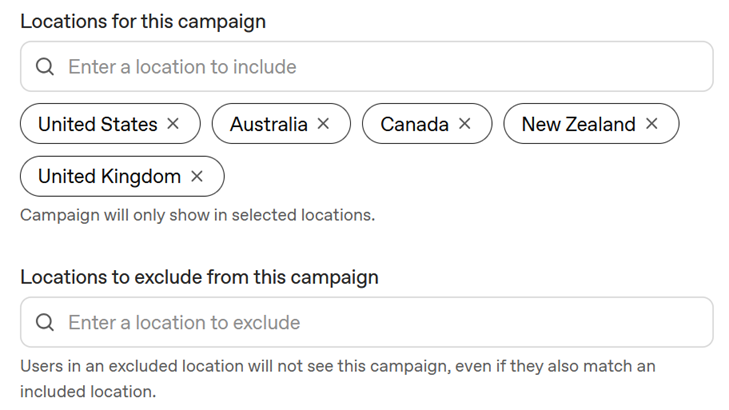
The countries you want your ads to appear in, from the 7 currently available:

And the platforms you want to be shown on:

I’m only targetting web here, as PerfectTablePlan doesn’t run on mobile devices.

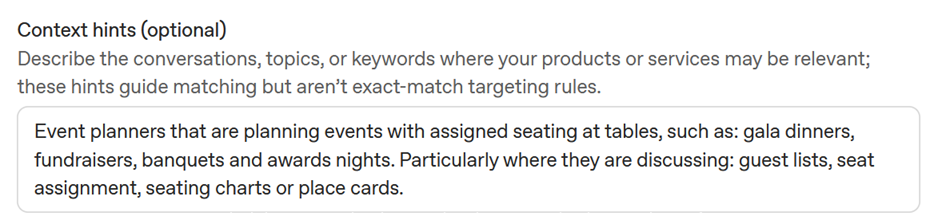
At the Ad Group level you set your maximum bid and ‘context hints’. This is where OpenAI differs from other PPC platforms. In Google Adwords you can choose which keywords to bid on. With OpenAI ads you provide a prompt saying how you want your ads targetted.

OpenAI will then use that (and, presumably, what it knows about your product) plus your bid, to decide when to show ads.

At the ad level you define one or more ads for each ad group. The ads are a 50 character maximum title, a 100 character maximum description and a small image:

So far I have 1 campaign, with 1 ad group, which contains 3 ads.

I set the conversion tracking to fire when the person who clicked on the ad arrives at the web page that gets shown when they install PerfectTablePlan on Windows or Mac.

It is all refreshingly simple compared to the lumbering monstrosity that Google Adwords has become.

Take the recommended bids with a pinch of salt (as with Google Adwords). I quickly started to get a clicks at a reasonable price, much lower than the recommend bid price. Click through rate is 7.9%, which is a bit lower than I manage with Google Adwords, but still decent.

The bad

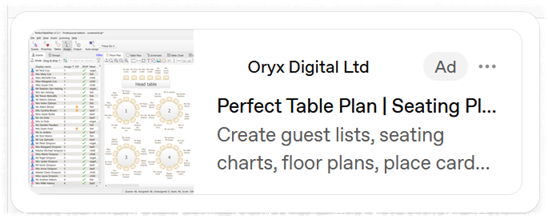
Your ad show up in ChatGPT looking something like this:

The fact that they can arbitrarily truncate the text is not ideal.

The first few days, clicks reported by OpenAI did not match clicks reported in Google Analytics. I found out you have to add a utm_source tag to your website URL to track the traffic:

Choosing search keywords is pretty straightforward, but context hints less so. Guidance from OpenAI is vague and I have no idea if my context hint is any good.

There is no equivalent of negative keywords.

I have added an OpenAI tracking pixel, but it shows zero conversions. I’m not sure why. Several Youtube videos I watched reported 0 conversion events triggered from spending substantially more than me. So I have to rely on Google Analytics and utm_source for my conversion tracking.

When it comes to advertising, targetting is everything. But I have no idea who my ads are being shown to, or in what context. In Google Adwords I can at least see what search queries people typed and infer their intent from that. But in OpenAI ads, I have no idea what people were prompting ChatGPT before they clicked my ad. This requires me to trust OpenAI. But I really don’t trust them.

It should also be noted that OpenAI are not showing ads to customers on higher tier plans. This means that your ads are only being seen by cheapskates on Free and Go tier plans. Hardly an ideal market for paid software.

The ugly

Behold the engagement metrics from Google Analytics:

SourceAverage engagement time (s)Bounce rate (%)
Google organic4835%
Bing organic5429%
Google Adwords1646%
ChatGPT2738%
OpenAI Ads576%

5 seconds. That is horrible. Even worse than my experiment with Reddit ads. It is also noticeably worse than people clicking organic (non-ad) links in ChatGPT. It is hard to avoid the conclusion that the people clicking on my ads are either extremely poorly targetted or have clicked on the ad unintentionally. Or, putting my tin foil hat on, maybe are bots or AI agents.

But there is worse. According to Google Analytics, 857 clicks have resulted in exactly three completed installs. That is 0.35% click to install conversion ratio. This is an order of magnitude below what I need to just break even on the ads. For other sources PerfectTablePlan averages between 2% and 8% click to install.

Given that I have no information on the context my ads are being shown, I don’t think there is much I can do to improve the situation. I might try changing the context hint and reducing the bid. But it will be just trial and error guesswork. It feels like shovelling money into the void and it isn’t clear that this situation will improve.

I would be interested to hear what other people’s experiences are.