Tag Archives: software

An interview with Terrell Miller of CattleMax

Software developers are usually so busy writing software for other techies, that they often forget there is a bigger world out there. Terrell Miller has a successful herd management software product for cattle ranchers. He generously agreed to share his experiences on what it has been like building a software business in a non-techie niche market.

Can you tell us a bit about CattleMax?

CattleMax is herd management software designed specifically for beef (meat) cattle, and helps ranchers keep track of their cattle records including births, purchases, sales, breeding history, measurements, lineage, and more. Having the records in one location enables producers to stay organized and helps them make better decisions – which in turn helps them be more efficient and profitable in their operation.

What was your background before CattleMax?

My wife Penny and I met at Texas A&M University while we were both in Undergraduate programs. My degree in Information Systems in the College of Business and family member’s involvement in cattle, along with Penny’s degree in Agricultural Leadership and years of showing cattle, proved to be a great compliment for us to start a business where we could work together.

How long have you been working on CattleMax?

I started working on the first version of CattleMax, which started out as a custom application for a local ranch, in July 1999 right after I graduated and have worked for Cattlesoft ever since. Penny worked at the local university on a full and then part time basis for 18 months before joining the business on a full-time basis.

What technologies and languages do you use to develop CattleMax?

CattleMax is developed in Microsoft Access 2007. Access has been a key ingredient to our desktop software’s success. A lot of developers don’t give Access the credit it deserves as a powerful and rapid development tool. We have done extensive customizations to our interface to differentiate from the Access default templates and many customers don’t realize we are even using Access.

If you were starting CattleMax from scratch today would you go for a web based solution? Or would you stick with a desktop solution?

That’s a hard choice to make right now in January 2011 because I think we are in a transitionary period.  Developers want to embrace the latest technology because it’s clearly the future. However, you don’t want to create a product that cannot be utilized by all of your customers (Internet in rural areas can still be spotty).  Though we are in the process of developing a web-based version of our CattleMax, I expect the desktop version to continue selling well for years to come.
While a desktop software offers a larger revenue up front to cover customer acquisition costs, a web app can potentially offer more revenue in the long run assuming you have good customer retention.  I think it’s easier to get started with a desktop app because you can use the up-front revenue to reinvest in marketing.
Why did you choose this market? How confident were you that it was a commercially viable market?

You could say the market chose us. Initially, we wanted to create a side project that involved both of our interests. Being students at Texas A&M helped open doors to talk with professors and experts about our product and ideas. Through these talks, we were introduced to a nearby ranch who needed an easy-to-use cattle record keeping system. They became our first customer and continue to use our software today.

How long did it take you you to get CattleMax to v1.0?

It took about 9 months to get CattleMax marketable and stable. Our first public release date was at a local trade show where we received great response. Being a student, we didn’t really have any income to replace – it was the ideal time for us to have started Cattlesoft and the software. We had little to lose and the rest of our life to recover from any business or financial mistakes made.

How technically proficient are your customers? Can you reach them with online marketing?

Our average customer is in the 45 – 65 age range. Over the years, cattle ranchers have become much more knowledgeable with technology. Our marketing is primarily online (PPC, SEO, direct website advertising) along with some print advertising.

The CattleMax user interface looks very slick and intuitive. Do you do any usability testing? Did you find the switch to a ribbon bar difficult for you or your customers?

In the beginning, I would go to a customer’s ranch and watch them use the software. By listening and watching how they interacted with the software, I was able to identify areas of confusion and see ways that we could make processes and areas easier to work with.

The ribbon was mandatory when we switched to Access 2007. While I was initially apprehensive about the change, I now see that the ribbon has made CattleMax easier to use, since it allows priority of certain menu items/common areas by giving them larger icons and visibility.

I see you have a Facebook widget on your home page. Have you found Facebook to be a useful marketing tool?

We use Facebook to post upcoming events, interesting articles and ask our customers for their feedback, plus it’s another way for customers to ask us questions. While advertising on Facebook allows for laser targeting based on interests, our in-house email list is larger than the number of ranchers on Facebook according to their PPC platform. Therefore most of our communications efforts are through our email newsletter and Cattle Management blog.

How did you choose the price of the product?

In the beginning, we chose prices that were comparable to other cattle software programs. We have two editions of our software, one for the commercial/beef producer and another for the purebred/seedstock producer. Each of these editions is available in a Small Herd (50 cow limit) and Standard (no record limit). We chose two editions so that it would be easy for a rancher to confidently choose the edition right for their herd. The two herd size options are so we can offer a solution to small herd producers while providing additional value for larger herds that may require additional support. See Camels and Rubber Duckies.

You have a generous 60-day money back guarantee. Do you have to give many refunds?

We may have one customer, at most, per year return the software because of dissatisfaction. We may have 5 returns a year from people who bought without downloading our trial and wanted a refund – a few of those reasons are receiving it as a gift and not wanting it, software not working on their computer (Windows 95 anyone?), or lacking a key feature. I highly recommend a satisfaction guarantee as it does help customers buy with confidence, knowing that you will stand by your product. No software company wants a dissatisfied customer who feels you “took their money.”

Do you charge for upgrades? Is this a significant source of income?

Our upgrades have been on about a 2-3 year schedule, and current customers can purchase them at half the price of the full version. While upgrade purchases are a double-digit percent of our business, we focus more on new sales. One of the challenges of making a good product is it takes an even better product for customers to understand the value in upgrading.

Do you outsource much work?

We work frequently with independent contractors and freelancers. While we’ve had 6 or more full and part-time employees over the years, I find employee management and “keeping people busy” to be too distracting from working on the big picture. Having people working from their own locations gives us more flexibility, plus we are not limited to just our physical location/city for finding experienced workers.

Do you have any products besides CattleMax?

We adapted CattleMax into LonghornMax, a software for Texas Longhorn cattle that enables breeders to record horn measurements in addition. LonghornMax primarily arose from our connections with the Texas Longhorn Breeders Association where we were previously their official software program. We also raise Texas Longhorn cattle on our ranch near College Station, which is about 90 miles west of Houston. Another spinoff is EquineMax, a software program for horse owners to keep track of their horse records.

Stepping beyond software in 2010, we launched CattleTags.com which is a website for purchasing cattle ear tags. In 2011 we launched LivestockSupplies.com which includes additional equipment and supplies for the ranch. Selling livestock supplies has proven to be a nice complement to our software as it helps us offer additional services and value to customers by offering them convenience and variety of selections, without them even needing to leave the ranch!

Would you recommend others to start a business straight out of college? Or should they work for other people first to gain experience?

The younger you are and the less commitments you have, the easier it is to get started, because your opportunity cost on your time is lower than it will ever be.  Also if your business fails, you have the rest of your life to recover.  I think entrepreneurs can have the best of both: starting their own business while gaining experience.  I’ve learned a lot through in-person networking as well as online communities like Business of Software, Hacker News, SEOBook.

Given that you started the business straight out of college, how did you learn all the business and marketing skills you needed? Did you make a lot of mistakes?

I learned much of my business & marketing skills through three sources: formal academic learning, informal discussions with other entrepreneurs and mentors, and of course personal experience.  Several years out of college, I realized that my business skills and not technology skills were holding me back, so I decided to return to school and pursue my Masters of Business Administration (MBA).
As far as mistakes, I asked one of my mentors about his biggest mistake and he replied “I’ve not made any mistakes, but I’ve bought a lot of expensive learning lessons”.  Many of my learning lessons have been as a result of losing focus and could have been avoided by asking myself “is this the highest priority and best use of my time?”.

Any advice you would like to give to aspiring software entrepreneurs?

I’ve visited with many software entrepreneurs over the years and frequently find an imbalance of priorities.  As programmers we tend to gravitate towards technology and automation.  However, once you’ve built a great product, often times the best return on your time and money is in marketing (blogs, PPC, SEO, print advertising, talking with customers).
Another bit of advice would be to embrace the lifestyle aspect of your business.  Owning your own business helps you be in control of when you work, where you work, how you work, and what you work on.  I consider it a good day when I can wake up in my house, walk down the hall to my office, work for a while, and then spend time outside on our ranch with my family.

Terrell and “Dude”, an 80 inch (200cm) tip-to-tip 2,000 pound (900kg) Texas Longhorn steer.

Problem exists between keyboard and chair

I like my customers. As well paying my salary, many of them have been incredibly helpful in tracking down bugs, suggesting improvements, giving me testimonials and recommending my event seating planner to other people. But every so often somebody buys my software and I really wish they hadn’t. They just don’t have the skills or attitude that is going to result in a happy relationship between me, my product and them.

It isn’t just me. Everyone who does software support has a few ‘war stories’ about crazy things their customers have said or done. I have collected a few of them here for your enjoyment. I hope they will also be educational to those considering selling software or (horror of horrors) working full-time in support. If nothing else, they might make you feel a bit more sympathetic to the person at the other end of the phone next time you have to email or phone someone in support. They come from the ASP forums and various microISVs of my acquaintance and are reprinted with permission. For obvious reasons the authors are anonymous.

Of course, we shouldn’t  feel too superior. Many (if not most) user errors could be avoid by better design and we’ve probably all done stupid things in areas outside our fields of expertise. But sometime the problem really does exist between keyboard and chair.

The litigious

A couple of weeks ago, we had one guy who threatened to sue us because he received a “second hand” CD from us. Turned out he installed our software from the CD and assumed that our included demo database was data from a previous customer.

The quart in a pint pot

Many years ago, back in the days before Hard Drives I spent some time on the phone with a chap who couldn’t get our software loaded. Eventually he issued the words “I had problems getting the disk into the machine in the first place, could that have something to do with it?” I tried to expand on this a little. He eventually said “The disk was too big, so I had to fold it in half”. He’d bought the 5.25″ floppy version and tried to fit it in a 3.5″ slot!!!

The dabbler

My favourite was the user who emailed me saying he’d tried every setting in the options dialog and the software wouldn’t work. I gave him instructions on how to set the options back to the defaults at which he mailed back saying it was now working.

The literalist

I told a customer to right-click on the desktop. I hear scribbling, then he says “I wrote it. Now what?”.

The shiftless

I spent time trying to figure out why someone couldn’t load our software. It was a CP/M based machine. I can’t remember the exact command now, but the instructions showed that to start the software you had to put the disk in the machine and type run “appname” then press enter. The customer on the phone kept getting some error saying file not found or something similar. I couldn’t figure out what was wrong. I’d got her to do a dir and the file was listed as on the disk. We’d scanned the disk for errors, no errors. Finally I had her read back to me what was on the screen. She said “run 2 appname 2”. Finally it clicked that she had no idea that she needed to press the shift key to get the quote character and she was just pressing the “2” key (UK keyboard). To be fair the application she was trying to run was a typing tutor.

The vague

Your program doesn’t work. Where do I have to click?

The misdirected

Someone calls for tech support. They tell me what they are tying to do. I tell them how to do it. They tell me either the steps I give them don’t exist or don’t work. Turns out, they arent using my software, they bought a different product.

The hasty

A customer told me that he had spent 8 hours on a task. What he had done was pretty bizarre, completely missing the entire point of the software. I gently point out that he could have done it in 10 minutes if he had spent 10 minutes reading the tutorial. He told me “I didn’t have the time to read the tutorial”.

The beyond help

My favorite of all time is a user who insisted that my app’s Options screen didn’t work.  He said he kept clicking on check-boxes and buttons but that nothing happened.  I had him reboot just to make sure there wasn’t a problem with Windows at the moment and he did so with the same complaint. Finally, while on the phone, I discovered he was clicking on the screen shot in the help file.  When I explained that images in help files aren’t the same as the application screens themselves he insisted that this was confusing and that I needed to put a large, bold notice below the picture in the help file explaining that the picture above was just a picture.

The blonde

I know im BLONDE trust me!! How the hell do I “DOWNLOAD & INSTALL XXXX”??? All I would truely would is my statement, Is that to hard to ask HELP? Im not the computer buffin. Got any suggestions to help blondie? I would be grateful.
XXXX

The irrelevant

Subject:
for father mobil problam
Message:
sir my father name is XXXX XXXX XXXX  live in india State is Rajasthan my Distt. is bharatpur and address is XXXX XXXX XXXX my father Mobil numbir is not work please help me.

The paranoid

tHIS IS THE  R EAL XXXX. WE HAVE REAL PROBLEMS…. iHAVE IDENITY THEIF GOIN ON AND YOUR FREE DOWNLOAD IS GETTIN SOMEONE INTO MY FILES AND COMPUTER AND THEY ARE SEEING ALL MY INFORMATION… tHIS HAS TO STOP. tHANKS XXXX LET ME KNOW I HAVE PEOPLE WORKING ON THIS ALREADY.

The clueless

There was this lady who had bought a license but could not enter it in the program. I politely responded and tried to guide her to the dialog where to enter it. Btw. this was all in the early days, I didn’t have canned responses yet, I didn’t have ready made screenshots yet, I think there wasn’t even a help file yet. Every day, for 10 days, she responded that she could not find it. I tried everything possible to politely explain it to her, also with screenshots. Her tone was getting nastier with the day, pointing out writing mistakes (UK “s” vs “USA “z”) etc. and claiming she “knew” computers as she had entered data for 40 years. Every day I digged deeper trying to figure this one out. The 10th day she explained that she had entered it in Windows Word, NotePad, Windows Run, and whatever else she could type the code in … yet *nothing had happened* that would rescue her CD data.

Turned out that she had not even installed the software yet. She fell from the sky when I told her to download and install the software first, THEN try to enter the code in the program.

The super signature

Subject:
the software did not work

Body:
Eschew cruelty. It is not only unkind, but unwise to start the spiraling decent that will lead to all parties falling to a lower level!.

Pray, for Obama, Psalm 109:8  “LET HIS DAYS BE FEW; AND LET ANOTHER TAKE HIS PLACE OF LEADERSHIP.”

What does the Lord require of you? To act justly, to love mercy, And to walk humbly with your God. (Micah 6:8)
[URL removed]
or e-smoke supplies at  [URL removed]
Never be arrogant.

[URL removed]

Whiskey makes you think you’re smarter than you are.

Always, always make sure you know who has the power.

Don’t mess with old men, they didn’t get old by being stupid.

The rambling

yes i’ve got to question the true & honest nature which encompasses your company as well as your free downloadeable software. it’s always been my personal experience when something “seems to good to be true”, more often than not it generally is. being a victim of a scam or two on & offline i’d be a complete idiot,  more honestly in laymans terms, that’s just “stupid”. i question everything, good, bad, or indifferent. point!, blank!, period!. so my bottom line question for whomever receives this msg. & responds is this; how do i know this isn’t another one of the 1,000s of  con/scam artists online waiting to take advantage of ignorant, naive people with the mind set of ” sure, why not? as long as it’s free,” type attitude to come along & with one click of a button fall prey just like i did years ago?  i learned real fast if i was going to continue surfing the net as such, i had alot of work/learning to do. as a result, i  became a vessel for stockpiling any/all information. i still look for the catch behind all FREE DOWNLOAD”, “JUST CLICK HERE & IT WILL TAKE CARE OF ANYTHING ELSE”, due to my lack of knowledge surrounding the internet & all the evil, dishonest, “i’m too lazy to get a real job & make an honest living”, “why work for someone else when i can be my own boss & constantly take advantage of all these stupid people?”. damn this is the life. inflate the truth a bit here & there;& wait,wait,& wait. hell, this is just like fishing. i’ve got my bait, my line,pole,&all the time it takes for someone to take hold of my hook, i so easily cast out there,. hell the hard parts over”_ now the easy part, slowly yet carefully reel them in,hence mission accomplished. ironically, they never added illegal activity & a jail /prison sentence into their day of fishing., but i digress &please respond as soon as possible. if nothing else, you’ve definitly sparked my curiousty. be advised in the event your response is filled with big $.50 words dressed in a blanket of bullshit you will be eventually facing several fraudulent type charges, a long time behind bars, not to mention a victiim of your own circumstance.

never again,

XXXX

If that isn’t enough check out Nico Westerdale growing increasingly exasperated by people confusing his magnifying glass application with the built in one on Windows (I’m not sure how many of the comments are other developers having a bit fun at Nico’s expense).

Thank you to everyone that contributed. Please feel free to add your own stories in the comments. If you are worried about the comments not being anonymous enough you can email them to me and I will post them for you.

Advertising your software on Facebook (=Fail)

Facebook previously didn’t allow the advertising of downloadable software. Someone told me that they had relaxed this policy, so I checked their guidelines. Sure enough they have removed the offending line in their guidelines that used to say:

No ad is permitted to contain or link, whether directly or indirectly, to a site that contains software downloads, freeware, or shareware.

It says in their guidelines that downloadable software that does naughty things such as “sneaks onto a user’s system and performs activities hidden to the user” is not allowed, which is fair enough (see section 14 of their ad guidelines for the details).

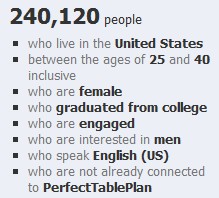
Woohoo! As part of my ongoing project to try every legitimate form of promotion known to man, I can try advertising my seating planner software to, for example:

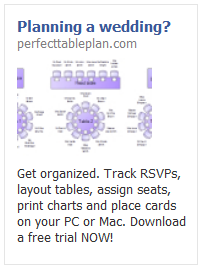
I ran 5 different ads over a couple of weeks. For example:

advertising software on facebookTrying to fit an attention grabbing and informative ad into the very limited strapline and image size was challenging. But I didn’t spend too long agonizing over the ‘creative’ (image and text), as this was just a feasibility study. The biggest problem was the minimum bid prices. Facebook was recommending I bid at least £0.40 per click. Given that the majority of my customers buy a single licence for £19.95 and typical conversion rates for clicks are around 1%, I would be likely to lose money if I bid £0.20 or more (especially when you consider ecommerce fees and support). I bid £0.10, but got no impressions at all. I bid £0.20 as an experiment and got a reasonable number of impressions. As soon as I dropped the bid to £0.15 the impressions slowed to a trickle.

Here are the stats from my experiments, as reported by Facebook:

Impressions: 357,366
Clicks: 310
Click through rate: 0.087%
Total cost: £46.60
Average cost per click: £0.15
Average cost per 1000 impressions: £0.13

Any of you who are used to Google Adwords might be surprised how low the CTR is. But apparently this is quite a reasonable CTR for Facebook. This isn’t too surprising when you consider that people are on Facebook to socialise, rather than to search for stuff.

Of course, the most important metric is the profit. So how many licences did I sell? According to my own cookie tracking: zero. Zilch, nada, nothing, not one. Cookie tracking isn’t 100% reliable, but it seems that a 1% conversion rate might be highly optimistic for a facebook ad. Advertising a £19.95 product on Facebook to people who might be planning to get married obviously wasn’t going to be profitable given my price point, the minimum bid prices and low conversion rate. So I created a new ad to try to target a more focussed demographic, who might convert better and perhaps buy one of the more expensive versions of my product. Ad number 6 was disallowed one minute after it had been approved.

Eh? This ad was very similar to the previous 5 approved ads and for the same product. Their email said:

The content advertised by this ad is restricted per section 5 of Facebook’s Advertising Guidelines. Restricted content includes, but is not limited to: 1. Downloadable products that may affect the user’s computer or browser performance in unexpected or undesirable ways; 2. Get rich quick and other money making opportunities that offer compensation for little or no investment, including “work from home” opportunities positioned as alternatives to part-time or full-time employment or promises of monetary gain with no strings attached. 3. “Free” offers that require users to complete several hidden steps or make additional purchases in order to receive the promised product. We reserve the right to determine what advertising we accept, and will not allow the creation of any further Facebook Ads of this type. Ads for this product, service or site should not be resubmitted.

I didn’t feel my ad/product violated any of those criteria. It was clear in the ad that only the trial was free (not the product) and it doesn’t do anything nasty or sneaky. I emailed them for clarification. Here is the response:

Hi Andy,

Thanks for your email. Please note that we don’t accept ads for downloadable products through our self-service advertising channel. We reserve the right to determine what advertising we accept, and will not allow the creation of any further Facebook Ads for this product.

In order to maintain legitimacy of the products and services promoted on Facebook, ads for downloadable or installable products are only permitted through a direct sales partnership with Facebook. At this time, we’re only able to provide this service to a small set of qualified advertisers.

We’re committed to providing high-quality support for all of our advertisers, and we’ll keep you and your business in mind for the future growth of our ads product. In the meantime, please continue to email us here with any questions you may have and we’ll be happy to answer them for you.

If you have any further questions about why your ad was disapproved for Restricted Content, please refer to our Help Center about downloads at:

http://www.facebook.com/help/?faq=18665

Thanks,

Gloria

Online Sales Operations

Facebook

So apparently, they still don’t accept advertising for downloadable software, unless you are an approved partner, because it ‘may affect the user’s computer’ (even if it doesn’t ). This wasn’t at all clear in their guidelines and they let me run 5 ads before they enforced it (these ads are still running BTW). Thanks Facebook, I like you less with every passing day (and I didn’t like you much to start with). At least I got enough data to show that I was unlikely to ever get a return on advertising a £20/$30 product. I also console myself with the fact that PerfectTablePlan is doing better financially than Facebook (after 7 years and with 500 million users Facebook are finally cash flow positive, but nowhere near recouping the estimated one billion dollars in venture capital) and my product will hopefully still be selling profitably after Facebook has  been buried by the ‘next great thing’ that comes along so regularly in the world of social media.

First impressions count

Imagine you are on a blind date. You’ve heard great things about how funny and intelligent your date is and they are certainly very attractive. But it isn’t going well. They just sit there, staring at you with glassy eyes. Nothing you say gets more than a nod or a shake of the head. Maybe they are just shy, but you are never going to find out about their hidden depths if you climb out of the toilet window and run off into the night after twenty minutes.

Now imagine you have downloaded some new software. You have high expectations and your credit card to hand. But you just can’t figure out how to get started. It just sits there, a blank canvas. Totally inscrutable. Offering no clue as to what you should do next. How long would you click buttons and examine the menus before you gave up and downloaded a competing product. Two minutes perhaps? Competing products are only a few clicks away, after all.

As developers we spend months or years lovingly crafting our products. This makes it very hard for us to see them with the same eyes as potential customers. But those first few minutes are crucial for converting a download into a sale. Give the user some pointers on what to do first: show a set-up wizard, quick start guide or tutorial when the application first runs; populate the application with sample data; show hint text or images in the GUI (e.g. grey “start by typing your email here” text in the background of an edit field). If they feel they are making some progress within those first few minutes they are much more likely to buy. It really isn’t difficult to do, and yet it will probably have a bigger effect on your conversion rate than adding a complex feature that may take weeks or months to write.

I remember reading about usability problems with one of the early wordprocessor packages. Users weren’t used to wordprocessors and many just sat there, not knowing what to do. The solution was simple – to show a flashing cursor at the top of the page as a cue that this is where text would appear when they started typing. Usability improvements are usually simple in retrospect. But this apparently trivial change made a big difference to the initial experience.

How good a job are you doing at engaging users in those crucial first few minutes? Are they hitting the ground running, or just hitting a brick wall? Are you sure? Try comparing your download to conversion ratio to industry averages. Better still, do some testing. Find a few people in your target market that haven’t used your software before and watch them try to use it. Don’t help them, no matter how much you want to. It is often a painful experience, but I have yet to speak to anyone who has tried it and didn’t find it incredibly useful. Remember, you only get one chance to make a good first impression.

This article was also published as a guest post in the upload.com newsletter.

10 things non-technical users don’t understand about your software

If you are writing consumer software you have to understand that you and your average user have a very different level of understanding of computers. When you first start doing support it can be a shock to realize just how vast this gulf is. It doesn’t mean that your users are stupid, just that they haven’t spent the thousands of hours in front of a computer that you have. Below I have summarized a few of the things I have come to understand about non-techies through answering thousands of support requests relating to my own table planning software.

1. Copy and paste

It is very clear from many support emails I have received that users will often re-type a licence key emailed to them because they don’t know how to (or even that they can) copy and paste text. Yes, really. You can mitigate this to some extent by including instructions on how to copy and paste where relevant and making licence keys easy to type (short and without ambiguous characters, e.g. ‘0’ and ‘o’).

2. The difference between web and native applications

Many users are used to web applications and don’t understand that they need to download and install new versions of desktop software to get access to the features in a new version. You can avoid this by automating the update process, but this can be pretty catastrophic if you get it wrong.

3. Data storage

Many users don’t understand how or where data is stored or even that it is separate from the application. They don’t understand that some data is stored on their local harddisk and some is stored ‘in the cloud’. And they don’t understand the difference between storage in a file, a database or the Windows registry. Consequently, when they install a desktop app on a new machine they are often surprised that it can’t automatically access the documents they created on a previous machine. So it is worth having something in your FAQ about moving from one machine to another.

Given that users don’t understand the basics of data storage it should come as no surprise that they also don’t understand the concept of file formats either. For example when told to ‘save a .xlsx file as a .csv file’ some users will simply change the file extension from .xlsx to .csv and be surprised when the resultant .csv file is gibberish when they open it in Excel. You can try to avoid this by providing clear step-by-step instructions on how to save a .xlsx file as a .csv file.

4. The jargon you use

Using terms that your users don’t understand can be very off-putting. For example, non-techies have no idea what a “dialog” is, let alone a “modal dialog”. Just call it a “window”.

5. Right click

Some users have not discovered (or will not think to try) clicking the right mouse button. You should therefore never put something only in a right click menu or anywhere else that it can’t easily be discovered.

6. Concurrency

Some applications can handle concurrent access (e.g. client-server and web-based apps) others can’t (e.g. most desktop apps). But many users assume that all software can be safely used by multiple concurrent users. If your software can’t it might be worth spelling this out in your marketing so as not to raise false expectations.

7. What changes can be reversed

Techies are happy to play with software to see what it does. They aren’t usually too worried about trying things because they can rely on some combination to undo, version control and backups to reverse most changes and they can usually judge when a change won’t be reversible. Non-technical users aren’t so confident and won’t try things in the same way. In fact some of them seem to think that a wrong move could cause the computer to burst into flames. So try to stick to conventions they will understand (e.g. on Windows those used by MS Office and Outlook) and offer step-by-step guidance for complex tasks.

8. The need for backups

Every few days I get an email from someone who has lost all their data because they had a major hardware problem and no backups on a separate device. Sometimes this is because they don’t even realize the data is stored on their computer. You can mention the need for back-ups in your documentation and/or in the software, but it is unlikely to make much difference. History shows that this is a lesson most people have to learn the hard way (techies included). Mentioning it doesn’t hurt though and it might help to defuse an angry users if you point it out to them after the event.

9. That they should read the documentation

People are using your software because they have things to do. Like it or not, your beloved software is just a means to that end. Although some users will read documentation, most consider it a waste of their precious time. In fact, support emails I receive provide incontrovertible evidence that some users won’t even read a single sentence of text in an error message explaining what the problem is. This means you need to write clear and concise documentation, but you also should develop your software under the assumption that most users won’t read it. That is where usability testing comes in.

10. Problem exists between keyboard and chair

Unskilled users often don’t realize how unskilled they are. Consequently they may blame your software for problems that are of their own making. One just has to be as polite as possible in such cases. Making your customer feel stupid is never great for business. If it is clear that the customer doesn’t have a sufficient level of skill to use your software, you should politely suggest that it “obviously isn’t ideal for their requirements” and offer to refund them. However, if several people have the same problem then you need to change your product to be a better fit for your users (changing your users to be a better fit to your software unfortunately not being an option for most of us).

Have you been caught out by assuming technical knowlege that your users don’t have? If so, please leave a comment below.

Selling your software in China

how to sell software in chinaI think a lot of people in the software business are wondering whether China will soon become a significant market for software and/or a source of competition in existing markets. So I was very interested to read a forum post about the realities of selling software in China from Felipe Albertao, an ex-Silicon Valley software engineer currently living in China. He kindly agreed to expand his forum post into an article for this blog.

Disclaimer: Although I live in China, I absolutely do not claim to be a China expert. I accepted Andy’s kind invitation because I have not seen anything at all written about the business of software in China for microISVs, and I humbly hope it will positively contribute to the discussion. This article is mainly based on my observations, and not on proven techniques. Use them at your own risk, and please report back your own findings!

Getting Paid

The first thing I need to say, right off the bat: Chinese users will not buy your software. Period. That does not mean that there is no money to be made, it simply means that they will not pay for your software license. The reasons are many, but for the sake of conciseness let’s suspend our “piracy is bad” mindset, and simply accept this fact as a reality. Think of the positive side: no payment processors or merchant accounts to worry about!

Chinese users will not buy your software, but Chinese companies might. Actually, let me clarify that: They will not buy the software license alone, but they are willing to pay for the license if it is part of a package that includes services (customization, installation, support, training, etc…). So, to get paid in China, you must offer services connected to your software. Of course, it would be very hard for westerners who do not speak the language nor have contacts in China to provide such services, but there are opportunities to partner with local independent professionals or small businesses in your target industry. More on that later.

Education is a huge business in China, especially for skills that give them a professional lead, like English language or IT. So, if you can somehow “plug-in” your software to an education-related service, that would also be another way to make money. For example, if you offer a component for ASP.NET, why not offer training on ASP.NET itself using your software? I am sure they will not pay for a self-paced course, but there is a good chance they will pay if you offer a hands-on remote live course. That is, a service rendered by a human, as there is no value perceived in the standalone immaterial software itself. Of course there is huge local competition, but one thing we have going for us is the fact that westerners enjoy a high degree of trust among Chinese people.

I suspect SAAS may be another way that Chinese users will pay for software (with a big question mark here). For example, today they do pay for services like site hosting, advertising and e-commerce presence, so we can assume there is at least a perceived value in subscription-based intangible products, though only the ones provided by well-known established companies, and not independent vendors. However, as the marketplace gets more fragmented and niche-oriented, I believe there will be opportunities for small players as well.

Web Site and Software Translation

Young Chinese people normally have a good grasp of written English, so I don’t think translation of the software itself is essential, although it always helps. IT professionals tend to be more English-proficient, as well as undergrad-level students. However, I do believe that the documentation must be translated, especially with IT-related software. Differently than western users, Chinese people actually have enough attention-span to thoroughly read a manual, and I have seen English-proficient programmers choosing frameworks and components based not only on the quality of the software itself, but whether the manual is in Mandarin Chinese or not (it’s always easier for them to read Chinese). So, translation here is not really a necessity, but a promotional strategy.

The “larger attention-span” assessment is also valid for the web site. We are used to the Web-2.0-ish recipe of a catchy one-liner plus 3 benefits and the big “Buy” orange button, and in China that probably works too, but users expect much more than that. I have observed that paid services almost always include some kind of workflow with arrows and circles and boxes explaining how the service works. Long explanations (not just a FAQ) are also quite common, and people actually read them! The fact is that here in China there is no such thing as “money back guarantee”, so people and companies normally think a lot before putting their hard-earned money into something. And forget the big “Buy” orange button: Instead, the call-to-action should be “Free Download” or “Free Sign Up”.

Sales

You are now probably asking yourself “Then where does the big ‘Buy’ orange button go?”, and the answer is: nowhere on your site! One fact you should be aware of is that here in China nothing happens without an established relationship (Google the keyword “guanxi” for more information). It is very unlikely that you will get any paid conversions originating from an ad or email. The goal of your conversion funnel should not be “sales” but instead “relationships”. Then, from the established relationship, the user can recommend your software to their boss, or whoever is the actual buyer. Of course the sales cycle is longer and it requires much more effort, but the rewards may be bigger too as you will be selling a package, and not only the license. Also, since guanxi is such an important part of making business, Chinese people are quite receptive when approached with a business proposition, differently than in the west where sales are normally met with resistance.

However, note that I have not suggested that you should be the one personally cultivating those relationships. Maybe it is possible to do it remotely and in English, but it would be more effective if you partner with locals and funnel the leads to them. They do not need to be sales professionals per se, but they need to know your software and be able to help prospects. They could be software students for example. Of course, at some point you must get involved, but your partner can help you to filter the good leads as they cultivate the relationship. The reward for them could be payment per hour or a percentage of the sale. Students might also be eager to help a foreign company, so they can add that experience to their resumes.

A word about consumer-oriented microISVs: I am extremely skeptical about independent microISV B2C sales in China, because I honestly cannot imagine an individual paying for independent software. That does not mean that microISV B2C cannot succeed in China. My point is that B2C sales are in fact B2B, because businesses who deal with consumers are more likely to pay. And B2B requires guanxi.

Approaching bloggers

As in the west, approaching bloggers is probably the most effective way to let users know about your product. You can use Google Translate to find sites and bloggers that you would like to contact: Google Translate does a good job in translating keywords (that you can use on searches on Baidu) as well as entire pages (so you can read the blog posts). For IT-related blogs, cnblogs.com (Microsoft-focused) and javaeye.com (you guessed correctly) are the most popular ones.

You can contact the bloggers directly in English, as most young Chinese people have a good grasp of written English. Foreigners in China are well-respected, especially in the IT industry, so this is a point in our favor.

Dealing with piracy

Actually “Dealing with piracy” is a misleading title, because in reality there is no way to deal with piracy. People will crack, copy and use your software as they wish, and they will not even feel guilty about it. Again, let’s not judge, but accept the fact that piracy is simply part of the culture (for some it is piracy, for others it is just sharing)

Instead of talking about code scramblers and licensing keys, let me offer here a contrarian (perhaps even controversial) point of view, in the wisdom of “if you can’t fight them, join them”. You should consider yourself lucky if your software gets pirated, because that means that it got traction. For every pirated software there is always a happy user behind it (after all, they chose to pirate your software, and not your competitor’s), and if this user convinces their employer to use your software, then there is a good chance that these companies will be your future clients.

SEM / SEO

By no means am I an SEO expert, let alone a China SEO expert. However, I can tell a little about the users’ search behaviors: Non-technical users very rarely use Google. In fact, my observation is that while Google is a somewhat known brand, people first turn to Baidu hands-down. Baidu has the best search results in Mandarin Chinese, and they have a service similar to AdWords (though you might need help to set-up an account, as the interface has not been translated to English)

Technical users have a different behavior: These are IT professionals and students, and because English is so pervasive in IT, they normally do have a good grasp of the language. So, for technical searches they might use both Mandarin and English keywords, but still Baidu is their first choice. However, interestingly enough, Gmail is also quite popular among Chinese techies. So, if you are selling IT-related software, your SEM/SEO strategy should include keywords in both Mandarin and English, and include both Baidu and Google (or more specifically, AdWords targeting Gmail).

Face

I cannot finish this article without mentioning such important part of the culture: Face. There is not enough space here to explain the concept (Google “mianzi” for more information), but it’s suffice to say that it’s basically the same as in the west (face as in reputation), except that in China face is much more important.

When it comes to software, always keep in mind that most (if not all) decisions are made based on face: Users will use your software to be more efficient in a certain job, and thus look better to the boss; or to show that they have knowledge that other colleagues don’t have; or to show to their clients what cool software they have, and not their competitor. The contrary (that is avoiding face lost) is also true: To finish a job quickly so they can deliver the project on time, and thus avoid getting the boss mad; or to learn a new skill that their colleagues already have; or to show their clients that they also have the same cool software their competitors use. In the west we also make decisions based on face, but in China it is so much more prevalent. Keep that in mind when creating your promotional material.

Conclusion

I have no doubts that China will become a major technology consumer in the very near future, not only because of the sheer size of its Internet user base (which today surpasses the size of the entire US population), but also due to the number of high-quality IT professionals graduating at their universities.

The key message I want to communicate is that your China strategy should be a long-term one. It takes time and effort, but the rewards are worthwhile. Even if you conclude that there are no opportunities to be pursued, at the very least you should have a strategy to protect your marketshare against competitors that decide to go to China.

You don’t necessarily need to be so enthusiastic like me and move to China (although I guarantee you would have an experience of a lifetime!), but at the same time you cannot simply ignore it. Chinese users will certainly knock on your door, and you can even ignore them, but your competitors won’t.

Felipe Albertao is a software engineer with more than 15 years of experience, and has been living in China since June 2009. He is a native from São Paulo, Brazil, and lived in Silicon Valley, USA for 8 years. Felipe blogs about software and China at shanzhaier.com.

Shareware is dead – long live shareware!

The Association of Shareware Professionals has renamed itself today to the Association of Software Professionals. I have written a guest post over on the ASP blog putting this name change into context. The article includes reactions from quite a few shareware industry veterans.

Read the article

** Update **

The ASP dissolved itsself in 2021. But you can still find the article on the Wayback Machine here.

Lessons learned from 13 failed software products

“No physician is really good before he has killed one or two patients.” – Proverb

Software entrepreneur culture is full of stories of the products that succeeded. But what about the products that failed? We rarely hear much about them. This can lead to a very skewed perspective on what works and what doesn’t (survivor bias). But I believe that failure can teach us as much as success. So I asked other software entrepreneurs to share their stories of failure in the hope that we might save others from making the same mistakes. To my surprise I got 12 excellent responses, which I include below along with one of my own. It is a small sample and biased by self selection, but I think it contains a lot of useful insights. It is an unashamedly a long post, as I didn’t want to lose any of these insights by editing it down.

Case #1: DRAMA

Contributor

Andy Brice.

The product

DRAMA (Design RAtionale MAnagement) was a commercialization of a University prototype for recording the decision-making process during the design of complex and long-lived artefacts, for example nuclear reactors and chemical plants. By recording it in a structured database this information would still be available long after the original engineers had forgotten it, retired or been run over by buses. This information was believed to be incredibly valuable to later maintainers of the system, engineers creating similar designs and industry regulators. The development was part funded by 4 big process engineering companies.

Why it was judged a commercial failure

Everyone told us what a great idea it was, but no-one bought it. despite some early funding from some big process engineering companies, none of them put it into use properly and we never sold any licences to anyone else.

What went wrong

  • Lack of support from the people who would actually have to use it. There are lots of social factors that work against engineers wanting to record their design rationale, including:
    • The person taking the time to record the rationale probably isn’t the person getting the benefit from it.
    • Extra work for people who are already under a lot of time pressure.
    • It might make it easier for others to question decisions and hold companies and engineers accountable for mistakes.
    • Engineers may see giving away this knowledge as undermining their job security.
  • Problems integrating with the other software tools that engineers spend most of their time in (e.g. CAD packages). This would probably be easier with modern web-based technology.
  • It is difficult to capture the subtleties of the design process in a structured form.
  • A bad hire. If you hire the wrong person, you should face up to it and get rid of them. Rather than keep moving them around in a vain attempt to find something they are good at.
  • We took a phased approach, starting with a single-user proof of concept and then creating a client-server version. In hindsight it should have been obvious that not enough people were actively using the single-user system and we should have killed it then.

Time/money invested

At least 3 man years of work went into this product, with me doing most of it. Thankfully I was a salaried employee. But the lack of success of this product contributed to the demise of the part of the company I was in.

Current product status

The product is long dead.

Any regrets?

It was a fairly painful experience. I would rather have spent all that money, time and energy on something that someone actually used. But at least I learnt some expensive lessons without using my own money.

Lessons learned

  • Creating a new market is difficult and risky.
  • Changing people’s working habits is hard.
  • Social factors can make or break a product. The end-users didn’t see anything in it for them.
  • If the end-users don’t like a product, they will find a way not to use it, even if their bosses appear to be enthusiastic about it.
  • Talk is cheap. Lots of people telling you how great your product is doesn’t mean much. You only really find out if your product is commercially viable when you start asking people to buy it.

Case #2: CleanChief

Contributor

Sam Howley.

The product

CleanChief was to be ‘The easy management solution for cleaning organisations’. Managing assets, employee schedules, ordering supplies, you name it CleanChief handled it. Essentially it was light weight accounting software for cleaning companies.

Why it was judged a commercial failure

A small number of copies were sold. No one is actively using it at present. Once I realised that it wasn’t a complete product and that additional development was required I moved on to other product ideas. I had basically run out of enthusiasm for the product.

What went wrong

  • I am not an accountant.
  • I have never run a cleaning company.
  • I developed it for more than two years without getting feedback from real cleaning companies. I was arrogant enough to think that I knew what they wanted (or could work it out on my own). Or maybe it was that I was just where I was most happy and comfortable – writing software. Talking to real users was new and to be honest a bit scary for me.
  • A successful cleaning company operator, a friend of a friend, offered to become involved for a 30% share. This was a gift from the heavens, exactly what I needed. I refused.
  • In a way, even though I spent so long on the product, I gave in too soon, I was just getting feedback from real users, just getting my first batch of sales when I decided to move on.
  • I developed the application in VB6 even though I knew it was outdated technology when I started the project.This meant there was no ‘cool factor’ when discussing it with other developers, I told myself it didn’t bother me, but it probably did.

Time/money invested

I worked on it at night and weekends for about 2 1/2 years. I paid for graphic design work, purchased stock icons and images. I probably spent a couple of thousand Australian dollars in total and an awful lot of time.

Current product status

I moved on to other products that have gone much better. My newer products were released in months rather than years and I looked for real feedback from real users from day one. they are:

I do occasionally ponder returning to CleanChief and trying to raise it from the ashes.

Any regrets?

No. Looking back I learned a few lessons from a huge amount of time and work, it was a very inefficient way to learn those lessons. But when you are new to something like starting a business or creating useful software being inefficient at learning lessons is the best you can do, it’s a thousand times better than not learning lessons at all.

I learned so much more in my two and a half years of trying to develop CleanChief than I did in the two and a half years prior to that, during which time I really wanted to start a software business but didn’t take any action.

Lessons learned

Hearing or reading some piece of advice is totally different to living it. Here are some of the ideas that I always agreed were true but didn’t fully understand the implications of until I had lived them out:

  • Force yourself to get out and talk to people. Ask their advice. Almost everyone will help if you ask them for feedback.
  • Force yourself to cold call a few businesses in your target market.
  • Create a plan of how to market your product.
  • Try and use your product as much as possible as you build it.
  • Get out of your comfort zone from day one
  • Do not have the mind set that the day you release version 1.0 is the finish line, it’s the starting line, so hurry up and get there.

Case #3: Chimsoft

Contributor

Phil Anderson.

The product

ChimSoft – Software for Chimney Sweeps.

Why it was judged a commercial failure

I believe this failed for two reasons:

  • Focusing on too small of a niche
  • Me not being able to work full time on it.

I don’t consider it a complete failure because I sold two copies when it retailed for $2k, and maybe 10-15 more copies when I lowered the price to $200. Those sales proved that I wasn’t completely off base in thinking there was a market for the software, but the cost of customer acquisition and the size of the market were too small. Customers wanted to have a bunch of phone calls, face-to-face etc… the type of stuff you only see with much more expensive software. The problem was that for a niche this small we had to charge a lot of money to make it worthwhile for us, but the customers were small businesses where this is a major investment, so the fit was never right. The other issue was the people that did buy it were not super tech savvy, so there was a high cost of support that made even a $200 product not worth it.

What went wrong

  • Having all partners who were not full-time, and had equal equity.  I ended up doing most of the work and this is the main reason I didn’t force success is I felt I was in it alone.
  • Focusing on too narrow of a niche.  The plan all along was to expand for all service industries, but it was much harder to make that move than we expected.
  • Not researching pricing more, we knew small businesses made major purchases for things that really helped their business, but I think it would have been better to have a cheaper product with wider appeal than an expensive product with narrow appeal.

Time/money invested

I invested maybe a year of time and $3k into the company. I did not take any huge risks on it, so there were no big negative outcomes.

Current product status

The company folded in 2007, I refocused my efforts on my existing companies (AUsedCar.com and BudgetSimple.com) and both have been doing well enough that I quit my day job.

Any regrets?

I don’t regret it entirely, I think I learned several valuable lessons about working with other people, small business sales, trade-shows and software development.

Lessons learned

  • Pick partners wisely. Don’t try to be even-steven with equity. Use restricted stock to ensure everyone does their part.
  • Know what your customers expect (24/7 phone support?) to determine if you can do this while working a day job.

Case #4: PC Desktop Cleaner

Contributor

Javier Rojas Goñi.

The product

PC Desktop Cleaner. Simple software that cleans your desktop and archives your files.

Why it was judged a commercial failure

My goal was to sell 10 units per month. I’ve sold less than 1 unit per month.

What went wrong

  • I think that the product concept is not useful enough. It’s not a thing that people would pay for.
  • The market exists (some people buy) but it’s too little or difficult to reach.
  • I didn’t do any market research. I just got in love with the idea and did it. Later, I’ve learnt to use “lazy instantiation marketing” and have trashed a lot of embryo projects. :-)

Time/money invested

I think I wasted near $500 in development tools and some freelancers. Not too much.

Current product status

I’m still selling it. I’ve thought about others products, but not really decided yet.

Any regrets?

No, it was a lot of fun and I learnt lot of things. In my “day job” I own a small firm that sells software for production scheduling. I’ve learn a lot of SEO and AdWords in the DesktopCleaner project that now I’m using with great results.

Lessons learned

Go for it, maybe you win, maybe you fail, but you will grow and get tons of useful knowledge on the way.

Case #5: Smart Diary Suite

Contributor

Dennis Volodomanov.

The product

Smart Diary Suite.

Why it was judged a commercial failure

It sells and the profits cover current investments in the product, but there is little left over on top of that.

What went wrong

If I had a chance to do anything differently:

  • Take it seriously from day one.
  • Never stop developing and supporting.
  • Invest as much as possible in marketing early on.
  • Don’t stop believing in your creation.

Time/money invested

Up to this point, I have spent 13 years on Smart Diary Suite and a lot of money went into buying hardware, software, hosting, marketing, etc… All of that money came from my day job, but at this point SDS has recovered all of that back and is now making a small profit. The actual amount is hard to calculate (over the 13 year span), but we would be talking in tens of thousands of US dollars.

Current product status

For a while it may have seemed like SDS is not going to be successful, but that’s probably my fault – I stopped believing for a little while. Now I am back, starting again and this time I’ll make sure it doesn’t fail.

Any regrets?

I do not regret doing it. I regret allowing myself to stop working on it, basically bailing out on it for a while – that is my biggest mistake.

Lessons learned

If you want a successful product – believe in it and let others know that you believe in it.

Case #6: Highlighter

Contributor

Mike Sutton.

The product

Highlighter. A utility to print neatly formatted, syntax highlighted source code listings.

Why it was judged a commercial failure

I earnt a grand total of £442.52 (about $700 in todays money) in just over two years, so I guess it paid for itself if you exclude my time.

What went wrong

Since it was my first product and I was very green about both marketing and product development. I would suggest the following would have made things better:

  • Get feedback from potential users about the product (eg from the ASP forums). Some parts of the program where probably too option heavy and geeky.
  • Diversify. If people didn’t want to print fancy listings, maybe they would have wanted them formatted in HTML.
  • Better marketing. I’m not sure this would have saved it, but all I knew in those days was uploading to shareware sites. I never even sent a press release.

I figure it failed simply because it was a product nobody wanted. Actually, more importantly than that,, it was a product *I* didn’t want to use, but it developed from a larger product I was working on, on the assumption I could earn some money on the side from part of the code.  Since then I’ve stuck to products which I’ve actually wanted to use myself. There’s a lot to be said for dogfooding, not just for debugging, but for knowing where the pain points are and what extra features could be added.

Time/money invested

I would guess a couple of months of evening/weekend development time. Financially there was little spent, except that I offered the option of a printed manual and CD for an extra charge. One customer took me up on the offer, so I had to get 100 manuals printed and 99 of them went in the bin.

Current product status

I moved on to another product which has sold over £50,000 and a third which has earnt even more than that. Not enough to retire on but considering I only do this part time it must work out at a great hourly rate. There’s a lot to be said for not giving up…

Any regrets?

Nope. I figure every failure in life teaches you valuable lessons. Of course if I’d made a large financial investment I may feel differently, but that’s one of the big advantages of software over physical product sales.

Lessons learned

Just to reiterate – develop something which you find useful, instead of second guessing others.

Case #7: R10Clean

Contributor

Steve Cholerton.

The product

R10Clean. A data cleaning and manipulation tool.

Why it was judged a commercial failure

In the 18 months or so it’s been on the market I have sold 6. It has been £199, £99 and £19 – with no effect on sales !

What went wrong

Not sure what I did wrong ?  The product is maybe too techie ?

Time/money invested

No effect financially as at the time I was in a strong financial position.

Current product status

I still have it for sale but do not market it at all. I have other products.

Any regrets?

I don’t regret it as it saved me a ton of time when I was working with legacy databases a lot, as a commercial product it has been raved about (once!) and received a good review from the Kleper report, but has failed totally.

Lessons learned

Advice to others ?  Just because you need it personally, don’t assume the rest of the world does too. :-)

Case #8: nBinder

Contributor

Boghiu Andrei.

The product

nBinder, packs multiple files into a stand alone executable with over 50 advanced output and file unpack options, conditional run and commands.

Why it was judged a commercial failure

It was the first product I began selling. It sold to 300+ customers in 4 years. But for about a year the sales began to go down and have finally stopped completely.

What went wrong

  • The biggest problem was that because it was a packer intended for people that wanted to pack their products (software or games) into a single package (compressed and encrypted) many have used it for creating malware by binding malware files to legit files and then distributing the output so it isn’t detected by antivrus software (although it would be detected at runtime). Because of this I had lots of problems with antivirus companies that flagged files create with nBinder as malware. This was of course affecting legit users as their files would be falsely marked as malware. I used virustotal.com to see which antivirus detected it and contacted the antivirus manufacturer as soon as I detected the problem. In most cases they would remove it from their definitions. But it was an uphill battle because it would appear again in a matter of weeks. Some small AV companies didn’t event bother to reply to my emails to fix the problem. Others were using heuristics to flag files create with my applications and AV developers were reluctant to whitelist files created with nBinder. You can imagine it that it was enough for an AV such as Kaspersky or Norton to pick my files as malware for a day and customers would be affected and not use my product any more, especially that it took about 3 days for AVs to remove the false positive.
  • Infrequent updates. Due to lack of time I only updated the product once or twice a year and this affected the product a lot.
  • No marketing. I decided that I didn’t want to invest money in marketing so, except for a short AdWords campaign, I invested no money in marketing.
  • My decision to develop 3 products instead of concentrating on one or two affected development time and quality. I have worked on 3 products simultaneously instead of concentrating on making a single good one. The reason I worked on 3 is because I enjoyed developing different software in different categories. I didn’t start this for money but for the fun of development.

Time/money invested

I invested almost no money (except for hosting costs). Time invested I can’t really say exactly, but not too much as I only worked on nBinder in short bursts like 6 hours a day for a week or so before releases.

Current product status

Still for sale. My other products are:

Any regrets?

It’s not a total failure as I did make some money out of it with no investment, so I don’t regret starting it, but it could have been much better.

Lessons learned

Words of advice for others trying to make money from software development:

  • Study the market and the current trends very well.
  • Before deciding to take on large competition make sure you have something better (at least from one point of view) than the competition ( for example you might not have the same features but you have a better GUI and general presentation).
  • Do not get scared of an overly populated market segment. For example with nBinder I picked a segment with very little competition but also few possible users and the results were not so great (I didn’t have many users). With nCleaner I went head-to-head with lots of already established products but also the market is very big. Although nCleaner is free it has had the most success because there are so many potential users (anyone with a PC actually), so it had over 2 millions downloads and I still receive lots of mails regarding it, even if the last update was in 2007. So it is possible to have success in a market with lots of competition with no investment but it’s hard to reach the level of more established products.

Case #9: Net-Herald

Contributor

Torsten Uhlmann.

The product

Net-Herald – a monitoring application for water supply companies. It was a complex client server application that would receive monitoring data from specialized hardware and store that data inside a SQL database.  The client displays that data in different graphs, provides printable reports or sends alarm messages via SMS if a monitored value is not within its specified limits.

I developed Net-Herald as a perfect fit for that specialized hardware that is provided by a local manufacturer. That way, so I hoped, I could profit from their sales leads and would find a smoother way into these water supply companies. The downside of course, was that my software would only work with their hardware.

Why it was judged a commercial failure

I sold a first license fairly soon after I had a sellable product, although it took the customer nearly a year until they finally bought. But since then I sold only one more license within the last 4 years or so.

What went wrong

  • I didn’t do my own marketing and the hardware guys weren’t really concerned with selling my software.
  • Water management companies have a terribly long sales cycle. Other vendors monitoring applications usually cost tens of thousands and are geared toward large suppliers. Whenever a supplier buys into such a product he is unlikely to change within the next decade or more. I tried to position my software towards small suppliers but even then most of them were already locked into another vendor’s solution.
  • My software only worked with a specific hardware. That narrowed the marked down substantially.
  • In the end the software became too complex for one poor mortal to maintain. Because the software didn’t produce any substantial income I had to stop adding new features which would make it attractive for more prospective clients.
  • This kind of software is not sold over the Internet. Rather it needs very active sales people that nurture clients over a rather long period of time.
  • All these facts indicate that software like this should not be developed by a one man show.

Time/money invested

The development time for the first sellable version was maybe about 9 months. I didn’t have a job income at that time, but got funding due to government support for small start-up businesses. So I didn’t drain our family’s personal finances. But I did of course invest a great deal of time and sweat.

Current product status

Now, I have drawn a line and stopped active development of Net-Herald. I still do some custom extensions for my first clients. But I no longer market the software. I have instead focused on my consulting services. I also try to learn developing and selling software with my cross-platform drag and drop product Simidude.

Any regrets?

I didn’t succeed yet selling my own software (which is still my goal) but I do not regret doing it. I developed Net-Herald using (Java) technologies that now give me leverage at my consulting gigs. All in all it was a heavy ride. But it was fun and I would do it again.

Lessons learned

  • My biggest mistake was the lack of market analysis. I trusted the word of the hardware manufacturer without verification.
  • I have written more about the above and some other failures on my blog.

Case #10: HabitShaper

Contributor

Adriano Ferrari.

The product

HabitShaper – set and track daily targets for your goals (weight loss, quit smoking, jogging, writing, etc…).

Why it was judged a commercial failure

I sold a few copies, but not enough to make back the time I invested in it and my conversion numbers and traffic are below average.

What went wrong

  • Did not do enough pre-production research (talking to customers, etc).
  • Did not do a large enough beta to make up for lack of initial research.
  • Ignored gut-feeling that my product is better suited to being web-based and multi-platform (incl. mobile).
  • Did EVERYTHING myself (logo, web design, video, software, AdWords, etc).

Time/money invested

I worked on it two years, part-time, while doing Masters/PhD in Physics. It had no impact on my finances (very little money invested) or circumstances.

Current product status

I am relaunching as a web-based product this summer.

Any regrets?

Not in the least! I learned about as much from making HabitShaper as I have from my MSc thesis and PhD work.

Lessons learned

  • Most important: PAPER prototypes, minimum viable product, and iterate.
  • Don’t be afraid to launch early.
  • Launch a little bigger than you’d expect (it’s harder to find those initial customers than you think).
  • Don’t be afraid to change directions, especially early on.
  • Doing things yourself is a great learning experience, but if you want to get your product out to customers as fast as possible, don’t be afraid to invest money and outsource your weaknesses.

Case #11: BPL

Contributor

Jim Lawless.

The product

BPL – Batch Programming Language Interpreter.

Why it was judged a commercial failure

I sold about 10 copies.

What went wrong

  • I didn’t really do enough research to find out if the target market was in existence. I was hoping that network admins and support staff members would find it easier to use than batch files and less complicated than any of the free scripting language options available. So, I just rushed to get the MVP (Minimum Viable Product) out the door.
  • I never did provide a compiler that would build a stand-alone EXE. I think that might have met with more success.
  • I didn’t do much as far as advertising the existence of the product.

Time/money invested

I only spent a few weeks coding and documenting it in my spare time. Support issues sometimes took a whole evening, but nothing major. It did not have any impact on my finances as I had invested nothing but my time.

Current product status

I will still address support issues with this product for registered users, but I don’t actively sell it. I’ve open-sourced the program and it still really isn’t seeing heavy use.

I was more successful with other products. I have a few retired products that saw some good bulk-purchase deals ( command-line DUN HangUp, command-line scheduler ) and I still sell the following (for Windows):

All of the above still bring in a modest passive income.

Any regrets?

Not at all. “Nothing ventured,…”.

Lessons learned

Had I not attempted to bring the BPL product to life, I might still be sitting here wondering “what if?” I think it was very beneficial for me to invest the time to try out this idea.

Case #12: Anonymous

Contributor

Anonymous.

The product

A time tracker.

Why it was judged a commercial failure

Because it is not my primary income. I have about 150 customers in one year.

What went wrong

  • No marketing.
  • No real thought into features.
  • I don’t spend any time on it.

In my defense, the reason I do not spend much time on it is that the market became saturated with ‘me toos’ right after I released, which was quite expected. In fact, as I was looking for users, I got an email from a competitor suggesting that I don’t enter the market because they are working on the same thing! I don’t know what I would do differently. Maybe spend more time on it? I think the law of diminishing returns applies quite early in this space so I am not sure.

Time/money invested

Since inception (Nov 2008), I’ve spent close to 250 hours total. Total cash outlay was something like $500.

Current product status

I never tried to make it succeed, to be honest. It was only a learning experience for me. What I probably need now is to go all in. Quite frankly, if I double the sales for this product, I can quit all consulting work. But I really do not think it is a good idea to work on this app full time as it is too simple.

Any regrets?

Definitely not.

Lessons learned

  • Do it!
  • Solve a problem people know they have.
  • Don’t invest too much time and money at the beginning.
  • Don’t be wedded to a particular idea.
  • Don’t only listen to your customers. Listen to yourself. After all, you created the idea which attracted the customers.
  • Never promise a feature for a sale. I’ve never done it but the pressure is really great. My stock response is always: “While such a feature may be available in the future, I recommend that you only use current features when deciding on your purchase.”
  • Do use Google to your advantage.

Case #13: ScreenRest

Contributor

Derek Pollard.

The product

ScreenRest – a consumer software product that reminds users to take regular rest breaks while using their computer.

Why it was judged a commercial failure

ScreenRest failed commercially because we built a product without having a clearly defined market.  This was compounded by it offering prevention, not a solution. ScreenRest continues to regularly sell a small number of licences but not in sufficient quantity to justify further enhancements.  The conversion rates are good, but there are simply not enough visitors to the website.

What went wrong

  • Not doing market research first.
  • Creating a prevention rather than solution product – people generally wait until they have a problem and then look for a solution.
  • Creating a product with medical associations – the SEO and PPC competition for related keywords is prohibitive for a product with a low purchase price.

Time/money invested

At least £2000 was spent on the project, including software licences and additional hardware.  The product and website were created over roughly 12 months by myself and my wife Lindsay, some during spare time, then part-time and finally full-time so it is difficult to determine the total number of hours.  Working part-time and then full-time on ScreenRest caused a significant impact on our finances.  Although right from the beginning we saw this as in investment for building a business.

Current product status

Once the product was complete and we started learning SEO it became all too apparent that organic search traffic for related keywords was going to be insufficient.  Research into PPC then revealed that the price point was too low to support purchasing medical terms. Planned features for ScreenRest have been put on hold and no further marketing is planned.  We continue to support new and existing ScreenRest customers and plan to do so for the foreseeable future. Rather than create another software product we chose to use what we had learned about marketing, copywriting and SEO to create a series of websites targeting a range of topics (often known as niche sites).  The most successful of these sites we are expanding in value and functionality to fill gaps not serviced by the competition.

Any regrets?

No.  ScreenRest succeeded in every way intended, other than commercially.  Creating it was a rewarding learning exercise that started us down a path to finding the intersection of our skills, experience and market opportunities.

Lessons learned

  • Start with market research – creating a high-quality product you believe in is not enough on its own.
  • Make sure you can identify a specific target market, that you can reach that market and that it is large enough to support your financial goals.

Conclusion

Analysing the above (admittedly small and self-selected sample) it is clear that by far the commonest cause of failure were:

  • lack of market research
  • lack of marketing

With the benefitof 20/20 hindsight it seems blindingly obvious that we should:

  • spend a few days researching if a product is commercially viable before we spend months or years creating it
  • put considerable effort into letting people know about the products we create

Yet, by my count, a whopping 6 out of 13 of us admitted to failing to do each of these adequately. Probably we were too busy obsessing over the features and technical issues so beloved of developers, which actually contributed to far fewer failures.

It is also noticeable that, despite the failure of these products, there are few regrets. Important lessons were learned and no-one lost their house. Many of us have gone on to develop successful products and the others will be in a much stronger position if they do decide to try again.

A big thank you to everyone who ate a large slice of humble pie and submitted the above. I hope we can prevent other budding software entrepreneurs making the same mistakes. Even if you don’t succeed, you will learn a lot.

Feel free to add your own hard-won lessons from failure in the comments below.

“No physician is really good before he has killed one or two patients.” – Hindu proverb

Social factors can make or break a product.

New Software Marketing Facebook group

Alwin Hoogerdijk has created a ‘Software marketing’ Facebook discussion group. Personally I’m not a fan of Facebook, as will be obvious to anyone that checks out the howling void that is my Facebook account. But Alwin is a very smart online marketer, so I have tried to overcome my aversion to Facebook and joined the group. Just don’t expect me to care how you are doing at Farmville …

How to find a great software product name

A while back I exchanged a few ideas with Dennis Gurock about names for their new testing product. Choosing a name is difficult, but it is something every product developer has to do. So I asked Dennis to write a guest post about the process they went through before they ended up with ‘TestRail’.

Coming up with a great name for your new business, product or service is hard. I’m sure you already noticed that! But what is a good name anyway? Deciding if you like a name is, of course, pretty subjective. But there are some useful criteria that can help you find a great name.

Around a year ago we desperately needed a name for the new test management software we had been working on. We aren’t very good with names. In fact, we used a codename for the project until the very last minute, so that we didn’t have to come up with the product name earlier. Still, even with many months to think about a name, it was difficult to find one that we liked.

So what did we do to finally decide a name? We made a list, of course (we are programmers for a reason). A list of objective criteria that the new name should meet. This helped us quickly evaluate new names that we brainstormed. So I figured, if it helped us coming up with a name, why not share our tips with other fellow programmers? So here are the criteria that we used to find a name for our new product.

#1 The shorter, the better

A good, catchy name needs to be short. Do you think Google would be used as a verb today if it had six syllables? I don’t think so either. But even if you don’t plan to become the next Google, having a short name that can be used in everyday discussions is a powerful way to make your brand stick. “Have you seen the bug report in Jira?”, “Could you post your meeting notes to Basecamp?”, “What’s the project status in TestRail?”

#2 Make it easy to spell

Coming up with “creative” and “hip” ways to spell your new name is generally not a very good idea. I’m pretty sure Joel Spolsky has regretted more than once naming his bug tracker FogBugz. I once talked to a customer who kept calling it fog bug zed and I’m sure he is not alone. You don’t want a customer’s purchasing department not find your product on the web because they are unable to spell it correctly.

#3 Own the .com domain

Did you notice that a lot of companies don’t own the .com domain of their new brand names lately? There’s a good reason for it: most good .com domains are taken. If you have been trying to register a good domain name recently you know how frustrating that can be. Still, I don’t believe it’s a good idea to just own widgethq.com, or foobarapp.com. Invest the time and resources to come up with a name that you can  register or buy the .com domain for. You don’t want a competitor to purchase “your” .com domain from a domain squatter after you invested tens of thousands of dollars to promote your brand name.

#4 Trademarks, or: how not to get sued

This one is important. You really want to make sure that you are not infringing on someone else’s trademark. So make sure your new name is not already used or registered (at least in your industry) and that it’s not similar to an existing mark. Ideally you come up with a name that you can easily register with your country’s trademark office (and then do so when you actually use it). I’m not going to pretend that I know everything about trademarks and I’m not a lawyer. So make sure to either contact a lawyer or do your own research on this topic. I found Trademark: Legal Care for Your Business & Product Name from Nolo pretty helpful.

#5 Google is your friend

I’m sure Microsoft didn’t foresee how a simple name could impact developers’ life so negatively when they decided to name their new software platform .NET over ten years ago. It turned out that such a generic name (especially with a leading dot) made it really difficult for developers to find related resources online using a search engine. Don’t make the same mistake. Choose a name that is unique and can be easily found on Google. It can also help your search rankings if your product name contains relevant search terms. For example, our new product is related to software testing and having the term ‘test’ in the product name helped us considerably with this.

#6 Consult a native speaker

Are you not a native speaker of the language your primary market communicates in (e.g. English)? Have you found a great name that is unique, that no one uses, has no trademark registration and is available as a .com domain? Congratulations, you’ve probably found a name that is severely offensive to native speakers in one way or another! If it weren’t so embarrassing, this would now be the place where I told you a story about how I once almost named a product similar to a body part you don’t usually want to talk about in a business conversation. The moral of the story is that you should always discuss your name ideas with a native speaker before making a complete fool of yourself.

It can be a challenge to find a name that meets all these criteria perfectly. Some of the criteria are obviously more important than others, but I still recommend trying to come up with a name that meets most of them.

So how did we end up naming our new product? We called it TestRail. It’s not the best name in the world, but we are happy that we came up with a name we like. And most importantly, having finally found a name allowed us to concentrate on doing what we enjoy most: building great tools for software teams.

Dennis Gurock is the director and co-founder of Gurock Software, a company specialized in tools for software development teams and quality assurance departments. Gurock’s first product SmartInspect is a .NET, Java and Delphi logging tool. Gurock’s second product TestRail is comprehensive web-based test case management software to efficiently manage, track and organize software testing efforts. Dennis can also be found on Twitter as @dgurock.

It can also help your search rankings if your product name contains
relevant search terms. For example, our new product is related to
software testing and having the term 'test' in the product name helped
us considerably with this.