
 You’ve got this great idea for a software product. You are pretty confident that you can crank out version 1.0 working full-time on your own from the spare room, and you are fairly confident that people will buy it. But you’ve also got a well paid full-time job ‘working for the man’. It’s cosy and familiar in that cubicle. Is it worth risking your career and savings to set out into uncharted waters on your own? Do you take the red pill or the blue pill?
The aim of this article is just to give you some insight into the economic realities of becoming a one man software company (a microISV). The results might surprise you. ‘Working for the man’ you get a steady monthly income every month. Working for yourself you start off with no income, while you create your product. If all goes well you start to make sales when you release v1.0 and these sales gradually improve over time until you are earning the same amount each month as when you were working for the man . As the sales continue to improve you (hopefully) reach the point where you have made as much money as if you had stayed in your old job for the same period of time. From here on it’s all gravy. Here is a very simple model:
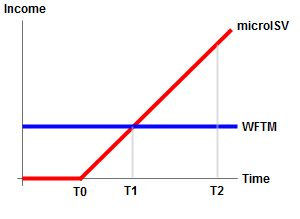
Monthly income as microISV vs WFTM (T0=version 1.0 release, T1=monthly income equal to WFTM, T2=areas under the red and blue lines are the same)
Obviously I am making a lot of assumptions and simplifications here. In particular I am assuming:
- Net income from microISV sales rises linearly month-on-month as soon as you release v1.0. Obviously this can’t happen forever (or you will be richer than Bill Gates) but it seems as good a guess as any and it keeps the mathematics simple.
- MicroISV start-up expenses (buying a domain name, starting your company, buying equipment and software, getting an Internet connection etc) are fairly low compared your monthly WFTM salary.
Even though the model is embarrassingly over-simplified, I think it can still give some insights. If I plug some numbers for T0 and T1 into a simple spreadsheet I can come up with values for T2. I’ll choose numbers that I consider optimistic, realistic and pessimistic for each. For T0 (time to V1.0) I choose 3, 6 and 12 months. For T1 (time to same income as WFTM) I choose 12, 18 and 24 months.

Months required to reach T2
i.e. if it takes you 6 months to get V1.0 out and then another 18 months until it is making the same monthly income (after expenses) as WFTM then it will take you 47 months to reach the point where a microISV has made you more money than WFTM.
So how much do you need in the way of savings to survive until you have a decent income? I can work this out by assuming living expenses as some proportion of WFTM monthly income. Calculating for 50% (living on noodles) and 100% (full speed ahead and damn the torpedoes):

Maximum debt in months of WFTM income with living expenses=50% of WFTM income

Maximum debt in months of WFTM income with living expenses=100% of WFTM income
i.e. if it takes you 6 months to get V1.0 out and then another 18 months until it is making the same monthly income (after expenses) as WFTM and your living expenses are 50% of your WFTM income then your maximum debt is 5 months of WFTM income.
I think the results of this simple little model make a few points:
- Rate of sales growth is critical but the the time to getting v1.0 out is also very important. The longer it takes, the more you have to catch up later.
- You are unlikely to come out financially ahead after 2 years as a microISV, even with fairly optimistic sales figures. It could easily take 3 or 4 years and, if the sales don’t take off or level out too early, you may never get there. There are many reasons to start a microISV, but getting rich quick isn’t one of them.
- Given that you can’t know what T1 will be for your product, you should probably have at least 6 months WFTM income in the bank. Preferably 12 months.
- Learn to love noodles.
You can download my Excel spreadsheet here (it’s a quick hack, so don’t expect too much).
So which is it going to be, the red pill or the blue pill?

 I don’t remember when or where I first saw an editor with syntax highlighting. But I do remember that I was ‘blown away’ by it. It was immediately obvious that it was going to make code easier to understand and syntax errors easier to spot. I would now hate to have to program without it. So I was interested to try version 1.1of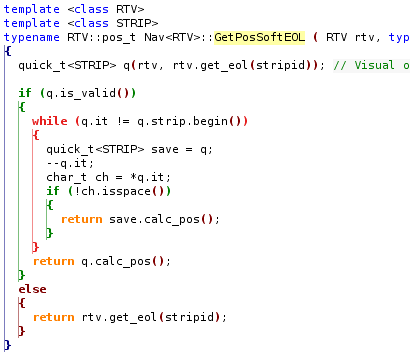
 Software cracks are a real problem for software vendors large and small. I have
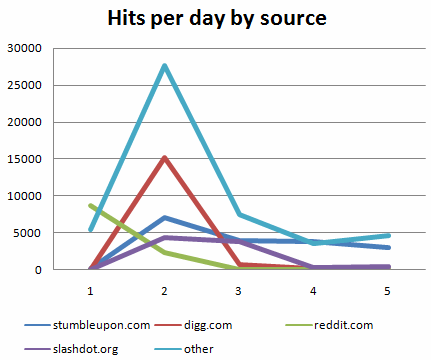
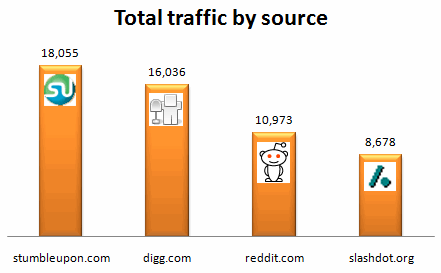
  Social news and bookmarking sites, such as reddit.com, digg.com, slashdot.org and stumbleupon.com, use voting by users or selection by editors to rank interesting stories. Much to my surprise, I recently had an article from this blog featured prominently on all four of these popular sites. This generated a large amount of traffic and gave me an interesting opportunity to turn the tables, by using my hit statistics to rank these sites.


 I put out a new product a couple of weeks ago. This new product has so far won 16 different awards and recommendations from software download sites. Some of them even emailed me messages of encouragement such as “Great job, we’re really impressed!”. I should be delighted at this recognition of the quality of my software, except that the ‘software’ doesn’t even run. This is hardly surprising when you consider that it is just a text file with the words “this program does nothing at all” repeated a few times and then renamed as an .exe. The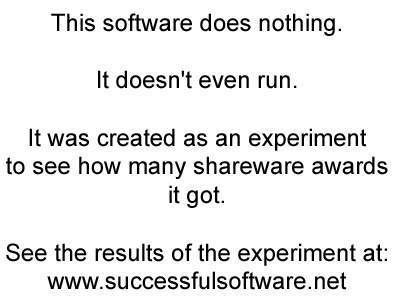

 When I saw the new
 I cringe every time I hear about someone who has spent years writing their ‘killer app’, but still hasn’t released it. My preferred approach is to get a solid, but minimally featured, v1.0 out there and then iterate like crazy based on real customer feedback. There are a number of arguments for and against releasing early:
 My grandfather was a hoarder. He had an entire barn full of rusty old tools. I think I might have inherited some of his hoarding instinct, because I hate throwing stuff away. ‘You never know when you might need it’. Worst of all is throwing away stuff that I think other people could use. But, as I run my business out of my house, space is limited and something has to give.
 Most small software vendors don’t want all the hassle of taking payments direct from customers, so they use a third party registration service. Registration services provide payment processing plus additional services, including handling of:
 Joel Spolsky has
