 I started feeling a mild burning sensation in my left wrist a few weeks ago. This is a classic early sign of Repetitive Strain Injury. Uh-oh. I had an email exchange not long ago with someone who now has to use voice activation because typing is too painful. I can’t imagine how frustrating that must be. I decided to ignore Jane Fonda’s advice to “feel the burn” and looked for a way to alleviate the problem.
One approach is to reduce the amount of typing I do. But that is tough when you are running a microISV and writing a blog. I already use the text expander capabilities of the excellent Direct Access software to save a lot of typing (it tells me that it has saved me 51 hours of typing so far). I decided to try an ergonomic keyboard.
I bought myself a Microsoft 4000 Ergonomic keyboard. This is shaped to allow more natural positioning of the forearms and elbows.

Microsoft Natural Ergonomic Keyboard 4000
For more comfortable wrist positioning it also has a built-in wrist rest and the front of the keyboard is higher than the back.
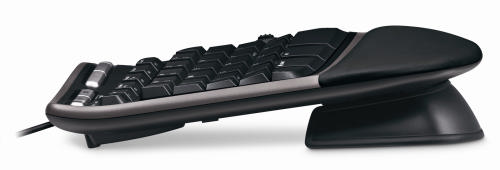
Note the front of the keyboard (right) is higher than the back (left)
I was quite surprised how physically large it was when it turned up. The shape of the keyboard felt very strange to start with and it took me a few days of slow typing to get used it. The feel of the keys is nothing special and I haven’t yet used the extra gizmos, such as the integral zoom button. But I feel it is an improvement in comfort over the conventional keyboard I had before.
An unexpected advantage of the new keyboard is that it has improved my typing. If you watch a good touch typist, their hands hardly move. I (unfortunately) never learnt to touch type, I just didn’t have the patience. The clearer separation between keys for the left hand and keys for the right hand on the new keyboard made me realise that I was moving both hands left and right, more like a concert pianist than a touch typist. I am now moving my hands less and I think my typing speed has improved as a consequence.
I didn’t feel the new keyboard on it’s own was going to solve my impending RSI problems though. The major problem seems to be the continual Ctrl-C, Ctrl-V, Ctrl-A, Windows-D, Windows-E and Alt-Tab key combinations I do with my left hand, hundreds of times a day. Using the right hand Ctrl key instead of the left one helped a bit. But it occurred to me – why are my hands doing all the work? My legs are doing so little that I often feel stiff when I stand up from a long programming session. Why not put them to use?
I Googled for foot pedals for computers. After wading through lots of hits for music and dictation foot pedals I finally found the Savant Elite Triple Foot Switch. This is a programmable 3-pedal foot-switch that plugs into a USB port.
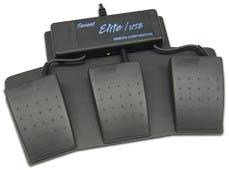
Savant Elite Triple Foot Switch
At £86.00+VAT it isn’t cheap. But what price do you put on your health? I ordered one.
When it arrived I wanted to program the pedals to map to the Ctrl, Shift and Windows keys. But I couldn’t install the device driver to program the pedals. After a call to the retailer it turns out the device driver doesn’t work on Vista, despite assurance on the website that the pedals could be used with “virtually any computer”[1]. Grrrrr. How long has Vista been out? I finally managed to program the pedals using my wife’s laptop – my last remaining XP box.
So now I can type using my feet for most of the modifier keys. I am using the pedals as I type this. I am still getting used to them, but the burning in my left wrist has definitely reduced. I think I can also type a little faster, but I am too lazy to do the speed tests with and without the pedals to verify this. On the negative side:
- Working out where to put your feet when you aren’t typing can be a little awkward.
- The pedals tend to move around the carpet, despite being metal and quite heavy. Some small spikes might have helped.
- Although the travel on the pedals is small, they are surprisingly stiff.
When I told a friend about the pedals he asked – why stop there? I could also be using my elbows, knees and head like a one-man-band. I could be working-out and typing at the same time. It is an intriguing prospect.
I just hope I don’t end up with burning ankles.
[1] System requirements have since been added to the website.

 I have have heard plenty of people saying that desktop software is dead and that all future development will be done for the web. From my perspective, as both a buyer and seller of software, I think they are wrong. In fact, of the thousands of pounds I have spent on software in the last three years, I would guess that well over 90% of it was spent on software that runs outside the browser. The capabilities of web based applications have improved a lot in recent years, but they still have a long way to go to match a custom built native application once you move beyond
  The sink is full of washing, I am wearing odd socks and I haven’t been out of the house in days. It must be time to put out that new release. But how can I be sure my testing hasn’t missed a hideously embarrassing bug? Maybe I introduced a major bug when I made that ‘cosmetic’ change at 2am?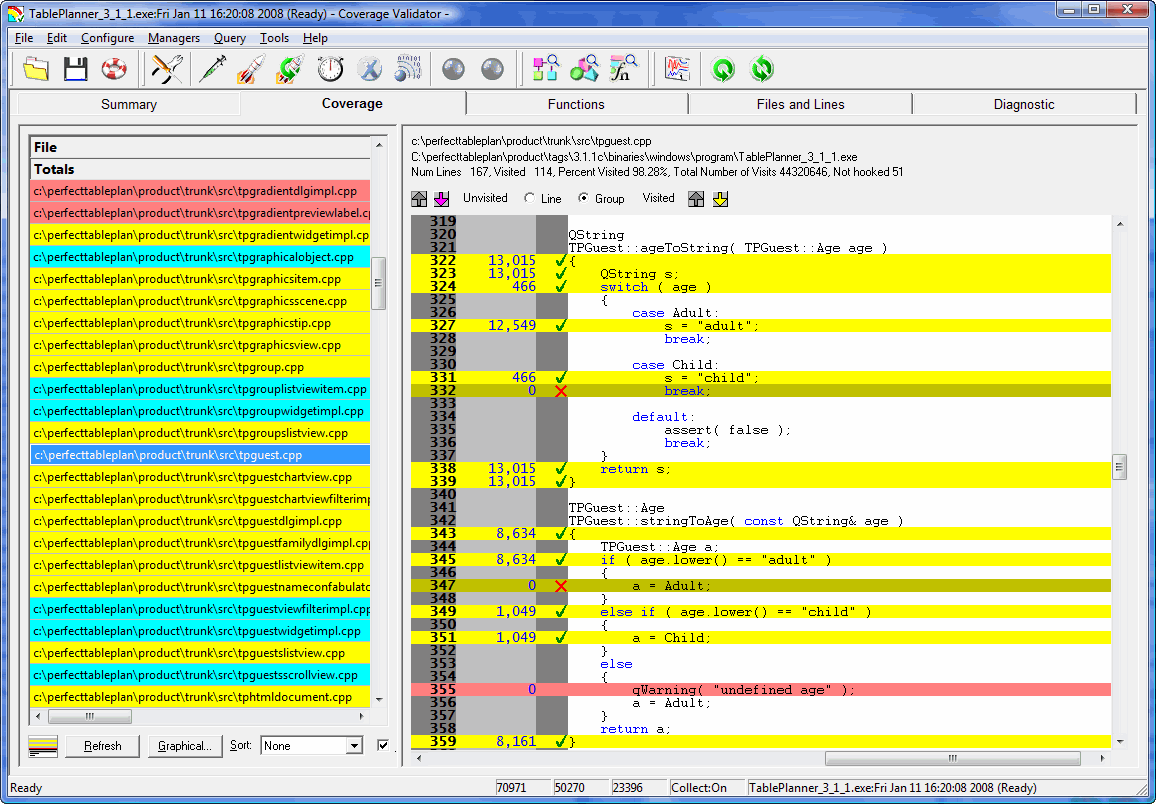
 I don’t remember when or where I first saw an editor with syntax highlighting. But I do remember that I was ‘blown away’ by it. It was immediately obvious that it was going to make code easier to understand and syntax errors easier to spot. I would now hate to have to program without it. So I was interested to try version 1.1of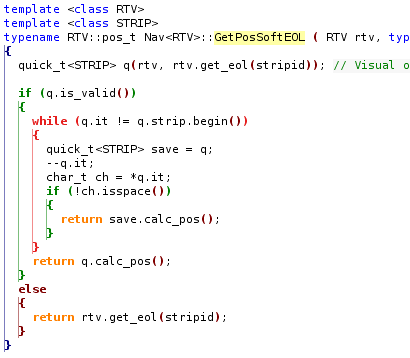
 Fashion is such a ridiculous business. Every year anorexic clothes horses strut up and down modelling ridiculous clothes no-one is ever going to wear. Hemlines go up or down. Various baubles are ‘in’ or ‘out’. Grey is the new black. We geeks are above all that. Comfortable in our jeans, bad haircuts and nerdily sloganed black t-shirts we know that #000000 != #0c0c0c . We care not a jot for fads and fashions. Or do we?
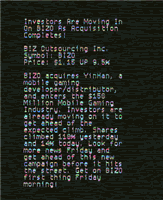 Spam and phishing emails can be a huge drain on productivity for an Internet based business. I use Mozilla Thunderbird and I find the spam filtering works tolerably well. Most of the incoming spam is quietly siphoned off into a ‘Junk’ folder and there appear to be very few false positives. I supplement this with a message filter to move all emails purporting to be from paypal.com or ebay.com (99% of which are phishing emails) to a ‘Suspicious’ folder, which I check from time to time. But I still get lots of spam with embedded GIF images, which Thunderbird’s spam filter seems to be powerless to handle.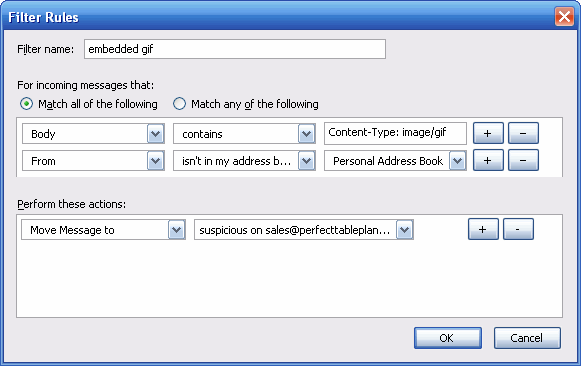
 Successful Software