Surely no amount of execution can save this idea?

Things have been a quiet here as I have been on holiday in New Zealand for the last 5 weeks. I tell you this not merely to gloat (it was lovely, by the way) but to explain how we happened to be in Hong Kong overnight looking for somewhere to eat, when my wife spotted the ad below.

That’s right. A toilet themed restaurant where “Food is served in mini toilet bowls” and the dessert looks like a, well, see for yourself. The ad was in a tourist brochure and they have a website, so it appears to really exist.

I was curious about what the real toilets in this restaurant look like. Not curious enough to eat out of a toilet bowl to find out though.

Donationware – An interview with Hillel Stoler of GetSocial

This blog is hosted on WordPress.com. This has its advantages, but it means that I can’t use the huge range of add-ins that are available to those that host their own WordPress server. In my attempts to find a simple way to add social bookmarking to WordPress posts I stumbled across GetSocial, a Windows desktop program that generates the social bookmarking icons you see at the bottom of my recent posts. GetSocial is donationware – the author requests a small donation if you find the software useful. But the software is not crippled or time limited in any way and the donation is optional. I found the software useful so I made a small donation.

I use a number of donationware products. Human nature being what it is, I rarely get round to making donations – despite the best of intentions. It just never quite makes it to the top of my ever expanding TODO list. I have also heard various tales about how dismal the donation rates are. So I was curious about how well the donationware model works in this particular case. I emailed the author of GetSocial, Hillel Stoler, and he was kind enough to do this interview.

What was the motivation behind GetSocial?

GetSocial is not a business – it’s my contribution to the WordPress.com community. I needed a way to generate social bookmarking buttons for my own blog, and when I saw none was available I made GetSocial. I decided to request donations because I too was curious about the feasibility of donationware, and wanted to investigate the subject. I hate spammy “business models” such as installing Toolbars, embedding ads and so forth and wanted to make software that I would like to use.

Does anyone actually make a donation?

Surprisingly, yes. Many people donate, and I think all of them are glad to do so.

What is the average donation?

At the beginning I was only asking for a fixed amount (5 USD). The reason for this was that a fixed donation simplifies the donation process (because the potential benefactor needs to make one less decision). I’ve selected 5 USD because it was the lowest sum of money for which the PayPal commissions amounted to less than 10% of the donation.

Recently I’ve enabled donations in different currencies and variable amounts (but only on my websites, donations made from inside the application are still fixed). I’ve seen some decline in the ratio of donations per download (although it could be explained by many factors, and cannot be directly attributed to the added complexity of the process without applying proper A/B testing methods). However, the average donation has increased to 9.19 USD, and I’ve also received donations of over 20 USD. This is interesting because 19.99 USD is enough to purchase many commercial software products. To date, no one has donated less than 5 USD.

What is the donation/download ratio?

First of all, please consider that GetSocial is upgraded frequently, and I cannot differentiate between a new download and an upgrade download. Also, I can only count downloads which originated from my own websites. That said, dividing the number of the donations by the total number of documented downloads yields a donate/download ratio of about 0.55 percent (e.g. a single donation is received on average about every 182 downloads).

Can you make any money out of donationware?

I do make some money out of GetSocial, but I’m far from making a living out of it. With the current donation/download ratio, GetSocial will only begin to become economically interesting when it hits the 500k download mark. It’s not impossible market-size wise (there are about 10 million bloggers in WordPress.com) but it’s not easy.

The amount of money one can make with donationware is directly proportional to the number of people involved. For example, in the case of GetSocial, take a million downloads, divide by 182 and multiply by 5 dollars and you have 27k USD (before PayPal commissions). This amount of money can cover the development costs for many small software products.

That said, a million is a big number, even for free software. If you’re thinking about making real money out of a donation based product, I would recommend that you research the size of your market carefully. Getting those million downloads is not an easy task.

I personally don’t think that money is the sole motivation for doing things though. When discussing profits, we should also take into account the indirect benefits I receive from GetSocial such as incoming links, a user base, visits to my website, comments, world fame (or at least some publicity), and even fan mail!

And hey, the donationware model works for Wikipedia, doesn’t it?

Why did you choose a donation model instead of selling licences?

The reason I made GetSocial was that when I started hillelstoler.com (on a WordPress.com platform), I wanted to add social bookmarking buttons for my visitors. When I realized no one was doing that (there was an old text file floating around for manual use) I decided to make GetSocial. I wanted to attract visitors to my new blog, and I knew that distributing a hyped piece of free software would help me build credibility and acquire an international audience. It did.

Why did you choose donationware over freeware?

Out of curiosity, I guess. I wanted to know if one could make any money this way, and if people actually pay when they don’t have to (especially in cases where no one is looking). Today I can clearly say that I was pleasantly surprised. I think that Donationware is a beautiful (and very user-friendly) concept, and I’m glad it’s not just another web myth. Besides, I knew that people needed GetSocial, but to be honest I didn’t really think that anyone would actually pay for such a service at the time. In the end, I think that my potential buyers are also the ones who made the effort and donated, even though they didn’t have to. I’ve actually received some donations larger than what I could possibly charge if GetSocial was a commercial product!

Another important factor in my decision was the fact that I could do it rather easily. Recall the old days, when Donationware DOS programs asked you to kindly snail-mail some cash to a P.O box? That’s the kind of thing I would never bother with, especially when we’re talking about an international market.

Do you think you have made more money through donations than you would have through selling licences?

Absolutely! When I’ve received my first donation I was surprised (so people do donate after all), and as donations kept pouring in I realized that there is a donation culture. Selling licenses also meant becoming a part-time police officer, and that’s not what I was after.

What really amazed me, is that even in this very specific niche of social bookmarking for WordPress.com blogs (where I offer an industry grade solution for free) competition still sprung!

How did you promote GetSocial?

I didn’t. I’ve posted about it on the WordPress.com forums several times, and wrote about it on my website, hillelstoler.com. Other people wrote about it too. No paid ads or anything like that. You’ll notice that I didn’t even include a link on the toolbar itself (the viral ‘Get one!’ link you see everywhere else) because it was important to me not to impose.

You now have a web version of GetSocial. How long did that take to create compared to the desktop version? How do the desktop and web version compare in terms of the amount of use and the amount of donations?

GetSocial Live (the on-line version) started as a weekend project actually. GetSocial is a Windows application, and many people wanted a Mac version. Since I don’t even own a Mac, I decided to make a cross-platform web service (currently, about 40% of GetSocial Live visitors are indeed Mac users). It was easy to make, because I copied some of the code directly from GetSocial. The images are all photos I took of the plants in my house. In the end it did mean additional costs (hosting, domain, etc), but originally it was hosted for free on (the late) Google Pages service.

Later on, I discovered that the on-line version made GetSocial much more flexible and dynamic. I can now post updates much more quickly and effectively. The web version is also much easier to upgrade and maintain because it lacks some of the internal complexity of the GetSocial application (things like self encryption).

Do you get any useful revenue from the Google ads on getsociallive.com ?

As in the case of the donations, I was curious about AdSense. I know for a fact that I never click sponsored links myself, but I guess some other people do because Google makes a living out of it. I didn’t bother with A/B testing and other cash boosters, I just added a single ribbon of ads.

So far revenue has been disappointing (this is also the place to mention that the process of getting my AdSense account approved was very annoying and arbitrary, with zero support). There were some cases where I got more than 1 dollar per click, but I currently get more money through donations than through AdSense. Interestingly, the ratio of ad clicks per page view is similar to (though a bit lower than) the ratio of donations per download.

You can find out more about GetSocial here and GetSocialLive here. Hillel’s blog is here.

Add to FacebookAdd to DiggAdd to Del.icio.usAdd to StumbleuponAdd to RedditAdd to BlinklistAdd to TwitterAdd to TechnoratiAdd to Yahoo BuzzAdd to Newsvine

Unskilled and unaware of it

Unskilled and unaware of itHave you ever noticed that you rarely (if ever) meet someone who admits to having below average driving skills? My Grandfather started driving a car before UK driving tests became compulsory in 1935. So he never had to take a driving test. This was lucky for him, because he was a terrible driver. He would get distracted and cross the line into oncoming traffic, veering back at the last second when his passenger started shouting. He claimed he had never been in accident, but I expect he would have seen quite a few if he had ever thought to look in his mirrors. Few people would accept a lift from him a second time. Even as a young boy, I realised that I was in mortal danger getting into his car. I would make an excuse and make my own way by bicycle. And yet, he considered himself a good driver. After having read the excellent book Bad science by Doctor, journalist and blogger Ben Goldacre, I think I know why.

The book contains this startling graph from the paper ‘Unskilled and Unaware of It: How Difficulties in Recognizing One’s Own Incompetence Lead to Inflated Self-Assessments’ by Kruger and Dunning :

Dunning-KrugerGraphics courtesy of explorativeapproach.com (click to enlarge)

The graph shows how good subjects were at logical reasoning as measured by a test (blue), how good they thought they were  (green) and how well they thought they did at the test (red). Apart from the top quartile, there was actually an inverse relationship between how skilled people thought they were and how skilled they actually were. The study also showed that the least competent individuals were also the least capable at recognizing the skill levels of others. This is the abstract from the paper:

People tend to hold overly favorable views of their abilities in many social and intellectual domains. The authors suggest that this overestimation occurs, in part, because people who are unskilled in these domains suffer a dual burden: Not only do these people reach erroneous conclusions and make unfortunate choices, but their incompetence robs them of the metacognitive ability to realize it. Across 4 studies, the authors found that participants scoring in the bottom quartile on tests of humor, grammar, and logic grossly overestimated their test performance and ability. Although their test scores put them in the 12th percentile, they estimated themselves to be in the 62nd. Several analyses linked this miscalibration to deficits in metacognitive skill, or the capacity to distinguish accuracy from error. Paradoxically, improving the skills of participants, and thus increasing their metacognitive competence, helped them recognize the limitations of their abilities.

Or, more succinctly:

Ignorance more frequently begets confidence than does knowledge. Charles Darwin

The findings fit in with the concept of ‘unconsciously incompetent’ in Maslow’s four stages of learning:

  1. Unconscious Incompetence:  The individual neither understands nor knows how to do something, nor recognizes the deficit, nor has a desire to address it.
  2. Conscious Incompetence:  Though the individual does not understand or know how to do something, he or she does recognize the deficit, without yet addressing it.
  3. Conscious Competence: The individual understands or knows how to do something. However, demonstrating the skill or knowledge requires a great deal of consciousness or concentration.
  4. Unconscious Competence: The individual has had so much practice with a skill that it becomes “second nature” and can be performed easily (often without concentrating too deeply). He or she may or may not be able to teach it to others, depending upon how and when it was learned.

The Dunning-Kruger effect might explain why every crank and barstool scientist appears to think they understand global warming better than the world’s top climate scientists. I am also reminded of my own experiences learning ju-jitsu. After a year or two of training, having reached the exalted rank of green belt, I thought I was pretty good. It was only some years later, as a black belt, that I realised how much I still had to learn.

What has this got to do with software? Well, it might explain some of the very poor website design, GUI design, graphics and copywriting I see from time to time. The perpetrators may be sufficiently unskilled, that they don’t even realise how unskilled they really are. It is a thorny problem. Firstly you don’t realise you have the problem. Secondly, even if someone convinces you to delegate or outsource that type of work, you are unable to accurately assess the work of others. It is particularly worrying for one man software companies (such as myself) who have to perform or oversee a very wide range of  skills including: website design, user interface design, programming, testing, copyrighting, marketing, PR, documentation, support and systems admin.

By the same token,  many customers with poor IT skills might not have any insight into the extent of their deficit. Below are the results of a survey I did with some of my own customers a couple of years ago:

skill survey

Note how skewed the results are and bear in mind that relatively few of my customers are IT professionals. Similarly skewed results were reported recently by Patrick McKenzie in his blog:

Surprisingly many of my customers self-evaluate as comfortable with computers.  50% were “very comfortable”, and 30% were “mostly comfortable”.  These numbers are, candidly speaking, not what I would have assigned on the basis of reading support requests for three years.

I don’t have any easy solutions for this problem. All you can do is:

  • accept that you might not be the best judge of your own competence in all areas
  • actively solicit feedback from your customers and your peers and listen carefully
  • be a bit more tolerant of newb@aol.com when they blame your software for problems arising from their lack of basic IT knowledge
  • console yourself that, whatever your IT shortcomings, at least you are a good driver

5 great ways to waste money in Google Adwords

google adwordsI have looked at quite a few Google Adwords accounts as part of a  1-day consulting package I do for other microISVs and small software vendors. I have also talked to a lot of people at conferences and on forums about Adwords. It clear that a lot of people are wasting a lot of money on Google Adwords, sometimes with really basic mistakes.
For example:

  • paying $1.50 per click to advertise a $20 utility
  • paying $1 per click for an expensive, English language only development tool in some of the poorest, non-English speaking countries in the world.

Ouch.

Below I list 5 great ways to waste money in Adwords. I have seen them far too often. I have considerable admiration for what Google has achieved. But I think Larry and Sergey are probably rich enough already. I would like to see a lot less people throwing money at them and getting nothing useful in return.

1. Don’t use conversion tracking

conversion tracking adwords

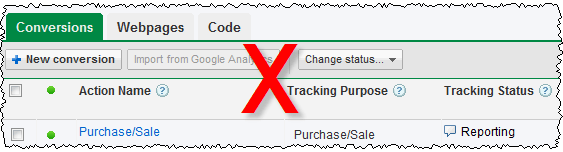
With conversion tracking you decide a goal to track (typically a customer buys your software) and put a small script provided by Google on the appropriate page (e.g. the ‘thank you for buying’ page). Google will then use cookie tracking to calculate the cost per conversion for your ads and keywords. It is that simple and you can set it up in a few minutes. I can’t understand why anyone wouldn’t use conversion tracking. With conversion tracking you will soon notice that some ads and keywords convert consistently better than others, often much better. Armed with this information you can optimise Adwords by changing bid prices and deleting under performing ads. Without conversion tracking it is pure guess work.

Conversion tracking isn’t perfect:

  • Adwords cookies time out after 30 days. If someone buys 31 days after they click your ad it won’t be tracked. And the cookie may be pushed out of the cache before 30 days.
  • If someone clicks your ad on one computer and then buys it on another computer (or even using a different browser on the same computer) the conversion won’t be tracked.
  • Some customers may have cookies disabled.

But imperfect data has to be better than no data. Obviously the 30 day limit on cookies is problematic if you are selling software with a sales cycle that is typically 30 days or longer (e.g. software with a 30 day trial). In that case you are probably better off tracking downloads, rather than sales. The fact that someone takes time to download your software, rather than bouncing straight out of your site, at least shows some interest. If you have stats which show your typical download to sale ratio (and you should) you can use this to work out what a download is worth, and set your bid price accordingly.

2. Don’t use negative keywords

adwords negative keywords

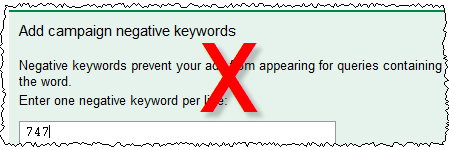
My own experiences with Adwords quickly showed me that people will click an ad, even if it isn’t at all relevant to what they are searching for. For example people searching for “747 seating plan” will click on an ad with the title “wedding seating plan”. It is the nature of the web that people are surfing rather than reading, and clicking on an irrelevant ad doesn’t cost them anything. You can avoid a lot of wasted clicks with carefully set-up negative keywords. For example, you can be sure that I have “747” set up as a negative keyword.

Ways to find negative keywords include:

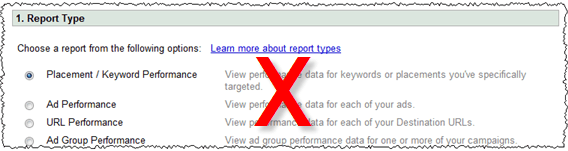
  • Generating ‘Search Query Performance’ reports from Google Adwords reporting
  • looking through your web logs/analytics for the sort of terms people are typing into search engines to find your site
  • using Google’s keyword suggestion tool
  • using Google suggest

There is also a useful list of negative keyword suggestions on Alwin Hoogerdijk’s blog.

3. Advertise in developing countries

adwords country selection
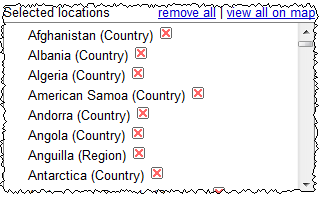
Over a billion people have access to the Internet. Many of them are in developing countries and aren’t realistically going to buy your software due to a combination of: cost (even $20 is a lot of money to people in many developing countries), payment issues (they may not have access to credit cards), language issues (your software isn’t localised for them) and cultural issues (there just isn’t much respect for intellectual property and copyright in many parts of the developing world). But that certainly won’t stop them clicking on your ads and you still have to pay for the clicks.

Start with wealthy countries where plenty of people speak a language your software has been localised into. If you really think you might be able to make a return in developing countries, then test it by creating a separate campaign that only runs in these countries and set your bids much lower (it is very easy to duplicate a campaign with Adwords Editor).

4. Bid too much

adwords bids

Lets use an example:

  • Your software sells for $30, of which you get $20 after subtracting ecommerce fees and average support costs.
  • Your typical visit to sale conversion ratio is about 1%.

That means you will only break even if you pay $0.20 per click through Adwords. Personally I find it hard to justify paying more than 50% of my profit to Google. So I wouldn’t bid more than $0.10 per click. If I couldn”t get any impressions at $0.10 per click I would try to either improve my quality score (e.g. improve my ads or delete keywords with low clickthrough rates) or find cheaper ‘long tail’ keywords to bid on. Paying $0.20 or more just to ‘get on the first page’ of Google is crazy (unless perhaps, it is a loss leader for market research purposes). You can’t make up on volume what you lose on each sale!

5. Don’t monitor your results

adwords reporting

Leaving your adwords campaign running for months on ‘auto pilot’ is ill-advised. Adwords is a constantly changing landscape. Google is continually changing the system and your competitors are coming and going and changing their Adwords campaigns and their products. So you need to continuously monitor how you are doing.  Google makes this very easy. For example, you can just set up Adwords reporting to email you a weekly summary of the number of conversions and the cost per conversion for each adgroup. A quick glance through this will let you know if things are going awry.

Conclusion

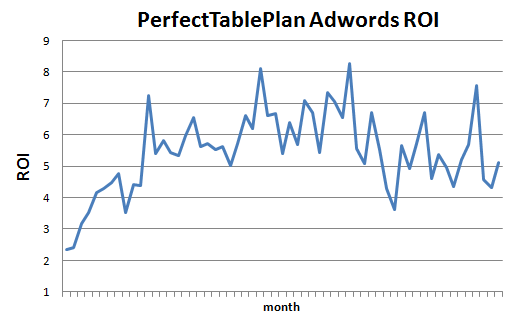
Adwords can be a very responsive, cost effective and well targeted form of advertising, if you take the time to learn the ropes and experiment. Below is a graph of my return on investment from Adwords for my table planning software over 5 years (almost certainly an underestimate due to the short-comings of conversion tracking, as discussed above). You can see that, after a few months finding my way, I was able to get a consistent ROI of around 4 or 5 to 1 and maintain this in the face of increasing competition.

adwords ROI graph

ROI = number of dollars in sales for each dollar spent on Adwords (1=break even).

Adwords is a complex system and the defaults are weighted in the house’s favour. In this article I have only touched on a few of the biggest mistakes I see. Google will give you plenty of rope to hang yourself and there are lots of other, less obvious ways to lose money. You really need to take the time to learn the system and experiment if you are going to have any chance of getting a decent return.

When I started with Adwords 5 years ago I read the Perry Marshall e-book on Adwords (beware – long copy!). I found it quite helpful. I assume they have kept it up to date. If nothing else, you will learn what it is like to be relentlessly marketed and upsold to. Google also has lots of free Adwords documentation and videos. If you go to conferences such as SIC or ESWC it well worth listening to Adwords specialists such as Dave Collins of softwarepromotions.com (formerly sharewarepromotions.com) talk about Adwords. There is also lots of useful information in the blogosphere. Start with a small daily budget and gradually increase it as you learn what works for you.

If you haven’t got the time or inclination to learn the system and experiment, pay someone who knows what they are doing to do it for you or stay well away from Adwords. Also bear in mind that Adwords works better for some products than others. If I was selling a $20 Mac-only product in a market with lots of more expensive competitors, I probably wouldn’t even bother trying Adwords.

** Update **

I used a deliberately provocative headline for this post, because I wanted to emphasize the fact that a lot of people are wasting a lot of money on Adwords. It seems to have worked in terms of traffic. But, judging by comments here and on Hacker News it has also confused some people. Sorry about that. To clarify, the sections heading are telling you how to waste money. To maximize your ROI you should do the opposite:

  • use conversion tracking
  • use negative keywords
  • only advertise in richer countries
  • not bid too much
  • monitor your results

Mailplane

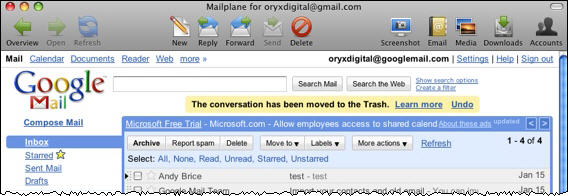
I recently did a day of consulting for Ruben Bakker of  Mailplane. I looked in depth at his marketing and did a screencast of myself downloading, using and buying Mailplane. We also discussed some ideas for a new product. At the end of the process he was kind enough to write me this testimonial:

How can I improve my sales? How can I make my application more profitable? Which of my ideas could be the next software product? With these questions in mind I hired Andy. He evaluated my small business, tested the product, checked the product website/store, and we discussed my strategy. Andy knows the Micro-ISV life and business with all its specialities and constraints. As a result of his work, I’ve now a clear plan and even tools on how to improve my sales. I was already able to put some ideas to work, and they already yielded measurable improvements. And Andy helped me choose my next project, I am now very much looking forward to it.

Ruben Bakker, www.mailplaneapp.com

Mailplane is a Mac desktop app that embeds and extends Gmail. For example, Mailplane allows you to drag and drop attachments, something that isn’t possible with Gmail running in a standard browser. This web/desktop hybrid approach potentially gives the best of both world – the richness of a desktop client, with the ability to fall back on the bare web app if required (e.g. from an Internet cafe). I expect to see more web/desktop hybrids in future.

Mailplane is a very polished app and I recommend downloading the free trial if you use Gmail on Mac OS X.

An interesting application of genetic algorithms

I recently watched an interesting BBC documentary called “The secret life of chaos”. It did a good job of explaining how interesting patterns could arise from very simple rules and how these could be further shaped by evolution to create the sort of complexity we see in the living world. It is well worth watching in full.

I have been interested in genetic algorithms for some time and use a genetic algorithm to optimise seating plans in my own PerfectTablePlan software. So I was particularly interested in a segment towards the end, where they showed how naturalmotion.com have used bio-mechanical modelling and genetic algorithms to create virtual humans that can respond realistically to various (unpleasant) physical stimuli, e.g. being shot, being hit or falling off things. The details are sketchy in the TV program, but it appears that they have evolved genetic algorithms that mimic aspects of the human nervous system. For example a human will instinctively put their hands out to cushion a fall or put a hand to an area that has been hit. They then combine this nervous system modelling with physics and a realistic a bio-mechanical modelling of the human anatomy. The results are impressive. You can see them about 2 minutes into the video below.

They claim they can use these models to generate realistic movements for synthetic characters in real time. Their Euphoria software is already being used in computer games, such as Grand Theft Auto IV.

More videos by naturalmotion.com

Haiti disaster relief

David Trump of the ASP is offering free software licences to people who contribute to Haiti disaster relief. This seems like a great idea to me, so I am copying it for PerfectTablePlan. I am going to try it for 24 hours and see how it goes. I am blogging about it here in case other software vendors are inspired to try it.

How to build an igloo

We have had loads of snow here in the UK. Loads by UK standards anyway (I don’t think a Scandinavian would be very impressed). So I decided to take full advantage of the flexibility my job allows and build an igloo. It was my second attempt and it turned out much better than rather wonky one I did a few days ago. This post is a quick overview of the modest amount I have learnt about igloo building, in case you are inspired to build your own.

how to build an igloo

First of all, building materials. The snow needs to be the sort you can squash together to make a snowball. If it is too powdery to stick together, forget it – you won’t be able to make a worthwhile igloo. Try again tomorrow.

Next you need to mark a circular base for your igloo. If you don’t then it is hard to get a decent overall shape. Two twigs and a bit a string is all you need to draw a circular outline. Don’t be too ambitous though, it takes a surpising amount of snow to build an igloo and the amount goes up fast as you increase the diameter. 1.5 to 2 metres diameter is plenty for a first attempt.

Then you need to have a bucket-shaped receptacles in a range of sizes. I used a household bucket as the largest, 2 different sizes of flower pot and a child’s bucket as the smallest. Start with the largest receptacle. Use it as a mould to create ‘snow bricks’. Pack the snow into the mould tightly to make strong bricks. Lay a circle of these bricks as close together as possible, leaving a gap for the door. Then place the next layer of  bricks on top, interleaving them like standard brickwork. Pack the gaps between the bricks with loose snow like mortar in brickwork.

Every few layers you need to swap to a smaller mould. Each layer needs to curve inward a bit more than the previous one to form the dome. It is quite surprising how easy it is to build an arch out of snow. It is stronger and stickier than you might think.

It took 3 adults a couple of hours to complete the igloo. I don’t think the Inuit will be offering us a job anytime soon, but it was very satisfying. Considerably more satisfying than the several hours I spent this morning failing to work out how to get rid of a maximise icon in Mac OS X.

A YouTube video of a similar approach using stacking boxes

Should you offer a money back guarantee?

money back guaranteeA few weeks ago I was going to buy a digitizer tablet for my PC. Then I noticed in the vendor’s terms and conditions that they wouldn’t accept a return once I had opened the packaging. But I couldn’t know if the tablet works until I open the packaging. Duh. I didn’t buy it. Similarly I look for a sensible money-back guarantee whenever I buy software. I don’t remember ever invoking such a guarantee for software, but it is nice to know that I could if I wanted to. Also, I see the lack of such a guarantee as a warning signal that the vendor isn’t confident about the quality of their product.

I offer a 14-day money back guarantee on my own Perfect Table Plan software. The only provisos are:

  • They have to tell me what they didn’t like about my software. This is very useful feedback for me.
  • They have to email me that they have uninstalled the software and won’t use it again. I have no way of checking this, but I want them to be clear in their own mind that they are a liar and a cheat if they carry on using it (if you have read Ariely’s excellent ‘Predictably irrational’ you will know that many people are prepared to be a little dishonest, but few will lie and cheat outright).
  • They have to return the CD, if they purchased one.
  • The guarantee is only valid for 14 days.

But I am fairly relaxed about about all of these. If it is clear that someone thinks they haven’t got their money’s worth out of my software, I will pretty much always give them their money back.

Note that is isn’t a ‘no questions asked’ money back guarantee. I haven’t been quite brave enough to try that yet and really want feedback on why they didn’t like my software. Also the 14 day guarantee is shorter than most. The reason is that a lot of people buy my software for a single use (e.g. their wedding reception) and I don’t want to make it too easy for them to use the software and claim a refund after they have finished with it. However I have heard vendors say that their refund rate actually dropped when they extended the length of their money back guarantee (due to increased procrastination, perhaps). I may test switching to a ‘no questions asked’ and/or longer guarantee period at some point.

The advantages of a money back guarantee to the vendor are:

  • More sales. If they customer is confident they can get their money back they are more likely to buy. I don’t have any numbers to back this up, as I have always had a money back guarantee. But I know I am considerably more likely to buy if there is a money back guarantee. Aren’t you?
  • Less chargebacks. If a customer buys with a credit card they can get their money back anyway. They just have to ring their credit card company and do a chargeback. Your payment processor will then take the payment back and, to add insult to injury, slap a chargeback fee on top. Too many chargebacks and they might even close your account. Better to refund and avoid the chargeback fee.
  • Less bad vibes. No matter how great your software is, some people aren’t going to like it. Maybe your software isn’t a good fit for what they want to do. Maybe they are just having a bad day. Better to give them their money back than to have them bad mouth your product on every forum they can find.
  • Less bad customers. Some customers (thankfully very few, in my experience) cost more in time and mental energy than their licence fee is worth. It is better for you to cheerfully refund them and focus your efforts on more financially and psychologically rewarding customers.
  • Staying legal. You may be legally obliged to give a refund in some circumstances.
  • Good karma. If you aren’t happy, I really don’t want your money.

Generally it costs you nothing to refund a software purchase, apart from a few seconds of your time (depending on your payment processor, some may not refund the processing fee). The only disadvantage of a money back guarantee is that it makes it easier for a customer to cheat you. A lot of vendors worry about this, but in my experience (and of others I have spoken to) this isn’t much of an issue in reality. My refund rate has been consistently around 0.5% (I am not including cases where I refunded because people bought the wrong type of licence, bought 2 licences instead of one etc.). I would be very surprised if dropping my prominent money back guarantee didn’t also drop my sales by a lot more than 0.5%. So, even if all the refunds are fraudulent (which I very much doubt) I am confident that the refund policy increases my profits overall. Sufficiently confident that I don’t intend to run an A/B test any time soon.

Interestingly, my refund rate is 10 times lower amongst customers who have purchased a CD. This could be because these customers are less price sensitive and so don’t see the refund as worth their precious time. Or it could be because of the extra hassle of having to send the CD back (I know a wily B2B vendor who includes a CD with every purchase for exactly this reason). Probably it is a combination of both.

Some vendors think that they don’t need a refund policy if they have a free trial. I don’t agree. When I buy software I want a free trial AND a money back guarantee in case I only discover a problem after purchasing. Also I know (from a survey) that some 25% of my customers don’t even try the free trial of my software before they buy. I expect I would lose a lot of these sales without a money back guarantee.

I think the case for a money back guarantee is even stronger for B2B software. Customers buying B2B software typically aren’t spending their own money, so they are probably less likely to ask for a refund. Especially as this would mean admitting to their boss and peers that they made a mistake buying your software in the first place. Certainly I have a lower refund rate to businesses than to consumers.

From a business point of view, I think the only case where you can justify a no refund policy is when you have a high cost of sale, e.g. enterprise software that requires a lot of configuration. In that case you could include a non-refundable set-up fee that covers your costs, but still have a money back guarantee on the remainder of the purchase.

No doubt refund rates vary according to product type, price range, customer demographics, geographic market and a range of other factors. But , reading forums and talking to other vendors, the typical refund rate seems to be in the range 0.1% to 1%. If your rate is much above 1%, perhaps there is a problem with your product you need to address? If your rate is much less than 0.1%, perhaps you aren’t marketing your product aggressively enough?

In the early days I found it hard not to see refund requests as an insult to my product. But now it really doesn’t bother me and I cheerfully make the refund. I just add the key to a ‘blacklist’ in the software so it won’t work in any future releases.  I don’t attempt to disable it in the current release. I don’t see implementing a ‘phone home’ strategy to make this work as being a profitable use of my time.

In summary, by not giving a money back guarantee you might avoid a small number of customers cheating you. But I think you are very likely to be losing a lot more in chargebacks, missed sales, ill will and missed feedback than you save in fraudulent refunds. Try it. You can always revert back in the unlikely event that your refunds go up significantly more than your sales. And if you have a money back guarantee you should shout about it on your website. Having a money back guarantee and not advertising it prominently seems like the worst of all worlds to me.

Interview for Shareware Radio

Mike Dulin has just uploaded an MP3 of an interview we did at SIC 2009 for Sharewareradio.com. In the 15 minutes we discuss marketing, how I got started with PerfectTablePlan, ads, the wedding industry, newsletters, the ASP, this blog and more. There are some problems with the recording levels, but hopefully that doesn’t detract too much.