
SWREG customers beware

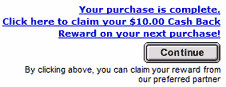
swreg upsellIf you are a customer of the ecommerce provider SWREG you should beware that they may be upselling highly questionable ‘discount’ schemes to your customers. From a post on the Business of Software forum:

This unannounced change was placed at the point of order completion where and leads to a $10/mo discount coupon scheme unrelated to the sold shareware. The way the offer is presented is deceptive – after the order is complete, they show a button with the word “Continue” on it. It looks like you are supposed to press the button to complete your order. Instead, you end up paying for something you probably didn’t want – and it’s a recurring charge.

Another posting suggested this only happens if your customer is in the USA.

I am not based in the USA and haven’t bought anything from SWREG recently myself, so I can’t personally verify the above. But these comments are backed up by posts I have seen on other forums from unhappy vendors and their unhappy customers. If you are using SWREG I suggest you buy a copy of your own software and see for yourself (you can always refund the payment later).

Assuming the above is true – what are they thinking? Either they don’t see anything wrong with it (which is very worrying) or they know its completely unethical, but are doing it anyway (which is even more worrying). It reeks of desparation to me. I thought their upselling of a registration backup service was highly questionable (I think vendors should provide this service for free), but at least it was clear what you were getting.

Vendors looking to move from SWREG to a different ecommerce provider might like to consider companies not owned by SWREG’s parent company Digital River. I use e-junkie.com with PayPal and GoogleCheckout. Other people have recommended Plimus and Avangate. You can compare processing fees here.

Google Adwords ‘placement performance’ report

Google Adwords placement reportYou can now find out what sites your Google content ads are appearing on, using the new ‘placement performance’ report. This will alllow you to spot under-performing sites in a content campaign. To exclude a site from your campaign click the ‘excluded site(s)’ link at the top of the appropriate campaign page.

My placement report for June shows that PerfectTablePlan has had 25,309 impressions and 0 clickthroughs from myspace.com. Does that make it officially the least cool software ever? ;0)

Business of software conference

business of software conferenceThe Business of software conference has recently been announced. It has got a fantastic line-up of speakers. I would sign up in a heartbeat if I lived in the USA (and maybe even try out for software idol). But California is too far for me to justify the expense and the time away. Pity.

However I will very likely be going to ESWC 2007 in Germany in November.

Software piracy

barrier_reef_2.jpg‘Software piracy’ is a colourful term for people using your software without paying the appropriate fee for all your hard work. It includes using cracks (versions with the security removed), keygens (software that can generate valid licence keys) and sharing licence keys in contravention of the licencing terms. Parrots, eye patches and attacking ships rarely feature prominently.

You might think that software piracy is only an issue for the Microsoft’s and Adobe’s of this world. But it is a real issue for all sizes of software vendor, even for small companies selling niche products such as mine. If you don’t believe me check the logs for the crack ‘honey-pot’ page I created[1] (IP addresses obscured to protect the guilty), click the image to enlarge:

piracy_logs.gif

That’s only the people who clicked through on to my honey-pot page. It really isn’t very inviting when displayed in a search engine, so I am sure that there are many more that searched for a crack but didn’t click through.

piracy_search2.gif

A quick look at this small sample of traffic shows that people looking for cracks come from all over the world, not just poorer countries. It also shows that Mac users look for cracks just the same as Windows users. In fact Mac users are a larger proportion of visitors to this page than you would expect from market share alone. I’m not saying that Mac users are less honest than Windows users, just that you shouldn’t be complacent about piracy just because you write software for the Mac.

I know from cookie tracking that some of the people who look for cracks go on to buy a licence (yes, I know who you are). Ergo, if there is a crack for the latest version out there it would definitely be costing me sales. So what can a vendor do to minimise sales lost to piracy? The first step is to understand the motivations of the people involved.

People crack software for many reasons. Some undoubtedly do it for commercial profit, e.g. so they can illegally sell the cracked version. But I understand the main reason is the challenge of cracking the software and resulting kudos from the cracking ‘community’. Some of the crackers are skilled and use sophisticated tools that emulate the computer environment, allowing them to quickly find and remove your security code. Although there is quite a lot you can do to make a crackers job more difficult, this is just going to make cracking your software more of a challenge and therefore more desirable to some. It is highly unlikely that the best security is going to defeat a skilled cracker for long. If Microsoft and Adobe can’t write uncrackable applications, what chance have we got? Trying to defeat piracy from the supply side is a fools errand. Just make sure your security is good enough to foil an unskilled cracker – if your average customer can bypass your security you are really in trouble.

On the demand side people use cracked software simply because they don’t want to pay for it. But they can end up paying in other ways. If we look at the costs and benefits in the wider sense:

costs of legitimate purchase:

  • purchase price
  • time taken to purchase

benefits of legitimate purchase:

  • use of current version
  • free upgrades

costs of pirate version:

  • time taken to locate crack
  • risk of malware in crack
  • risk of prosecution
  • guilty conscience?

benefits of pirate purchase:

  • use of current version

If your software is successful it will almost certainly be cracked at some point. Perhaps repeatedly. Congratulations! Somebody thought your software was worth cracking. We can’t stop cracks appearing. The best we can do is to make sure the benefits minus costs is greater for a legitimate purchase than a pirate version. Ways in which we can tip this equation in our favour are:

  • having cracks removed – Demand that ISPs remove cracks as soon as they appear (likely to be a lot more successful if the ISP is in Europe or North America). To find out when cracks appear you need to check your web logs regularly for unusual activity. For example a sudden flurry of downloads from countries that don’t normally buy your software could signal that a crack has appeared. You can also set up a Google alert for ‘<app name> crack’.
  • make existing cracks hard to find – Register your software with lots of download sites. Many of them search engine optimise their pages for phrases such as ‘crack or ‘keygen’ making real cracks hard to find.
  • price appropriately – Price your software at a level people will consider fair. Perhaps offer a ‘lite’ version at a lower cost.
  • make your software easy to purchase – The slicker and simpler the purchase process the less temptation to stray.
  • display the user name – Deter casual key swapping by displaying the licencee name prominently, for example in the splash screen and status bar.
  • use a digital certificate – A digital certificate reassures users that your installer hasn’t been tampered with and is free from malware.
  • release regularly – Crackers generally don’t want to pay for the bandwidth of lots of people downloading your software. so they will usually post patches and direct people to download the original software from your site. The patch is useless as soon as you release a new version and remove the old version. Making new and improved releases available to legitimate users also makes buying a licence more attractive.
  • create a honey-pot page – Make the case for buying your software and try to win over potential pirates. Point out the dangers of using cracks and emphasize that it isn’t a victimless crime.

Whatever we do there is a certain number of people who are never going to pay for our software due to some combination of lack of means (e.g. people in developing countries) and lack of scruples. There is not much point worrying about these people. In fact we could look on them from a ‘glass half-full’ perspective as potential free marketing – even though they are never going to pay for a licence they might recommend the software to someone else who will.

We also need to do our own little bit to educate people that software piracy isn’t a victimless crime. That means doing our best to ensure that our family, friends and work colleagues don’t use pirated software. It also goes without saying that we shouldn’t use pirated software ourselves – that would be the height of hypocrisy.

What we mustn’t do is make life difficult for our paying customers. Complex, intrusive and restrictive security schemes may have a negative impact on piracy, but they will probably have a much larger negative impact on our honest customers. If you are going to use ‘phone home’ or hardware based licensing you had better be absolutely sure there is no chance of false positives. It is hard to think of a better way to annoy an honest customer than to disable the software they paid for and brand them a thief. That would be enough to make anyone turn to crime. Shiver me timbers!

[1] I got the idea of a honey-pot page from another site. Unfortunately I can’t remember the name of the site to give them the appropriate credit.

Google playing fast and loose with broad match?

do_no_evil.gifIf you use Google Adwords you will want to read this article by Dave Collins. If correct (and I have no reason to believe otherwise) it is pretty outrageous. Not content to force up the price of bids artificially by invalidating keywords they are now apparently showing your ads for broad matches you didn’t bid on, i.e. extremely broad matches. This could in turn lead to a lower CTR and more invalid keywords.

Better start examining those logs and polishing those negative keywords…

The importance of targeted website traffic

Anyone who has a website can’t help but care how many people visit it. It’s great for our vanity to know that someone else is seeing our creation. Also, if you are running a business, more hits equals more sales doesn’t it? Well, not necessarily.
Take as many hits as you like and multiply it by a 0% chance of purchasing and you still end up with no sales. What matters is not just the number of visitors, but also the quality. Visitors that have a high likelihood of buying your software are said to be ‘targeted’. What you need is targeted traffic (preferably lots of it).

Targeted traffic is particularly important when you are paying per visitor e.g. using pay per click schemes such as Google Adwords. If you are paying $0.40 per click and your software retails at $40 you need more than a 1% conversion rate or you will just be donating to Larry and Sergey’s 767 fund.

I can illustrate the importance of targeted traffic with three examples from my own table plan software website.

1. Earlier this year I agreed for PerfectTablePlan[1] to be used as part of the demonstration of D-Wave’s prototype quantum computer in return for some free publicity. The controversial demonstration got huge publicity in the IT and high-tech communities. Sadly PerfectTablePlan didn’t get a mention in the press release as I was expecting, but it did get a mention in the D-Wave founder’s blog.

  • Click throughs from D-Wave founder’s blog: 566
  • Sales: 0
  • Conversion rate: 0%

2. I hang out on the JoelOnSoftware Business of Software forum quite a bit (especially when there are boring jobs I should really be doing). People often click through to the PerfectTablePlan website from my signature.

  • Click throughs from Business of Software forum: 4,757
  • Sales: 1
  • Conversion rate: 0.02%

3. PerfectTablePlan is built using the Qt framework by Trolltech and gets a mention on their cool apps page.

  • Click throughs from Trolltech coolapps page: 1,922
  • Sales: 2
  • Conversion rate: 0.1%

The data above is based on web stats and using cookies to track the initial referrer of sales. I don’t pretend it is hugely accurate, for example it doesn’t take account of someone clicking through to my site and then emailing the URL to a friend who then buys the software. But it is accurate enough for current purposes.

Adding all 3 examples together the conversion rate averages 0.04%, or about £0.01 revenue per click. So I would have lost a lot of money if I was paying for these clicks through Adwords. What these 3 examples have in common is that they were untargeted. The people clicking through to my site were primarily interested in quantum computing, selling software or creating cross-platform software, not creating table plans.

From better targetted traffic (e.g. people searching for “table plans” on Google) I do much better, with a conversion rate typically in the range 1% to 10%, depending on how well targeted it is. That is 25 to 250 times better than the less targeted traffic.

So, next time you are boasting about the number of hits on your site (or bemoaning the lack) remember that hit counts is a flawed metric. Like LOC (lines of code) it is easy to measure, but not terribly meaningful. You need quality as well as quantity.

[1] Actually an adapted version interfacing with their D-Wave quantum solver, rather than using PerfectTablePlan’s own genetic algorithm.

Google Adwords Editor

google adwords editorGoogle has a free desktop tool for managing Adwords accounts. Obviously downloading all your data on to your desktop offers the potential to remove some of the latency inevitable in managing large amounts of data online. However the Google Adwords web app was sufficiently good and the desktop app sufficiently bad that it wasn’t really an improvement. It was buggy (if you tried to add a phrase as broadmatch when you already had it as exact match you got a blank wizard window), lacking in basic GUI etiquette (simple things like Ctrl+click and Shift+click selection didn’t work) and slow. I can’t have been the only developer to delight in that fact that the gods of Mountain View had feet of clay when it came to desktop apps.

Anyway they seem to have fixed some of the issues and the latest version (3.5.0) is reasonably useable. Some of the things that I prefer it for over the web interface include:

  • adding new keywords to multiple campaigns
  • looking for inactive keywords across multiple campaigns
  • looking for keywords with low CTR or high conversion costs across multiple campaigns

I just wish they would add lifetime stats, as well as stats for the last 30 days, 7 days and yesterday.

Microsoft AdCenter vs Google AdWords

microsoft adcenter.gifI have been using Google Adwords since I launched PerfectTablePlan over 2 years ago. I started using Yahoo Overture (as it was then called) at about the same time, but gave up on it due to the lousy user interface and the poor return on investment. Always on the lookout for new ways to promote my product I recently decided to investigate the new-kid-on-the-block: Microsoft AdCenter.

My first impression is that Microsoft have copied Google Adwords. Badly. All the standard Adwords stuff is there: campaigns, adgroups, exact/phrase/broad match, negative keywords etc, they haven’t even bothered to change the terminology in most cases, but it feels clunky compared to Adwords. Wherever they have made a departure from the Adwords model it appears to be a change for the worse.

  • Negative keywords appear to be associated with phrases, not adgroups or campaigns. I might have 100 negative keywords and I don’t want to record them separately for every phrase!
  • You have to choose a single language for a campaign and you can’t change it. English-UK and English-US are counted as separate languages, so I have set up a UK+English-UK language campaign and a USA+English-US language campaign. Presumably people in the UK with their computer set to English-US won’t see my ads at all, but I can’t be bothered to set up another whole campaign just for them.
  • It confusingly mixes together campaign and adgroup properties in the interface.
  • The user interface is quite monochrome and poorly laid out compared to Adwords.
  • Everything has to be approved before it goes live. It took over 12 hours in my case (with Adwords it would be live in minutes).
  • It is set up so that you can’t store the password in the browser (in FireFox anyway) and times out quickly. Continually re-typing the password gets old quickly.
  • I tried opening AdCenter in 2 browsers so I could compare campaigns. It didn’t handle this well.
  • The minimum bid is £0.05. This automatically makes a whole swathe of keywords uneconomic for me.

But it gets worse. They rejected some of my phrases due to ‘Landing page content not relevant‘. One of the phrases was “seating plan” with a landing page The easiest way to create seating plans. How much more relevant can I make it? This sort of arbitrary interference was one of the things that made Overture so frustrating.

The number of impressions are much lower than Google, but there are also fewer advertisers, so my ads rank higher. Overall AdCenter clicks are currently running at about 10% of what I get through AdWords[1]. It is too early to say how conversion rates compare. But if the profit is only 10% of what I get through Adwords it might not be worth the effort to maintain.

It would be great to have a real contender to Adwords to keep Google on their toes. I’m not a Microsoft-hater and I really wanted to like AdCenter, but my first experiences are not favourable. To be fair, it is early days for AdCenter and I am still learning the ropes. I’ll let it run for a while before I make any decision about pulling the plug.

Microsoft have a reputation for bringing out a lousy version 1.0 and then continually improving it until it crushes all opposition, so it would be unwise to write them off this early in the game. But I think they have got a long way to go before they catch up with where Adwords is now.

[1] I have a lot less phrases in AdCentre than Adwords, but I do have all the most important phrases.

Effects of the GoogleCheckout badge on clickthroughs

Google Adwords adJust over a month ago I added GoogleCheckout as a payment processor on my site. This resulted in the much vaunted GoogleCheckout badge being displayed next to my Adwords Ads. I expected an increase in clickthough ratio (% of people who see the ad who click on it) due to greater visibility and a consequent decrease in conversion ratio (% of clickers who go on to buy) due to the greater visibility attracting more ‘tyre kickers’.

I have now looked through 2 months of data (a month before and a month after) and the exact opposite has happened. My Adwords clickthrough ratio has dropped by 10%, but the conversion ratio has increased by 20%. Perhaps the badge is actually putting off the tyre kickers by making it clear that the product isn’t free? It is hard to know how much of this is due to the badge and how much is due to other factors and I will be checking the stats again in another month. I would be interested to know whether other people have had similar results.

The moral of the story is: don’t assume, measure.

Promoting your software (part 6)

21. Viral marketing

Viral marketing is where you use the software to promote itself. For example an anti-virus product could append to each outgoing email “this email scanned for viruses by <product URL>”.

Paying customers might get annoyed at the free promotion, so you should give them the option to disable viral marketing elements. You probably don’t have to worry about this for customers using a free trial or ‘lite’ version.

Pros: Free. Requires little or no effort once set up.

Cons: Not all applications lend themselves well to this.

Data point: If you email a table plan from within PerfectTablePlan it appends a URL for downloading the free trial so you can view the plan. I have no idea whether this has resulted in any extra sales.

22. Cover CDs

Many computer magazines come with a CD or DVD full of software attached. These seem less and less relevant with the increasing availability of broadband connections.

Pros: Could be useful if your trial download is very large.

Cons: I am guessing that the conversion rate is very low, especially when there are lots of other products competing for attention on the same CD.

Data point: I haven’t tried this myself.

23. Online directories

A listing in an online directory, such as dmoz.org or Yahoo, can increase the visibility of your product. There are also specialist directories for different markets. Directories used to be considered important, but they seem to be becoming less important as search engines improve.

Pros: A directory listing can bring you additional traffic directly (from clickthroughs) and indirectly (by improving your search engine page rank).

Cons: dmoz is free, but who gets in depends on the whims of the editor in charge of that section. Yahoo costs $299 dollars and doesn’t guarantee that you will get included (maintaining the entry costs a further $299 per year).

Data point: I have applied to be added to dmoz.org every 6 months or so for 2 years, but to no avail. I’m not convinced that a Yahoo entry is worth the cost. A listing I paid for in a business entertainment directory was a total waste of money (and time, due to the incompetance of their accounts department).

24. Word of mouth

If your product is good customers will often recommend it to other people, face-to-face, by email and on forums.

Pros: A happy customer is the best possible form of promotion.

Cons: You need to get everything right (website, installer, software, documentation, support etc) and that isn’t easy.

Data point: Customers email me to tell me that they have recommended my table planning software to others and I see quite a few favourable comments in forums.

You need to try different forms of promotion to find out which ones work best for your product. But in general you should prefer forms of promotion that keep working day after day with a minimum of effort and where you can easily measure the results.

Which forms of promotion are most effective in terms of time and cost vs sales will obviously depend on your market and budget. If your ticket price is $100,000 then expensive print ads in are more likely to be effective than if your ticket price is $30.

Obviously I haven’t listed every possible method of promotion. Perhaps the one I haven’t listed is the one that will work best for your product. Feel free to comment if you think I have missed any important ones or if your experiences are different from mine.