
David Boventer has just reminded me that early bird registration for ESWC 2008 ends July 31st. I probably won’t make it this year due to other committments. But I have been the last two years and highly recommend it to any microISVs that can make it to Berlin for 8/9 November. Hurry up – you haven’t got much time to get the early bird rate!
Category Archives: microISV
The view from my office

This was the view from my ‘office’ last week, on holiday in Dorset (that’s Corfe Castle you can see in the background). You never really get a day off when you run a microISV, but spending an hour a day answering emails isn’t too onerous. Certainly it is better than not going on holiday. Mobile Internet access is truly a wonderful thing.
The above photo was taken by Claire. Below is a panorama created using Autostitch from 8 separate photos taken by me (click to enlarge).

The joys and challenges of running a nomadic software company
 In theory an Internet based software business isn’t tied to any particular geographical location and can be run from a laptop anywhere there is an Internet connection. So why not travel the world, financed by your business? Trygve & Karen Inda are doing just that. They kindly agreed to write this guest post discussing the practicalities of running a nomadic software company.
The freedom to wander aimlessly around the planet, visiting whichever countries you want, is something many people dream about. We have actually achieved it through our microISV. For the past six years, we have been living and working in numerous countries, with nothing more than our Mac laptops, backpacks, assorted cables and adaptors and an insatiable thirst for adventure.
We were thirty years old, with no kids and no debt, working steady jobs in Reno, Nevada, and had a small microISV on the side. It was a “nights and weekends” business that earned us dining out money, or even covered the rent in a good month. After September 11th, my husband Trygve’s day-job slowly went away, giving him more time to devote to our microISV. By March 2002, when we first released EarthDesk, the microISV had become his full-time job.
The response to EarthDesk was phenomenal and we soon realized that we could move overseas, bringing our microISV with us. Within several months, we had sold the bulk of our possessions, moved out of our apartment in Reno and purchased one-way tickets to Tbilisi, Republic of Georgia.
The experiment begins
For six months, we tried to manage our software business while teaching English and doing odd jobs for NGOs, newspapers and radio stations. We had brought with us two Mac laptops (a PowerBook G4 and an iBook G3), which were both maxed out as far as hard drive and memory were concerned, an extra battery for the G4, an external keyboard, a digital camera, and various cables and worldwide plug adaptors. We had also brought a CD case full of original software discs.
Tbilisi home office
In the end, the multiple infrastructure problems that plague the Republic of Georgia (mostly a serious lack of electricity) proved too much for us to bear. We escaped to Germany, carrying 170 pounds of stuff, including our two laptops, a UPS we had purchased in Tbilisi and a Persian carpet we had bargained for while on Christmas holiday in Dubai.
After a few weeks recovering in Germany, we spent a few months in Prague, Czech Republic. When the cold weather arrived, we flew south and spent eight months travelling around the Indian Ocean, South East Asia and Oceania. Shortly thereafter, we landed a software development contract in Dubai and relocated there, but regularly escape to Prague during the blistering summer months. We currently own a flat in central Prague and have considered buying a flat in Dubai.

Kampala, Uganda
By keeping a small base in one or two countries, we can have a “home”, a decent place to work and a life, while still taking long trips with the backpacks. Running the business from an apartment in the developed world is fairly straightforward. What’s challenging is running the business from a backpack while spending several months on the road.
The essentials
Everyone wants to sit on a beach and work only four hours a day, but the reality is a little different. If you are actually running your business, you’ll spend as much time working on the beach as you would in a cubicle. It’s certainly possible to work only an hour a day for a few weeks, but to develop and grow your business, you will need to spend time actually working, rather than sightseeing. It’s not a permanent holiday, but rather an opportunity for frequent changes of scenery.
As a practical matter, you can only travel with what you can carry and a good backpack with detachable day-pack is the only serious option. Since you are carrying a few thousand dollars worth of equipment, security becomes an issue, especially in poorly developed parts of the world. We generally stay in the least expensive hotels we can find that have adequate security and cleanliness, while occasionally splurging on something nicer to maintain our sanity. It is very important to budget properly for long trips. For some people this may be as much as $200/day, and for others it may be only $50/day, but managing expenditures is even more important when on the road. Of course you’ll soon realize that for the same money spent during 4 days in London, you could spend weeks in South East Asia or poorer parts of the Middle East.
On journeys of a month or more, we generally bring two up-to-date Mac laptops (currently 15″ and 17″ MacBook Pros), worldwide plug adaptors, software CDs, two iPods (one for backing up data), a digital camera and two unlocked 4-band GSM mobile phones. For longer-term backup we burn a data DVD about once per month and post it home.
Essential software includes Excel, Entourage, Filemaker Pro, Skype, iChat and, of course, the Apple Xcode Developer Tools. Speed Download saved us in Tbilisi because of its ability to resume downloads after our dial-up internet connection dropped the line, which it did every four minutes!
Surprisingly, the best Internet we have found in the developing world was in Phnom Penh. WiFi can often be found at big hotels, but it is more common to connect via Ethernet in a cafe, where a basic knowledge of Windows networking will allow you to configure your laptop to match the existing settings of the cafe’s PC. In the least developed countries, modems are still the norm.

Kigali, Rwanda
One important consideration, especially in countries where censorship is common, is that many places require you to use their SMTP server for outgoing mail. This may not work with your domain as a return address. To get around this, it’s useful to have a VPN, such as witopia.net, and an SMTP server at your domain.
Visas, taxes and other nasty stuff
If you have a western passport, visas usually only become an issue when you want to stay somewhere more than three months. Often, it is possible to do a “visa run,” in which you briefly leave the country and immediately return for another three months. Many countries make it easy to set up a local company, which can allow you to obtain longer-term residency visas, but there is a lot of paperwork involved with this. Staying more than six months as a “tourist” anywhere can be a problem as you’ll almost certainly have to deal with immigration issues.

Hong Kong
Although Dubai has straightforward immigration procedures and is a fabulous place to spend winters, the UAE Government blocks more websites than just about any other country on Earth. Even Skype is blocked because the local telecommunications company doesn’t want any competition. Unless you are able to find a way around the blocks (wink, wink), running any kind of internet business from Dubai will be fraught with difficulty.
Even if you are living in a tax haven, if you are a US Citizen, you can never fully avoid US taxes, although you can take advantage of the Foreign Exclusion. Local taxes aren’t really an issue if you’re just a “tourist” spending a few weeks in a country, but they can become an issue for long-term stays. If you are planning to stay somewhere for more than a couple months, and “settle”, you’ll need to research tax ramifications.

Sana, Yemen
Since we left the US, our taxes have become much more complicated. Fortunately, we found an American tax attorney to handle our annual filings. He lives abroad and therefore understands the Foreign Exclusion and other tax laws regarding expats. For our microISV, payment is handled online by two providers (always have a backup!), and ends up in a company account in America. We use a payroll service to pay our salaries into personal accounts, which we can access by ATM. We also have established a managed office in Nevada to act as our company headquarters and handle mail, voicemail and legal services.
We have no regrets about having left the US for our big adventure. We have truly lived our dream of being able to travel indefinitely, but sometimes it is wearying not knowing which country we will be living in just a few months into the future. Our ultimate goal is to own two properties on two continents so that we can travel between them with just a laptop.
by Karen Inda
photographs by Trygve and Karen Inda
Trygve & Karen Inda are the owners of Xeric Design. Their products include EarthDesk, a screensaver with a difference for Windows and Mac. They were last spotted in Prague.
planetmicroisv.com
 Floyd Price of Code Spaces has taken over the day-to-day running of microISV blog aggregator planetmicroisv.com from Baruch Even. He has already given it a fresh coat of paint. I appreciate the efforts of Baruch and Floyd to maintain this useful resource. planetmicroisv.com is well worth adding to your RSS feed if you are a microISV (or aspire to be).
MicroISV Sites that Sell!
 I have belatedly got around to reading Bob Walsh’s new e-book: “MicroISV Sites that Sell! Creating and Marketing Your Unique Selling Proposition”. This is the first in a series of e-books for microISVs that allows Bob to go into selected subjects in more depth than was possible in his book “Micro-ISV: From Vision to Reality“.
The e-book is aimed very specifically at microISVs looking to create a website to sell their software effectively. It has a lot of detailed advice that I think will be invaluable to anyone creating their first microISV website. I have lost count of the number of microISV sites that make some of the mistakes Bob identifies, including:
- it isn’t immediately clear what the product does
- selling on features instead of benefits
- too much text
- inappropriate use of technical jargon
The content will inevitably be less useful for established microISVs, but you only need to find one useful idea to justify the cost of the e-book. My only real gripe is the comparison between programming patterns and marketing. I didn’t find this a helpful comparison. Marketing is a very different beast to programming and the sooner we face up to it, the better.
You can get a copy for $19 here.
Full disclosure: I got a free review copy of this e-book.
Mobile Internet access
 I try to check my sales and support emails at least twice a day, every day. I managed this 362 days in 2007 (I took a break for Christmas day and 2 days I was in Germany at a conference). But providing this level of service can prove to be a problem for a one-man software company when it comes to taking holidays. Last year I restricted holidays to places with broadband Internet access. But finding child-friendly accommodation with broadband access proved to be quite a headache.
I have considered getting a Blackberry, but I really need something that can run my application to do proper support.
After some dithering I have now finally got mobile Internet access for my laptop through 3 Networks at £10/month. This provides 1GB per month of free data in the UK. You can get a higher data allowance with a more expensive contract, or a pay-as-you-go contract. But 1GB/month will hopefully be sufficient for my needs. Data costs outside the UK are a frightening £6/MB, so I will probably have to look for alternative arrangements if I take a holiday abroad. Vodaphone offer contracts with more reasonable roaming rates, but the contracts are much more expensive (£25 – £99/month).
Installation of the USB mobile modem and software was very easy – it took me about 5 minutes from opening the packaging to being connected. Only time will tell how good the coverage and service are. Watch this space.
Having mobile Internet access could also be a useful back-up if I lose my landline broadband connection. This is quite reassuring after several website outages and a failed harddisk in the last couple of weeks.
Business of Software microISV survey
 The Business of Software blog has published the results of a survey of 96 microISVs:
survey results – part 1
survey results – part 2
As the survey is self-selecting it is hard to know how representative the results are for microISVs in general, but it makes interesting reading.
Of respondents whose microISVs had been running 6 months or more, 50% made less than $25 in sales per hour worked. Assuming modest expenses of 20% that means that the majority of microISVs are making less than $20 per hour worked, before tax. This sounds rather discouraging, but some claim to be making >$200 per hour. The author has kindly provided the raw stats for download, so I looked at them in a bit more detail. According to my quick analysis the situation is, unsurprisingly, more encouraging for established microISVs. If you take you all the respondents who have been in business at least 12 months, are working at least 30 hours per week and are making any sales at all, the average is around $60 in sales per hour worked. This is not too bad for an indoor job, with no heavy lifting, that you can do in your underwear.
The data also shows an interesting difference in sales by category. I took the data for all the 1-man companies with monthly sales >0, divided them by category and then removed the top and bottom performers in each category (to prevent outliers distorting the averages).

Average sales per hour worked ($), by category, click to enlarge
I am not surprised that the average sales is relatively low in the ‘Developer tools’ market given the fierce competition, prevalence of free tools and the effects of developer ‘not invented here’ syndrome. I am rather surprised that consumer software appears to pay better than business software. This seems to turn conventional wisdom on its head (assuming I got the numbers right, it was after midnight). Of course, sales is not the same as profit. There appears to be little (if any) correlation between the ticket price of an item and the total monthly sales.
Digging a bit further, the stats also show some correlation between marketing spend and sales:

Monthly marketing spend ($/month) vs monthly sales ($/month), click to enlarge
Of course (repeat after me) correlation does not imply causation.
Thanks to Neil for taking the time to do the survey and publish the results.
Selling your own software vs working for the man
 You’ve got this great idea for a software product. You are pretty confident that you can crank out version 1.0 working full-time on your own from the spare room, and you are fairly confident that people will buy it. But you’ve also got a well paid full-time job ‘working for the man’. It’s cosy and familiar in that cubicle. Is it worth risking your career and savings to set out into uncharted waters on your own? Do you take the red pill or the blue pill?
The aim of this article is just to give you some insight into the economic realities of becoming a one man software company (a microISV). The results might surprise you. ‘Working for the man’ you get a steady monthly income every month. Working for yourself you start off with no income, while you create your product. If all goes well you start to make sales when you release v1.0 and these sales gradually improve over time until you are earning the same amount each month as when you were working for the man . As the sales continue to improve you (hopefully) reach the point where you have made as much money as if you had stayed in your old job for the same period of time. From here on it’s all gravy. Here is a very simple model:
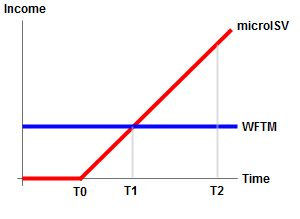
Monthly income as microISV vs WFTM (T0=version 1.0 release, T1=monthly income equal to WFTM, T2=areas under the red and blue lines are the same)
Obviously I am making a lot of assumptions and simplifications here. In particular I am assuming:
- Net income from microISV sales rises linearly month-on-month as soon as you release v1.0. Obviously this can’t happen forever (or you will be richer than Bill Gates) but it seems as good a guess as any and it keeps the mathematics simple.
- MicroISV start-up expenses (buying a domain name, starting your company, buying equipment and software, getting an Internet connection etc) are fairly low compared your monthly WFTM salary.
Even though the model is embarrassingly over-simplified, I think it can still give some insights. If I plug some numbers for T0 and T1 into a simple spreadsheet I can come up with values for T2. I’ll choose numbers that I consider optimistic, realistic and pessimistic for each. For T0 (time to V1.0) I choose 3, 6 and 12 months. For T1 (time to same income as WFTM) I choose 12, 18 and 24 months.

Months required to reach T2
i.e. if it takes you 6 months to get V1.0 out and then another 18 months until it is making the same monthly income (after expenses) as WFTM then it will take you 47 months to reach the point where a microISV has made you more money than WFTM.
So how much do you need in the way of savings to survive until you have a decent income? I can work this out by assuming living expenses as some proportion of WFTM monthly income. Calculating for 50% (living on noodles) and 100% (full speed ahead and damn the torpedoes):

Maximum debt in months of WFTM income with living expenses=50% of WFTM income

Maximum debt in months of WFTM income with living expenses=100% of WFTM income
i.e. if it takes you 6 months to get V1.0 out and then another 18 months until it is making the same monthly income (after expenses) as WFTM and your living expenses are 50% of your WFTM income then your maximum debt is 5 months of WFTM income.
I think the results of this simple little model make a few points:
- Rate of sales growth is critical but the the time to getting v1.0 out is also very important. The longer it takes, the more you have to catch up later.
- You are unlikely to come out financially ahead after 2 years as a microISV, even with fairly optimistic sales figures. It could easily take 3 or 4 years and, if the sales don’t take off or level out too early, you may never get there. There are many reasons to start a microISV, but getting rich quick isn’t one of them.
- Given that you can’t know what T1 will be for your product, you should probably have at least 6 months WFTM income in the bank. Preferably 12 months.
- Learn to love noodles.
You can download my Excel spreadsheet here (it’s a quick hack, so don’t expect too much).
So which is it going to be, the red pill or the blue pill?

Your code is sub-optimal!
 When I saw the new Source Gear ‘evil mastermind’ t-shirts, I had to have one for my nerd warddrobe. So I struck a Faustian bargain with Source Gear mastermind Eric Sink. The photo below is part of the bargain. Sorry about that.
Given that version control isn’t the most wildly exciting of topics (no offense intended) I think their comic book campaign is a very imaginative piece of marketing. I wish them every success with it. While I am plugging Source Gear I should mention that they offer a free one-developer licence for Vault. This could be very useful for microISVs out there looking for a source control tool. So far I am pretty happy with Subversion, apart from the ‘don’t come crying to me for help’ approach to merging branches.
I also recommend Eric’s blog and the resulting book as an excellent source of marketing information for techies. It helped me a lot.
Have I earnt my t-shirt yet Eric? This blog has also earned me one sale of PerfectTablePlan and a couple of dollars in referral fees from e-junkie. At this rate I will soon be able to retire from programming to blog full time. Watch out Scoble.

Business of Software wiki
 Joel Spolsky has announced a Business of Software wiki based on FogBugz 6. You can view/edit the wiki here.
“The point of this wiki is to bring under one roof as much high quality, useful information as possible about the business of software, whether it’s microISVs selling desktop software, Web 2.0 sites or even the big enterprise kind of outfits.”
This will become a useful resource for software entrepreneurs if enough people contribute. I have added an article from this blog to do my little bit.
 Successful Software
