
 Al Harberg (best known for his press release service for software vendors) has created a useful glossary of software marketing terms. Al knows a lot about marketing software. His glossary is 107 pages/53k words long and includes quotes, book review and feature articles. I particularly enjoyed some of the more tongue in cheek definitions e.g. “System requirements: A poorly cobbled statement of techie talk that software developers use to lose sales” and “Idiot customers: Clients who don’t understand every aspect of your software immediately”. If you don’t know what active voice, AIDA, astroturfing, cloaking, CPM, fast follower or purchase order mean, now is your chance to find out.
Is it worth advertising Mac software on Google Adwords?
I learnt a long time ago that people will happily click on totally irrelevant pay per click ads. For example, if you bid on “seating plan” I can assure you that a significant percentage of people searching for “boeing 747 seating plan” will happily click on your ad titled “wedding seating plan”. They won’t buy anything, as they aren’t interested in wedding seating plans, but you still have to pay for each click. You can stop your ad showing to these searchers by adding “boeing” and “747” as negative keywords. Problem solved.
But what do you do if you are selling software that only runs on Mac OS X? The vast majority of searchers are running Windows. Indiscriminate clicks by them could quickly turn your Adwords ROI negative. In your Adwords campaign settings you can choose to only show ads on desktop computers and laptops. But you can’t choose the operating system.
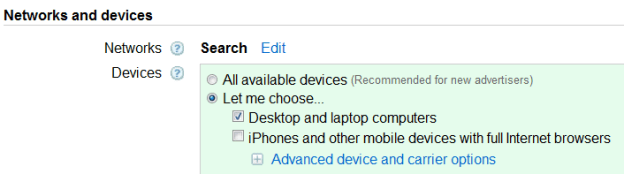
As discussed above, putting “Mac” in the title is unlikely to be enough. You can’t use negative keywords, because the vast majority of Windows users searching for, say, backup software will type “backup software” not “Windows backup software”. You can just bid on searches containing keywords “Mac”, “Apple” or “OS X”, but will this be enough? My general advice to Mac only software vendors was to avoid Adwords, unless the ticket price of their software was in the hundreds of dollars. But, as my software runs on both Windows and Mac, I didn’t have any data to back this up.
Recently I got some data on Adwords clickthrough rates for a Mac only app (www.puzzlemakermac.com) by Hokua Software. They have kindly allowed me to share the data.
Initially they bid on generic keywords, such as “crossword maker” and ran ads such as the following with “Mac” displayed prominently in the title:
 The results from analytics: 60% of the people clicking on the ads were on Windows and 40% on Mac.
Then Google banned them from the word “Mac” in their ads (it is possible to get this reversed with the express permission of Apple, but I don’t know how likely they are to grant this). So they switched to “OS X” in the ad, which hasn’t been blocked (yet).
 The results from analytics: 73% of the people clicking on the ads were on Windows and 27% on Mac.
Then they restricted their bids to Mac targeted keywords such as “mac crossword maker”.
The results from analytics: 23% of the people clicking on the ads were on Windows and 73% on Mac. But there was a big drop in the number of impressions.
I think it is going to be almost impossible for anyone to get a return from Adwords when the majority of their clicks have no chance of generating a sale. So only bidding on Mac specific keywords seems to be the way to go. But there will still be a significant number of wasted clicks from Windows users. Also any Mac users who don’t use the appropriate keywords won’t see your ad. Consequently the return on time and money invested is likely to be a lot lower than Windows, cross-platform and web developers can expect. If you have a Mac only product with: a high ticket price product, well-defined keywords and limited competition, it might be worth trying Adwords. But otherwise it is probably better to wait and see if Google release OS targeting.
Of course, you could always use one of the free Adwords vouchers that Google are handing out like confetti (I get one every month in my PC Pro magazine) and try for yourself. This is how Hokua software got the results above. If you do, I would be interested to know how your results compare.
PerfectTablePlan Royal Wedding Special
 It is the Royal Wedding tomorrow and everything has gone Royal Wedding crazy here in the UK. I did send the happy couple a complimentary copy of my Perfect Table Plan software a while ago. I haven’t heard anything back, but I will be checking my support emails tomorrow morning, just in case. ;0)
I am doing my bit to cash in honour the occasion by putting the Home Edition of Perfect Table Plan on one-day discount site BitsDuJour on the big day. 51% off for 29th April only.
After the discount, BitsDuJour’s commission and support costs, I won’t be making much per sale. But I figure it might be worth it for the exposure to a different audience. Also some of the purchasers might upgrade later. My product is rather different to most of the other products featured on BitsDuJour, so it will be interesting to see how it does.
Will you, or anyone you know, be planning a seated event (wedding, charity gala, award ceremony etc) in the future? If so, you can get the 51% discount here.
Interview with a cracker
 Through an unforeseen series of events, I have ended up corresponding with a cracker known only to me by a Hotmail address and the pseudonym “CrackZ”. It quickly became clear that he knew what he was talking about, but was motivated by curiosity rather than criminality. Obviously crackers are a more diverse group than the criminal masterminds and script kiddies of popular imagination. To my surprise he agreed to be interviewed for this blog and I jumped at the chance to find out a bit more about the shadowy world of cracking.
*** I realize this is an emotive subject, but please read the whole interview before posting anything in the comments. ***
What is your background? How did you get into cracking software?
I graduated in software engineering about 10 years ago and started out seriously cracking software in my first year at University. It was the first time I’d had access to a fast, unmetered Internet connection and my interest became collecting software and then breaking it; most of my associates never proceeded much beyond the downloading lots of free software stage. Prior to this I’d really only ever had a casual knowledge of the piracy scene from owning a Spectrum, Commodore 64 and then an Amiga. Think tapes and copy disks being swapped in the playground and you wouldn’t be far wrong ;-). The first PC experiences I can recall were studying some very early Phrozen Crew cracks and the Quox virus that someone gave to me on a disk.
Do you also write software? Is your day job in the IT industry?
Yes and yes.
What is the motivation for cracking software?
Motivation for cracking really seems to vary. For me I think its always been mainly about the intellectual challenge, studying code, or ‘breaking the minds of protection authors’ as one correspondent so eloquently put it. For many there is also the ‘social aspect’ of being amongst a like-minded group of individuals (see some of the interviews with former members of famous groups e.g. PWA, DOD if you want to understand how powerful a *pull* the social element can be). Then there are also those who simply enjoy getting software for free or those who do it simply for ‘kicks’. Contrary to the various anti-piracy associations propaganda, very few of those I’ve ever been associated with have been motivated financially. That’s not a justification of course, but it might help if most authors realised that the person who cracked their software is more likely a bored 16 year old Chinese male than a future terrorist.
Is cracking an individual activity or is it organized?
The answer is both, but that is an oversimplification. Most of my cracking has been pretty much a lone-wolf occupation, although there have been times I have worked with others on group projects, expensive CAD/CAM applications for example. One only has to look at the scene to see that there are plenty of organized groups out there and some of the group infrastructures I’ve seen would rival small corporations in their sophistication. A lot of authors are often quite surprised to find their software on the cracking scene radar.
What is your attitude to intellectual property? Do you release cracks and keygens ‘into the wild’? What do you think of those that do?
I’ve actually gone full circle here; in my early years IP literally meant absolutely nothing to me, the value of the software didn’t matter and authors were inconsequential. I would happily release cracks and key generators under a variety of nicknames and scene groups and I didn’t lie awake at night thinking about the damage I might be causing to someone’s livelihood. Currently, I’m 100% in the ethical category (you can debate that). I haven’t been able to curb my interest in protection code, but have managed to channel my interest towards simply contacting the authors when I have broken their code. Sometimes I’ll even offer a little helpful advice; though I’m afraid that’s probably the ‘moral best’ I’m ever going to be. I don’t support those who release cracks and key generators. I’ve heard enough from authors to know how damaging it can be, but anyone who has ever experienced the scene can probably understand why it still happens and will continue.
I can understand the attraction of cracking as an intellectual challenge. But why do some crackers then release the cracks? What do they gain?
Respect amongst their peers and the ‘scene’ at large and dubious notoriety. I’ve known some who did so in order to get a job.
When people release cracks do they think about the effect they are having on the livelihoods of the people who write the software? Do they care?
My guess would be ‘probably not’ on both counts. I think this changes with age though and many get more considerate as they get older.
What is your opinion of people that add trojan horses and other malware to cracks?
I suppose I might be accused of some degree of hypocrisy ;-), but these really are the bottom-feeders and low-lifes of the world.
What types of software do you target?
Myself it has been pretty much exclusively Windows, with the occasional bit of *nix, but there is plenty of interest in virtually every platform out there, even groups dedicated solely to them. Nothing escapes attention these days.
What tools and techniques do you use for cracking?
My tools of choice are IDAPro (the best disassembler which also includes a debugger) and also a mixture of other debuggers depending on the target (e.g. OllyDbg, SoftICE, Syser and even WinDbg). And then there are other associated tools like a decent Hex Editor (Hiew, UltraEdit) and more specific utilities covering the various cracking fields. There are quite a few books out there on the subject of reverse engineering that list virtually all of the tools in most crackers toolsets.
How long does it take you to crack the protection on an average piece of software?
On average shareware protections I’d usually be able to break them in a matter of hours, although understanding their intricacies might take a good deal longer. I’ve had some fall in minutes and others take full days of analysis. Perhaps as a small comfort, I’d say that each year the average protection seems to be getting a little more difficult to crack.
How long are you prepared to spend to try to crack a piece of software? Do you ever come across software you can’t crack?
In the past I’d be prepared to invest most of the hours in a day in one piece of software. I’d make literally pages of notes on paper and in the disassembler, naming functions, variables, structures, commenting fields etc. For many crackers time is a commodity they have in spades. I’ve met several targets that I couldn’t crack and several I simply didn’t bother completing because others had beaten me to it. Of the few I couldn’t break I did understand the reasons why (some need specific server-side responses). In some cases, several years later, users sent me the necessary hardware / information to enable me to break those targets.
Are applications protected by commercial anti-piracy software harder to crack than applications with home grown protection?
This is a tricky one; commercial anti-piracy software is pretty much exclusively written by ex-members of the cracking community and by default is protected better than many authors own creations. However, once a protector gains what I’d best term as a ‘critical usage mass’, its attractiveness as a target becomes that much greater. Experienced crackers are drawn to it almost like moths to a flame, since breaking an entire ‘protector’ can yield a lot of targets. Some of the very best and worst of the protections I’ve seen have been of the home grown variety. A lot of authors (IMHO rightly) conclude that improving the attractiveness of their software to potential customers is a much more productive use of their time than writing the ultimate copy protection.
Is software that phones home harder to crack?
Software that simply ‘phones home’ presents more of a nuisance than any real barrier to cracking. I’ve seen some that implement server license checking (mIRC is a widely available example) and it hasn’t stopped the cracks appearing. Several other targets have required decryption keys to be fetched from the server and these also haven’t presented any real problem. Its worth remembering that a cracker will often have access to a legitimate license with which to perform his study. At some stage a true client/server protection model over the internet will be a real possibility (MS has some stuff already like this), where all of the code is actually executing on a server. This will most likely simply move the goalposts, but seeing as a lot of the software I have been asked to look into was leaked to me by company employees the server model might not be as secure as it suggests.
Do hardware solutions (e.g. dongles) make software significantly harder to crack?
Hardware keys and, more recently, smart cards do make software harder to crack, largely due to the fact there is usually an element of hardware encryption these devices perform that can’t be easily replicated without access to the original device. However, over the years, I’ve met literally hundreds of disgruntled end-users of these devices, many of whom have sent me their keys and risked their jobs just to be free of them. A few eastern European contacts of mine sell ‘dongle emulating’ solutions and have archives of probably more than 10,000 individual dongles.
Is any method of securing software 100% secure?
Absolutely not, and anyone who tells you otherwise is lying.
What are the commonest mistakes software developers make related to security?
In no particular order:
- Depending on commercial protection schemes for security.
- Directly comparing the license string entered with the correct one.
- Not using some sort of encryption/obfuscation (XOR isn’t *good* encryption).
- Using a single simplistic registration function that is easy to isolate.
- Displaying message boxes with helpful strings sending the cracker straight to the protection code.
- Not integrity checking against patching.
- Not updating the software once a crack is discovered in the wild.
Do you think software vendors should spend more time making their software harder to crack?
I’m pragmatic; I’d advise all software authors to invest time in a *reasonable* copy protection and keep abreast of whether cracks are out there, educating your potential customers can be worthwhile. Make your protection something custom and use some imagination by all means, but make it proportional to what you are protecting. There isn’t much point having a £million lock on a £100 product, you simply can’t defeat every single cracker out there.
Can you expand on “educating your customers can be worthwhile”?
‘Educating’ might be the wrong word, but appealing to peoples conscience can be quite effective. A few software authors have ‘crack catcher pages’ for the search engines that say things like “I work 60hrs per day on my software, please support me if you want me to continue adding features” etc. Its also worth pointing out that there are plenty of con-merchants and dodgy sites out there selling cracks that often do contain trojans/viruses. One could also appeal to the fact that ‘time is money’ for a lot of potential software buyers, so why invest several hours of their life looking for a crack if it’s more cost effective to buy?
Can you recommend any online resources for authors wanting to know how they can protect their software better?
There are several books and web resources on anti-debugging & protection advice, Google will find them ;-). There are also several mainstream books, Pavol Cerven’s springs to mind.
Success is always one feature away
 In my consulting and various other dealings with aspiring microISVs, I notice certain recurring patterns. One of the most common is the belief that it is just one missing feature that is holding back a product from the commercial success it deserves. As soon as that feature is coded the sales are going to come pouring in! When they don’t, then maybe it was that other missing feature that our competitor has. It is a horizon that keeps receding until you run out of money or enthusiasm. But, in my experience, poor sales are almost always due to insufficient marketing. A fact that is borne out by these 13 case studies. It doesn’t matter how great your software is if no-one know about it, or if you can’t persuade them to try it when they do find out about it.
It isn’t surprising that microISVs fixate on features. MicroISVs tend to come from a programming background and learn marketing on the job (I have yet to meet a microISV who started off in marketing and taught themself programming). Features and coding are what we like to do best and it feels like ‘real work’. But all too often the warm embrace of an IDE is just an excuse to stay in our comfort zone. Of course, features are important. No features = no product. But, if you have got low traffic to your website and/or you are doing a lousy job of communicating with people that arrive at your site, then adding more features really isn’t going to help much. If you are in a hole, stop digging. Successful marketing is about being different from your competitors. You can even make a virtue of your lack of features. If you are competing against more feature-rich competitors, then emphasize the simplicity and ease-of-use of your product instead. It certainly seems to work for 37Signals.
Marketing can seem like a very alien discipline for someone from a programming background. But you can learn it like any other skill. There is loads of great information out there, for example Eric Sink’s marketing for geeks. Also, some elements of online marketing are actually quite technical with plenty of opportunites for number crunching. Analytics, A/B testing and Adwords will give you more data than you know what to do with. This can give programmers a considerable advantage over people from a more traditional marketing background, many of whom don’t seem to be able to handle anything more complicated than a 2×2 matrix. You don’t have to be a marketing genius, you just need to be better than your competitors (in the same way that you don’t need to be able to run faster than a lion to survive a lion attack, you just need to be able to run faster than the next guy). Given that your competitors are likely to be other programmers (who are probably also not doing enough marketing) or people from a marketing background (who don’t really understand software and are probably more interested in long lunches) that may not be as hard as you think.
ESWC 2011 registration is now open
 Registration is now open for the European Software Conference 2011. It is on 19th-20th November in London, with informal drinks the evening before. This is the top European event for microISVs and other small software businesses. It is always good to meet up with other microISVs and London is a great city to visit, even if only to remind yourself how glad you are you don’t live in a big city. The early bird rates are just 55 Euros (with no meals) and 155 Euros (including 2 networking dinners). The schedule is still being fleshed out. I will be doing a talk, provisionally titled “Promoting your software”. Watch this space for more details. There are still some spare speaking slots. It would be nice to see some new faces doing talks, so why not volunteer?
Sadly there might not be a Software Industry Conference this year. But if you are based in the USA you might want to consider MicroConf 2011 in Vegas 6th-7th June. There is also Business of Software 2011 in Boston 24th-26th October, but I think this is aimed more at larger software companies (or those that want to be larger software companies).
Is it possible to run a successful software business with a 4 hour work week?
 Tim Ferriss’ ‘Four Hour Work Week’ is a thought provoking, but controversial, book. One of the central ideas he promotes is that you should be able to use outsourcing to create a money making business (‘muse’) that you can run in only a few hours per week. Leaving you with enough free time and income to travel the world, learn to tango or otherwise amuse yourself. But I am highly sceptical that anyone can sustain, let alone grow, a software business long term, working only 4 hours per week. I have run my own business working less than 10 hours week for a month or two at a time while travelling or doing house renovations. But it only gave me enough time to keep things ticking over. I wasn’t able to improve my product or marketing. I am sure my business would decline in the face of technological changes and hungrier competitors if I kept this up for too long. I have spoken to other owners of small software businesses and they were of a similar opinion.
So I was interested to see a case study on the Four Hour Work Week blog from someone running a software business. Brandon Pearce owns musicsteachershelper.com, a slick-looking web based app for music teachers.
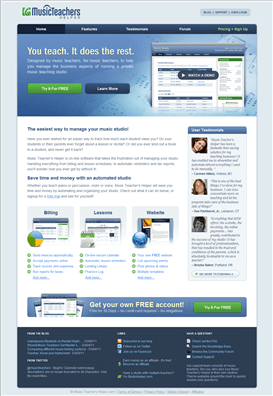
He says that after 5 years he is making $25k in sales per month with $10-12k in expenses per month[1] and no employees[2]. So that is a net profit of around $168k per year. That’s not too shabby, especially when you consider that he lives in Costa Rica and says he works just 5 hours per week. That’s nearly $650 per hour!
But he doesn’t say how many hours per week he worked to build the business. He also says in the case study:
With a complex web application, you can’t write it once and be done; you need to continue making enhancements and listen to user feedback in order to have a successful product.
I couldn’t see how this squared with working only 5 hours per week. Even if you are outsourcing everything you still need to manage the outsourcing, which can be time consuming in itself. I emailed him for some clarification and he was kind enough to give some more details:
It’s hard to give an average time worked over the past five years, since it’s changed so much. The first two years I was also working full-time as a programmer, but spent most of my free time working on the site – probably 10-20 hours per week. Once I quit my job (years 3-4) I worked probably 40 hours per week on the site. The past year or two, it varies from week to week. Some weeks I’ll only work 2 hours on it, some I’ll work more like 15, if I’m preparing for a new feature, special offer, or doing a big launch of some kind. But these days I’m averaging about 5 hours per week, and it’s been that way for well over a year.
Yes, I can definitely sustain and improve profit levels at this number of hours. The business is a well-oiled machine, and I have teams that are working to help continue to improve and grow the business in various ways, largely without my constant supervision. The business continues to grow every month, regardless of how much I work.
What do I spend these 5 hours doing? Mainly reviewing the new features or bug fixes the programmers have been working on, the requests from customers that the support team has submitted, and determining which items I want the programmers working on next. I also spend a little time handling some of the more difficult support or billing issues, paying my workers, managing a few PPC campaigns, answering e-mails, and checking stats. Recently, I’ve also been writing the scripts for some new video tutorials, and finding people to help produce the videos, too.
So, pretty much everything I do at this point could also be outsourced, allowing me to work even less, but at this point, I still enjoy this work, and it allows me to keep some important aspect of control on the business. Some day I may decide to work even less, but I’m pretty happy with 5 hours at the moment. :)
So, unsurprisingly, it took a lot more than 5 hours per week to reach this point. And only time will tell whether he can continue to maintain (let alone grow) this business with such minimal input. It will be an impressive achievement if he can. But I think Brandon is the exception rather than the rule. Perhaps he is particularly talented or lucky. Very few of the successful software business owners I know work short hours for extended periods. Also I have no way to verify Brandon’s numbers. So I would recommend viewing Brandon’s case study as something to aspire to, rather than a likely outcome.
Brandon has a blog and is writing a book about his experiences creating MusicTeachersHelper.com “in the hopes that it will help others who want to do something similar”. It should be an interesting read. Given all the spare time he has it shouldn’t take him long to finish it!
Further reading:
http://brandonpearce.com/2009/02/i-lived-a-4-hour-work-week/
http://brandonpearce.com/2009/04/how-i-spend-my-time/
[1] He mentions the expenses in the comments.
[2] He does use several contractors, some of whom work full time.
TestRail
 The guys at Gurock Software were kind enough to send me this testimonial after I did some consulting on TestRail, their web based test management software.
After launching our new test management software TestRail early last
year, we recently contacted Andy to help us increase the visibility of
our product. Based on customer feedback and reviews, we knew that many
software development teams prefer TestRail over legacy solutions that
are difficult to use. But we also knew that most teams weren’t aware of
our new product, so we wanted to improve this situation.

The first thing Andy did was to try and test the application as a normal
user would use it. While he walked through the application and briefly
tested its major features, he recorded a video of this experience and
narrated the video with comments and suggestions. Seeing how a
first-time user uses your application can be very useful and it
definitely showed us a few things that we could improve.

Learning more about the application was also important for the next
step: Andy interviewed us to learn more about our goals, marketing
methods and many other things. He then prepared a detailed and thorough
report with many suggestions, comments and recommendations. Implementing
all those suggestions will take time but we are already seeing first
positive results of the short-term improvements that we’ve implemented.

If you want to bring your product (or product marketing) to the next
level, Andy’s consulting service is highly recommended.
Dennis Gurock, http://www.gurock.com
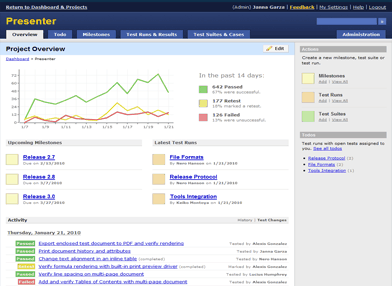
Although only launched last year, TestRail is already a polished product with an impressive customer list. If you have a suite of test cases you need to manage, I suggest you take a look.
After launching our new test management software TestRail early last year, we recently contacted Andy to help us increase the visibility of our product. Based on customer feedback and reviews, we knew that many software development teams prefer TestRail over legacy solutions that are difficult to use. But we also knew that most teams weren’t aware of our new product, so we wanted to improve this situation. The first thing Andy did was to try and test the application as a normal user would use it. While he walked through the application and briefly tested its major features, he recorded a video of this experience and narrated the video with comments and suggestions. Seeing how a first-time user uses your application can be very useful and it definitely showed us a few things that we could improve. Learning more about the application was also important for the next step: Andy interviewed us to learn more about our goals, marketing methods and many other things. He then prepared a detailed and thorough report with many suggestions, comments and recommendations. Implementing all those suggestions will take time but we are already seeing first positive results of the short-term improvements that we’ve implemented. If you want to bring your product (or product marketing) to the next level, Andy’s consulting service is highly recommended.
A small experiment with LinkedIn ads
 LinkedIn.com (the B2B equivalent of Facebook) supports Google style pay per click ads. So I decided to run some ads for my seating planner software as an experiment. Here is a brief summary of my (very brief) experiences.
The good news
LinkedIn ads can be laser targeted. You can specify who you want to see your ad based on their job function, company, gender, age group, country and (best of all) the LinkedIn groups they belong to. I targeted 10,102 LinkedIn members who live in wealthy English speaking countries, belong to various LinkedIn groups related to event planning and have appropriate job titles. The campaign was quite painless to set up. It probably took me less than 10 minutes in total and I started getting impressions within an hour or so.
The bad news
The minimum allowed CPC (cost per click) was $2. Ouch. I know from extensive experience with Google Adwords that there is no way I can get a return on that.
The minimum allow CPM (cost per thousand impressions) was $3. If the CTR (click through rate) is around 1% (about what you might expect from Google search ads) this is $0.30 per click. Possibly profitable. If the CTR is around 0.1% (about what you might expect from Facebook ads) this is $3 per click. No better than the CPC bidding. Given that LinkedIn is more similar to Facebook than Google search, I expected the latter. I decided to spend a few dollars to find out. The results are below (click to enlarge):
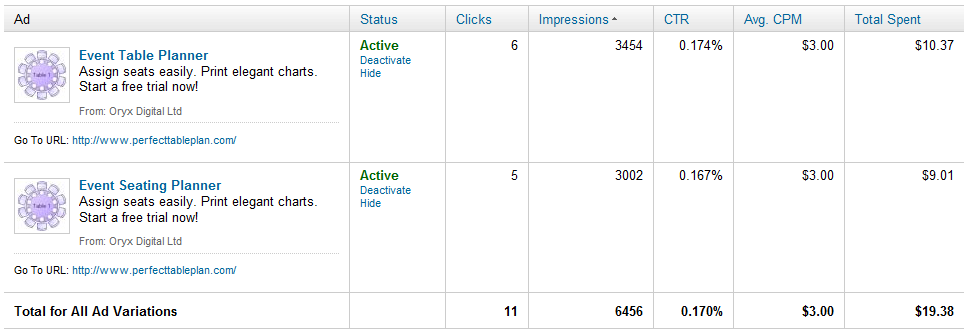
So, with an average 0.17% CTR, I ended up spending $1.76 per click. Given my average transaction value and a realistic conversion rate I know that I can’t make any return on this. Also the CTR is likely to drop the more often people see the ad. So I stopped the experiment after less than 24 hours, before I wasted any more time or money. As far as I can tell (based on my own cookie tracking – LinkedIn ads don’t have their own conversion tracking) I didn’t make any sales. But that is hardly surprising given the small number of clicks.
Summary
Obviously $19.38 is a tiny amount to spend, but I think it told me what I needed to know about LinkedIn ads. Unless they reduce their CPC or CPM bid prices by an order of magnitude there is no way I can make a return. Of course, if you are selling a product where the average lifetime value of a customer is hundreds or thousands of dollars, the numbers might work out quite differently for you.
Related posts:
Does the world *really* need yet another Twitter client, RSS reader, ToDo list or backup application?
 My heart sinks every time I hear a would-be-entrepreneur announcing they have written yet another Twitter client, RSS reader, ToDo list or backup application. Haven’t we got enough of those already? There are more than 1,900 Twitter apps already (possibly a lot more). Somebody probably released another one while I was writing this post. We have passed the Twitter app event horizon, where it is probably quicker to write your own custom app than it is to try and work out if any of the existing apps fulfils your requirements.
Even if you have done something radically new, interesting and different in one of these markets, how are you ever going to get noticed amongst thousands of more established competitors? Wouldn’t it be better to find a market that is currently under-served by software? It may be less fashionable than writing software for other techies, but it will probably contribute more to the sum of human happiness and be a lot more profitable.
There must be thousands of niches where there is a real need for software, but limited competition. You just need to open your eyes to the bigger world around you. It may mean having to learn about an unfamiliar domain. But it is generally much easier for a software developer to learn some domain knowledge about, say, butterfly collecting, than it is for the average butterfly collector to learn to create a software product. Next time you are talking to a non-techie about their job or hobbies, just ask them “Do you use software for that?” and “Is it any good?”. The ideal answers you are looking for are “Yes” (if there are existing software packages, there is probably a market) and “No” (maybe you can do better).
 Successful Software