Tag Archives: marketing

An interview with Terrell Miller of CattleMax

Software developers are usually so busy writing software for other techies, that they often forget there is a bigger world out there. Terrell Miller has a successful herd management software product for cattle ranchers. He generously agreed to share his experiences on what it has been like building a software business in a non-techie niche market.

Can you tell us a bit about CattleMax?

CattleMax is herd management software designed specifically for beef (meat) cattle, and helps ranchers keep track of their cattle records including births, purchases, sales, breeding history, measurements, lineage, and more. Having the records in one location enables producers to stay organized and helps them make better decisions – which in turn helps them be more efficient and profitable in their operation.

What was your background before CattleMax?

My wife Penny and I met at Texas A&M University while we were both in Undergraduate programs. My degree in Information Systems in the College of Business and family member’s involvement in cattle, along with Penny’s degree in Agricultural Leadership and years of showing cattle, proved to be a great compliment for us to start a business where we could work together.

How long have you been working on CattleMax?

I started working on the first version of CattleMax, which started out as a custom application for a local ranch, in July 1999 right after I graduated and have worked for Cattlesoft ever since. Penny worked at the local university on a full and then part time basis for 18 months before joining the business on a full-time basis.

What technologies and languages do you use to develop CattleMax?

CattleMax is developed in Microsoft Access 2007. Access has been a key ingredient to our desktop software’s success. A lot of developers don’t give Access the credit it deserves as a powerful and rapid development tool. We have done extensive customizations to our interface to differentiate from the Access default templates and many customers don’t realize we are even using Access.

If you were starting CattleMax from scratch today would you go for a web based solution? Or would you stick with a desktop solution?

That’s a hard choice to make right now in January 2011 because I think we are in a transitionary period.  Developers want to embrace the latest technology because it’s clearly the future. However, you don’t want to create a product that cannot be utilized by all of your customers (Internet in rural areas can still be spotty).  Though we are in the process of developing a web-based version of our CattleMax, I expect the desktop version to continue selling well for years to come.
While a desktop software offers a larger revenue up front to cover customer acquisition costs, a web app can potentially offer more revenue in the long run assuming you have good customer retention.  I think it’s easier to get started with a desktop app because you can use the up-front revenue to reinvest in marketing.
Why did you choose this market? How confident were you that it was a commercially viable market?

You could say the market chose us. Initially, we wanted to create a side project that involved both of our interests. Being students at Texas A&M helped open doors to talk with professors and experts about our product and ideas. Through these talks, we were introduced to a nearby ranch who needed an easy-to-use cattle record keeping system. They became our first customer and continue to use our software today.

How long did it take you you to get CattleMax to v1.0?

It took about 9 months to get CattleMax marketable and stable. Our first public release date was at a local trade show where we received great response. Being a student, we didn’t really have any income to replace – it was the ideal time for us to have started Cattlesoft and the software. We had little to lose and the rest of our life to recover from any business or financial mistakes made.

How technically proficient are your customers? Can you reach them with online marketing?

Our average customer is in the 45 – 65 age range. Over the years, cattle ranchers have become much more knowledgeable with technology. Our marketing is primarily online (PPC, SEO, direct website advertising) along with some print advertising.

The CattleMax user interface looks very slick and intuitive. Do you do any usability testing? Did you find the switch to a ribbon bar difficult for you or your customers?

In the beginning, I would go to a customer’s ranch and watch them use the software. By listening and watching how they interacted with the software, I was able to identify areas of confusion and see ways that we could make processes and areas easier to work with.

The ribbon was mandatory when we switched to Access 2007. While I was initially apprehensive about the change, I now see that the ribbon has made CattleMax easier to use, since it allows priority of certain menu items/common areas by giving them larger icons and visibility.

I see you have a Facebook widget on your home page. Have you found Facebook to be a useful marketing tool?

We use Facebook to post upcoming events, interesting articles and ask our customers for their feedback, plus it’s another way for customers to ask us questions. While advertising on Facebook allows for laser targeting based on interests, our in-house email list is larger than the number of ranchers on Facebook according to their PPC platform. Therefore most of our communications efforts are through our email newsletter and Cattle Management blog.

How did you choose the price of the product?

In the beginning, we chose prices that were comparable to other cattle software programs. We have two editions of our software, one for the commercial/beef producer and another for the purebred/seedstock producer. Each of these editions is available in a Small Herd (50 cow limit) and Standard (no record limit). We chose two editions so that it would be easy for a rancher to confidently choose the edition right for their herd. The two herd size options are so we can offer a solution to small herd producers while providing additional value for larger herds that may require additional support. See Camels and Rubber Duckies.

You have a generous 60-day money back guarantee. Do you have to give many refunds?

We may have one customer, at most, per year return the software because of dissatisfaction. We may have 5 returns a year from people who bought without downloading our trial and wanted a refund – a few of those reasons are receiving it as a gift and not wanting it, software not working on their computer (Windows 95 anyone?), or lacking a key feature. I highly recommend a satisfaction guarantee as it does help customers buy with confidence, knowing that you will stand by your product. No software company wants a dissatisfied customer who feels you “took their money.”

Do you charge for upgrades? Is this a significant source of income?

Our upgrades have been on about a 2-3 year schedule, and current customers can purchase them at half the price of the full version. While upgrade purchases are a double-digit percent of our business, we focus more on new sales. One of the challenges of making a good product is it takes an even better product for customers to understand the value in upgrading.

Do you outsource much work?

We work frequently with independent contractors and freelancers. While we’ve had 6 or more full and part-time employees over the years, I find employee management and “keeping people busy” to be too distracting from working on the big picture. Having people working from their own locations gives us more flexibility, plus we are not limited to just our physical location/city for finding experienced workers.

Do you have any products besides CattleMax?

We adapted CattleMax into LonghornMax, a software for Texas Longhorn cattle that enables breeders to record horn measurements in addition. LonghornMax primarily arose from our connections with the Texas Longhorn Breeders Association where we were previously their official software program. We also raise Texas Longhorn cattle on our ranch near College Station, which is about 90 miles west of Houston. Another spinoff is EquineMax, a software program for horse owners to keep track of their horse records.

Stepping beyond software in 2010, we launched CattleTags.com which is a website for purchasing cattle ear tags. In 2011 we launched LivestockSupplies.com which includes additional equipment and supplies for the ranch. Selling livestock supplies has proven to be a nice complement to our software as it helps us offer additional services and value to customers by offering them convenience and variety of selections, without them even needing to leave the ranch!

Would you recommend others to start a business straight out of college? Or should they work for other people first to gain experience?

The younger you are and the less commitments you have, the easier it is to get started, because your opportunity cost on your time is lower than it will ever be.  Also if your business fails, you have the rest of your life to recover.  I think entrepreneurs can have the best of both: starting their own business while gaining experience.  I’ve learned a lot through in-person networking as well as online communities like Business of Software, Hacker News, SEOBook.

Given that you started the business straight out of college, how did you learn all the business and marketing skills you needed? Did you make a lot of mistakes?

I learned much of my business & marketing skills through three sources: formal academic learning, informal discussions with other entrepreneurs and mentors, and of course personal experience.  Several years out of college, I realized that my business skills and not technology skills were holding me back, so I decided to return to school and pursue my Masters of Business Administration (MBA).
As far as mistakes, I asked one of my mentors about his biggest mistake and he replied “I’ve not made any mistakes, but I’ve bought a lot of expensive learning lessons”.  Many of my learning lessons have been as a result of losing focus and could have been avoided by asking myself “is this the highest priority and best use of my time?”.

Any advice you would like to give to aspiring software entrepreneurs?

I’ve visited with many software entrepreneurs over the years and frequently find an imbalance of priorities.  As programmers we tend to gravitate towards technology and automation.  However, once you’ve built a great product, often times the best return on your time and money is in marketing (blogs, PPC, SEO, print advertising, talking with customers).
Another bit of advice would be to embrace the lifestyle aspect of your business.  Owning your own business helps you be in control of when you work, where you work, how you work, and what you work on.  I consider it a good day when I can wake up in my house, walk down the hall to my office, work for a while, and then spend time outside on our ranch with my family.

Terrell and “Dude”, an 80 inch (200cm) tip-to-tip 2,000 pound (900kg) Texas Longhorn steer.

Advertising your software on Facebook (=Fail)

Facebook previously didn’t allow the advertising of downloadable software. Someone told me that they had relaxed this policy, so I checked their guidelines. Sure enough they have removed the offending line in their guidelines that used to say:

No ad is permitted to contain or link, whether directly or indirectly, to a site that contains software downloads, freeware, or shareware.

It says in their guidelines that downloadable software that does naughty things such as “sneaks onto a user’s system and performs activities hidden to the user” is not allowed, which is fair enough (see section 14 of their ad guidelines for the details).

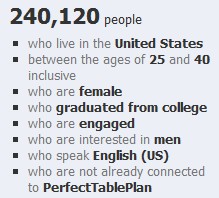
Woohoo! As part of my ongoing project to try every legitimate form of promotion known to man, I can try advertising my seating planner software to, for example:

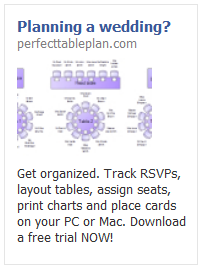
I ran 5 different ads over a couple of weeks. For example:

advertising software on facebookTrying to fit an attention grabbing and informative ad into the very limited strapline and image size was challenging. But I didn’t spend too long agonizing over the ‘creative’ (image and text), as this was just a feasibility study. The biggest problem was the minimum bid prices. Facebook was recommending I bid at least £0.40 per click. Given that the majority of my customers buy a single licence for £19.95 and typical conversion rates for clicks are around 1%, I would be likely to lose money if I bid £0.20 or more (especially when you consider ecommerce fees and support). I bid £0.10, but got no impressions at all. I bid £0.20 as an experiment and got a reasonable number of impressions. As soon as I dropped the bid to £0.15 the impressions slowed to a trickle.

Here are the stats from my experiments, as reported by Facebook:

Impressions: 357,366
Clicks: 310
Click through rate: 0.087%
Total cost: £46.60
Average cost per click: £0.15
Average cost per 1000 impressions: £0.13

Any of you who are used to Google Adwords might be surprised how low the CTR is. But apparently this is quite a reasonable CTR for Facebook. This isn’t too surprising when you consider that people are on Facebook to socialise, rather than to search for stuff.

Of course, the most important metric is the profit. So how many licences did I sell? According to my own cookie tracking: zero. Zilch, nada, nothing, not one. Cookie tracking isn’t 100% reliable, but it seems that a 1% conversion rate might be highly optimistic for a facebook ad. Advertising a £19.95 product on Facebook to people who might be planning to get married obviously wasn’t going to be profitable given my price point, the minimum bid prices and low conversion rate. So I created a new ad to try to target a more focussed demographic, who might convert better and perhaps buy one of the more expensive versions of my product. Ad number 6 was disallowed one minute after it had been approved.

Eh? This ad was very similar to the previous 5 approved ads and for the same product. Their email said:

The content advertised by this ad is restricted per section 5 of Facebook’s Advertising Guidelines. Restricted content includes, but is not limited to: 1. Downloadable products that may affect the user’s computer or browser performance in unexpected or undesirable ways; 2. Get rich quick and other money making opportunities that offer compensation for little or no investment, including “work from home” opportunities positioned as alternatives to part-time or full-time employment or promises of monetary gain with no strings attached. 3. “Free” offers that require users to complete several hidden steps or make additional purchases in order to receive the promised product. We reserve the right to determine what advertising we accept, and will not allow the creation of any further Facebook Ads of this type. Ads for this product, service or site should not be resubmitted.

I didn’t feel my ad/product violated any of those criteria. It was clear in the ad that only the trial was free (not the product) and it doesn’t do anything nasty or sneaky. I emailed them for clarification. Here is the response:

Hi Andy,

Thanks for your email. Please note that we don’t accept ads for downloadable products through our self-service advertising channel. We reserve the right to determine what advertising we accept, and will not allow the creation of any further Facebook Ads for this product.

In order to maintain legitimacy of the products and services promoted on Facebook, ads for downloadable or installable products are only permitted through a direct sales partnership with Facebook. At this time, we’re only able to provide this service to a small set of qualified advertisers.

We’re committed to providing high-quality support for all of our advertisers, and we’ll keep you and your business in mind for the future growth of our ads product. In the meantime, please continue to email us here with any questions you may have and we’ll be happy to answer them for you.

If you have any further questions about why your ad was disapproved for Restricted Content, please refer to our Help Center about downloads at:

http://www.facebook.com/help/?faq=18665

Thanks,

Gloria

Online Sales Operations

Facebook

So apparently, they still don’t accept advertising for downloadable software, unless you are an approved partner, because it ‘may affect the user’s computer’ (even if it doesn’t ). This wasn’t at all clear in their guidelines and they let me run 5 ads before they enforced it (these ads are still running BTW). Thanks Facebook, I like you less with every passing day (and I didn’t like you much to start with). At least I got enough data to show that I was unlikely to ever get a return on advertising a £20/$30 product. I also console myself with the fact that PerfectTablePlan is doing better financially than Facebook (after 7 years and with 500 million users Facebook are finally cash flow positive, but nowhere near recouping the estimated one billion dollars in venture capital) and my product will hopefully still be selling profitably after Facebook has  been buried by the ‘next great thing’ that comes along so regularly in the world of social media.

Selling your software in China

how to sell software in chinaI think a lot of people in the software business are wondering whether China will soon become a significant market for software and/or a source of competition in existing markets. So I was very interested to read a forum post about the realities of selling software in China from Felipe Albertao, an ex-Silicon Valley software engineer currently living in China. He kindly agreed to expand his forum post into an article for this blog.
Disclaimer: Although I live in China, I absolutely do not claim to be a China expert. I accepted Andy’s kind invitation because I have not seen anything at all written about the business of software in China for microISVs, and I humbly hope it will positively contribute to the discussion. This article is mainly based on my observations, and not on proven techniques. Use them at your own risk, and please report back your own findings!

Getting Paid

The first thing I need to say, right off the bat: Chinese users will not buy your software. Period. That does not mean that there is no money to be made, it simply means that they will not pay for your software license. The reasons are many, but for the sake of conciseness let’s suspend our “piracy is bad” mindset, and simply accept this fact as a reality. Think of the positive side: no payment processors or merchant accounts to worry about!

Chinese users will not buy your software, but Chinese companies might. Actually, let me clarify that: They will not buy the software license alone, but they are willing to pay for the license if it is part of a package that includes services (customization, installation, support, training, etc…). So, to get paid in China, you must offer services connected to your software. Of course, it would be very hard for westerners who do not speak the language nor have contacts in China to provide such services, but there are opportunities to partner with local independent professionals or small businesses in your target industry. More on that later.

Education is a huge business in China, especially for skills that give them a professional lead, like English language or IT. So, if you can somehow “plug-in” your software to an education-related service, that would also be another way to make money. For example, if you offer a component for ASP.NET, why not offer training on ASP.NET itself using your software? I am sure they will not pay for a self-paced course, but there is a good chance they will pay if you offer a hands-on remote live course. That is, a service rendered by a human, as there is no value perceived in the standalone immaterial software itself. Of course there is huge local competition, but one thing we have going for us is the fact that westerners enjoy a high degree of trust among Chinese people.

I suspect SAAS may be another way that Chinese users will pay for software (with a big question mark here). For example, today they do pay for services like site hosting, advertising and e-commerce presence, so we can assume there is at least a perceived value in subscription-based intangible products, though only the ones provided by well-known established companies, and not independent vendors. However, as the marketplace gets more fragmented and niche-oriented, I believe there will be opportunities for small players as well.

Web Site and Software Translation

Young Chinese people normally have a good grasp of written English, so I don’t think translation of the software itself is essential, although it always helps. IT professionals tend to be more English-proficient, as well as undergrad-level students. However, I do believe that the documentation must be translated, especially with IT-related software. Differently than western users, Chinese people actually have enough attention-span to thoroughly read a manual, and I have seen English-proficient programmers choosing frameworks and components based not only on the quality of the software itself, but whether the manual is in Mandarin Chinese or not (it’s always easier for them to read Chinese). So, translation here is not really a necessity, but a promotional strategy.

The “larger attention-span” assessment is also valid for the web site. We are used to the Web-2.0-ish recipe of a catchy one-liner plus 3 benefits and the big “Buy” orange button, and in China that probably works too, but users expect much more than that. I have observed that paid services almost always include some kind of workflow with arrows and circles and boxes explaining how the service works. Long explanations (not just a FAQ) are also quite common, and people actually read them! The fact is that here in China there is no such thing as “money back guarantee”, so people and companies normally think a lot before putting their hard-earned money into something. And forget the big “Buy” orange button: Instead, the call-to-action should be “Free Download” or “Free Sign Up”.

Sales

You are now probably asking yourself “Then where does the big ‘Buy’ orange button go?”, and the answer is: nowhere on your site! One fact you should be aware of is that here in China nothing happens without an established relationship (Google the keyword “guanxi” for more information). It is very unlikely that you will get any paid conversions originating from an ad or email. The goal of your conversion funnel should not be “sales” but instead “relationships”. Then, from the established relationship, the user can recommend your software to their boss, or whoever is the actual buyer. Of course the sales cycle is longer and it requires much more effort, but the rewards may be bigger too as you will be selling a package, and not only the license. Also, since guanxi is such an important part of making business, Chinese people are quite receptive when approached with a business proposition, differently than in the west where sales are normally met with resistance.

However, note that I have not suggested that you should be the one personally cultivating those relationships. Maybe it is possible to do it remotely and in English, but it would be more effective if you partner with locals and funnel the leads to them. They do not need to be sales professionals per se, but they need to know your software and be able to help prospects. They could be software students for example. Of course, at some point you must get involved, but your partner can help you to filter the good leads as they cultivate the relationship. The reward for them could be payment per hour or a percentage of the sale. Students might also be eager to help a foreign company, so they can add that experience to their resumes.

A word about consumer-oriented microISVs: I am extremely skeptical about independent microISV B2C sales in China, because I honestly cannot imagine an individual paying for independent software. That does not mean that microISV B2C cannot succeed in China. My point is that B2C sales are in fact B2B, because businesses who deal with consumers are more likely to pay. And B2B requires guanxi.

Approaching bloggers

As in the west, approaching bloggers is probably the most effective way to let users know about your product. You can use Google Translate to find sites and bloggers that you would like to contact: Google Translate does a good job in translating keywords (that you can use on searches on Baidu) as well as entire pages (so you can read the blog posts). For IT-related blogs, cnblogs.com (Microsoft-focused) and javaeye.com (you guessed correctly) are the most popular ones.

You can contact the bloggers directly in English, as most young Chinese people have a good grasp of written English. Foreigners in China are well-respected, especially in the IT industry, so this is a point in our favor.

Dealing with piracy

Actually “Dealing with piracy” is a misleading title, because in reality there is no way to deal with piracy. People will crack, copy and use your software as they wish, and they will not even feel guilty about it. Again, let’s not judge, but accept the fact that piracy is simply part of the culture (for some it is piracy, for others it is just sharing)

Instead of talking about code scramblers and licensing keys, let me offer here a contrarian (perhaps even controversial) point of view, in the wisdom of “if you can’t fight them, join them”. You should consider yourself lucky if your software gets pirated, because that means that it got traction. For every pirated software there is always a happy user behind it (after all, they chose to pirate your software, and not your competitor’s), and if this user convinces their employer to use your software, then there is a good chance that these companies will be your future clients.

SEM / SEO

By no means am I an SEO expert, let alone a China SEO expert. However, I can tell a little about the users’ search behaviors: Non-technical users very rarely use Google. In fact, my observation is that while Google is a somewhat known brand, people first turn to Baidu hands-down. Baidu has the best search results in Mandarin Chinese, and they have a service similar to AdWords (though you might need help to set-up an account, as the interface has not been translated to English)

Technical users have a different behavior: These are IT professionals and students, and because English is so pervasive in IT, they normally do have a good grasp of the language. So, for technical searches they might use both Mandarin and English keywords, but still Baidu is their first choice. However, interestingly enough, Gmail is also quite popular among Chinese techies. So, if you are selling IT-related software, your SEM/SEO strategy should include keywords in both Mandarin and English, and include both Baidu and Google (or more specifically, AdWords targeting Gmail).

Face

I cannot finish this article without mentioning such important part of the culture: Face. There is not enough space here to explain the concept (Google “mianzi” for more information), but it’s suffice to say that it’s basically the same as in the west (face as in reputation), except that in China face is much more important.

When it comes to software, always keep in mind that most (if not all) decisions are made based on face: Users will use your software to be more efficient in a certain job, and thus look better to the boss; or to show that they have knowledge that other colleagues don’t have; or to show to their clients what cool software they have, and not their competitor. The contrary (that is avoiding face lost) is also true: To finish a job quickly so they can deliver the project on time, and thus avoid getting the boss mad; or to learn a new skill that their colleagues already have; or to show their clients that they also have the same cool software their competitors use. In the west we also make decisions based on face, but in China it is so much more prevalent. Keep that in mind when creating your promotional material.

Conclusion

I have no doubts that China will become a major technology consumer in the very near future, not only because of the sheer size of its Internet user base (which today surpasses the size of the entire US population), but also due to the number of high-quality IT professionals graduating at their universities.

The key message I want to communicate is that your China strategy should be a long-term one. It takes time and effort, but the rewards are worthwhile. Even if you conclude that there are no opportunities to be pursued, at the very least you should have a strategy to protect your marketshare against competitors that decide to go to China.

You don’t necessarily need to be so enthusiastic like me and move to China (although I guarantee you would have an experience of a lifetime!), but at the same time you cannot simply ignore it. Chinese users will certainly knock on your door, and you can even ignore them, but your competitors won’t.

Felipe Albertao is a software engineer with more than 15 years of experience, and has been living in China since June 2009. He is a native from São Paulo, Brazil, and lived in Silicon Valley, USA for 8 years. Felipe blogs about software and China at shanzhaier.com.

Do customers need to see an advertisement seven times?

A few years ago, when I was buying magazine ad space  for my table planner software, I was told by an ad salesman that customers need to see an advertisement seven times before it is effective. How very convenient for his commission. I have heard variants of this “advertising rule of 7” quite a few times since, but I have never been able to find out where it originally comes from. I have now taken to asking people that quote it what evidence they have to back it up. So far no-one has been able to point me at a paper, study or any other form of credible evidence.

I have just searched google for see “ad seven times” and I found lots of mentions of the “advertising rule of 7”. Here are some of them that appeared high in the search results:

surveys prove people need to see the same ad seven times in order to buy

After all, they say, a person needs to be exposed to your ad seven times in order to create an impression.

The standard wisdom is that a consumer has to see a particular ad seven times before the message of the ad will even begin to sink in.

In fact, the Direct Marketing Association will tell you the average person needs to see an ad SEVEN TIMES before he responds to it.

Statics show that people see an ad seven times before responding.

The last statistic I saw pertaining to impressions stated that consumers must see your ad seven times before they really even notice it.

It’s estimated that potential members need to see an ad seven times before the marketing begins to register in their awareness.

This is not all bad since people generally need to see your ad seven times or more before they buy

A cardinal rule of advertising, known as “The Seven Times Factor,” says as a general rule, potential customers needs to see an ad seven times or more before they buy.

After all, research shows that, on average, you have to see an ad seven times before you even notice it.

In marketing, it is said that a customer has to see an ad seven times to remember it.

Marketers like to talk about “The Rule of Seven”: the idea that people need to see your marketing message seven times before they take action. Actually, research has shown that the number ranges from five to twelve, but seven is a good rule of thumb.

The Rule of Seven is an old marketing adage. It says that a prospect needs to see or hear your marketing message at least seven times before they take action and buy from you.

But again, no links, references or citations to back it up, even from the people that said it was based on “statistics”, “surveys” or “research”. What statistics/surveys/research? Is it based on some form of scientific study that can be reproduced, is it a rule of thumb that has been given more credit than it deserves or is  it total bullshit made up by a crafty ad salesman? I suspect the latter, but I would love to know. If you know the origin of  this “rule of 7”, please post a comment below.

** Update 09-Jun-10 **

I have had some useful feedback from this post, particular in the private ASP forums[1] (always a great resource). David Trump posted a link to this paper:

THE REPETITION/VARIATION HYPOTHESES CONCEPTUAL AND METHOLOGICAL ISSUES [Schumann & Clemons]

I used references and keywords in this paper to find 3 other relevant papers:

Beyond Effective Frequency: Evaluating Media Schedules Using Frequency Value Planning [Cannon & Leckenby]

The shape of the advertising response function [Simon & Arndt]

The Shape of Advertising Response Functions Revisited: A Model of Dynamic Probabilistic Thresholds [Vakratsas, Feinberg, Bass & Kalyanaram]

These papers talk about an ‘advertising response function’. This is a curve plotting the number of exposures to an ad against the customer likelihood of being influenced.  Some theorise that there is a threshold below which ads don’t have an effect, a saturation point above which exposures may have a negative effect and a sweet-spot in between. This ‘S’ shaped response function could provide some support for ‘you have to see an ad 7 times’, except support for the presence of a threshold effect seems to be weak to non-existent. Only one of the papers [Vakratsas, Feinberg, Bass & Kalyanaram] cited any evidence and that seemed less than convincing from my quick reading.

For effective frequency to be valid, advertising must be subject to a threshold effect, reflected in an S-shaped advertising response curve (Stankey 1989). But research suggests that, in actual advertising situations, response curves tend to be concave, characterized by Continually diminishing returns (Simon and Arndt 1980; Schultz and Block 1986; Zielske 1986). [Cannon and Leckenby]

In brief, then we are satisfied that the field experiments as a group show no solid evidence for increasing returns over operating ranges. … Taken together, the studies using physical and monetary variables add up to the conclusion that there are not increasing returns to advertising—that is, no S-shaped response function-over the normal operating range. [Simon & Arndt]

Futhermore, some of the papers mention a theory that a customer might have to see an ad 3 times, but none of them mention 7 times.

Krugman (1972; 1977) captured the imagination of the industry with his three-exposure theory, which described an intuitively appealing sequence of consumer responses to television advertising that appeared to be consistent with a communication threshold. He suggested that the first exposure causes consumers to ask, “What is it?” The second causes them to ask, “What of it?” The third exposure is both a reminder and the beginning of disengagement. … The magic number “three” came to be a commonly accepted industry standard (Lancaster, Kreshel and Harris 1986). [Cannon and Leckenby]

Al Harberg pointed out that those claiming a “7 times rule” might be confusing the ability to recall information (where 7 has been shown experimentally to be the “magic number” for short term memory) with the number of ad exposures taken to influence someone. Two completely different things.

So please shout “bullshit” very loudly next time you hear the “advertising rule of 7″ mentioned. Especially if it is by someone trying to sell you ad space.

[1]Private correspondence in the ASP forum referenced with permission.

** Update 13-Mar-19 **

Paul Moore writes:

“I read your blog post from a few years back, and thought you might find this of interest.  It’s a article passed around several newspapers at least as far back as 1859.   It showed up even in 1910.  Here’s the earliest iteration I was able to find on Google – the text is identical in several other American newspapers of the time.  I have no idea where it originated, but the theory has been around for a while.  I guess in modern times the number of impressions went from six to seven!”

A French editor gives the following amusing description of the effect of an advertisement: The first time a man sees an advertisement, he takes no notice of it; the second time he looks at the name; the third time he looks at the price; the fourth time he reads it; the fifth time he speaks of it to his wife; the sixth time he buys. [Weekly Constitutionalist (Augusta, Georgia) June 1, 1859]

New Software Marketing Facebook group

Alwin Hoogerdijk has created a ‘Software marketing’ Facebook discussion group. Personally I’m not a fan of Facebook, as will be obvious to anyone that checks out the howling void that is my Facebook account. But Alwin is a very smart online marketer, so I have tried to overcome my aversion to Facebook and joined the group. Just don’t expect me to care how you are doing at Farmville …

Interview for Shareware Radio

Mike Dulin has just uploaded an MP3 of an interview we did at SIC 2009 for Sharewareradio.com. In the 15 minutes we discuss marketing, how I got started with PerfectTablePlan, ads, the wedding industry, newsletters, the ASP, this blog and more. There are some problems with the recording levels, but hopefully that doesn’t detract too much.

Marketing for microISVS

Below are the video and slides of the “Marketing for microISVS – embracing the ‘dark side’?” talk I gave at ESWC 2009 in Berlin. This is a high-speed ramble through a vast subject. In the 45 minutes available I do my best to dispel some of the myths software developers have about marketing and discuss some marketing concepts, including: branding; positioning; pricing; and segmentation. Taking in Harley Davidsons, tinned tomatoes, Coca Cola and food blenders on the way. The first couple of minutes, where I dispel the myth that good software sells itself without marketing, are missing from the video due to a dead camera battery. But you knew that anyway, so I don’t think this detracts much overall.

Video:

Slides (which might not make much sense without the video):

NB/ When I said 47Signals, I meant 37Signals (brand inflation?). Thanks to Tarek for the correction.

Links to some of the things mentioned in the talk:

A big thank you to Alwin and Sytske of collectorz.com for hot-footing it from Alwin’s talk to do the video (you can see Alwin’s excellent talk on web app pros and cons here). And also to David and Panagiota for all the hard work that goes on behind the scenes organizing ESWC.

If you found this talk useful you might also like 10 mistakes microISVS make.

microISV reading list

I have added a microISV reading list page to this blog. Please feel free to add your own comments to the page on the books listed or any other books you feel are relevant.

Off to ESWC 2009

marketing for microisvsI will be off to ESWC 2009 in Berlin in a few days. I am doing a talk “Marketing for microISVs – embracing the dark side?” on the Saturday morning. It is going to be tough to tackle as huge a subject as marketing in 45 minutes including questions, but I like a challenge!

I am also looking forwarding to touching base with old acquaintances and meeting some new people. If you are going to there, do come and say hello.

Zed builds and bugs

zedI did some consulting for Zed builds and bugs a few months back and made some suggestions on how they could improve their marketing and product. In particular I focussed on their marketing message/positioning, website, Adwords campaign and set-up usability issues. They have now been kind enough to write-up their experiences working with me on their blog. Best of all, they have included some hard data on improvements since they implemented the recommendations:

Metric Change
Website Visitors 10% Increase
Trial Downloads 200% Increase
Google Organic Search Hits 320% Increase
Visitor Time Spent on Website 250% Increase

Obviously I can’t claim too much credit, as they did all the hard work. But it certainly looks like things are heading in the right direction and I think the changes to their website are a huge improvement.

Zed is an interesting product, integrating a continuous integration server with a bug tracker, wiki and forums, all behind a slick web interface. Obviously there are plenty of products that do these things individually, but Zed’s power comes from the integration of them all. For example, a build failure can automatically generate a bug report and bug fix can trigger an automatic build.

If you are interested in continuous integration and/or a more integrated approach to developer collaboration I recommend you try Zed. If you have less than 5 users you can take advantage of their free community edition.