
Category Archives: marketing

Google Adwords: improving your ads

google adwordsOne of the keys to success in Google Adwords (and other pay per click services) is to write good ad copy. This isn’t easy as the ads have a very restrictive format, reminiscent of a haiku:

  • 25 character title
  • 2×35 character description lines
  • 35 character display url

Whats more, there are all sorts of rules about punctuation, capitalisation, trademarks etc. You will soon find out about these when you write ads. Most transgressions are flagged immediately by Google algorithms, others are picked up within a few days by Google staff (what a fun job that must be).

Google determines the order in which ads appear in their results using a secret algorithm based on how much you bid, how frequently people click your ads and possibly other factors, such as how long people spend on your site after clicking. Nobody really knows apart from Google, and they aren’t saying. The higher your click frequency, generally the higher your ad will appear. The higher your ad appears in the results, generally the more clicks you will get. So writing relevant ads is very important. This means that each adgroup should have a tightly clustered group of keywords and the ads should be closely targeted to those keywords.

There is no point paying for clicks from people who aren’t interested in your product, so you need to clearly describe what you are offering in the few words available. For example you might want to have a title “anti-virus software” instead of “anti-virus products” to ensure you aren’t paying for useless clicks from people looking for anti-viral drugs (setting “drugs” as a negative keyword would also help here).

I have separate campaigns for separate geographic areas. Each campaign contains the same keywords in the same adgroups, but with potentially different bid prices and ads. This allows me to customise the bid prices and ads for the different geographic areas. For example I can quote the £ price in a UK ad and the $ price in a US ad. Having separate campaigns for separate geographic areas is a hassle, but it is manageable, especially using Google Adwords editor.

Writing landing pages specific to each adgroup can also help to increase your conversion rate. It is worth noting that the ad destination url doesn’t have to match the display url. For example you could have a destination url of “http://www.myapp.com/html/landingpage1.html?ad_id=123” and a display url of “www.myapp.com/freetrial”.

Obviously what makes for good ad copy varies hugely with your market. Here are some things to try:

  • a call to action (e.g. “try it now!”)
  • adding/removing the price
  • different capitalisation and punctuation
  • keyword insertion (much beloved of EBay)
  • changing the destination url

But, as always, the only way to find out what really works is testing. Google have made this pretty easy with support for conversion tracking and detailed reporting. I run at least 2 ads in each adgroup and usually more. Over time I continually kill-off under-performing ads and try new ones. Often the new ads will be created by slight variations on successful ads (e.g. changing punctuation or a word) or splicing two successful ads together (e.g. the title from one and the body from another). This evolutionary approach (familiar to anyone that has written a genetic algorithm) gradually increases the ‘fitness’ of the ads. But you need to decide how to measure this fitness. Often it is obvious that one ad is performing better than another. But sometimes it can be harder to make a judgment. If you have an ad with a 5% click-through rate (CTR) and 0.5% conversion rate is this better than an ad with a 1% click-through rate and a 2% conversion rate? One might think so ( 5*0.5 > 1*2 ) but this is not necessarily the case. I think the key measure of how good an ad is comes from how much it earns you for each impression your keywords get.

I measure the fitness by a simple metric ‘profit per thousand impressions’ (PPKI) where, for a given time period:

PPKI = ( ( V * N ) – C ) / ( I / 1000 )

V = value of a conversion (e.g. product sale price)

N = number of conversions (e.g. product sales) from the ad

C = total cost of clicks for the ad

I = impressions for the ad

Say your product sells for $30. Over a given period you have 2 ads in the same adgroup that each get 40k impressions and clicks cost  an average of $0.10 per click.

  • ad1 has a CTR of 5%, a conversion rate of 0.5% and gets 10 conversions, which gives PPKI=$2.5 per thousand impressions
  • ad2 has a CTR of 1%, a conversion ratio of 2% and gets 8 conversions, which gives PPKI=$5 per thousand impressions

So ad2 made, on average, twice the profit per impression despite the lower number of conversions. Given this data I would replace ad1 with a new ad. Either a completely new ad or a variant of ad2.

PPKI has the advantage of being quantitative and simple to calculate. You can just export your Google Adwords ‘Ad Performance’ reports to Excel and add a PPKI column. Some points to bear in mind:

  • Selling software isn’t free. You may want to subtract the cost of support, CD printing & postage, ecommerce fees, VAT etc from the sale price to give a more accurate figure for the conversion value.
  • PPKI doesn’t take account of the mysterious subtleties of Google’s ‘quality score’. For example an ad with low CTR and high conversion rate might conceivably have a good PPKI but a poor quality score. This could result in further decreases in CTR over time (as the average position of the ad drops) and rises in minimum bid prices for keywords.
  • PPKI is a simple metric I have dreamt up, I have no idea if anyone else uses it. But I believe it is a better metric than cost per conversion, or any of the other standard Google metrics.

To ensure that all your ads get shown evenly select ‘Rotate: Show ads more evenly’ in your Adwords campaign settings. If you leave it at the default ‘ Optimize: Show better-performing ads more often’ Google will choose which ads show most often. Given a choice between showing the ads that make you most money and the ads which make Google most money, which do you think Google will choose?

Text ads aren’t the only type of ads. Google also offer other types of ads, including image and video ads. I experimented with image ads a few years ago, but they got very few impressions and didn’t seem worth the effort at the time. I may experiment with video ads in the future.

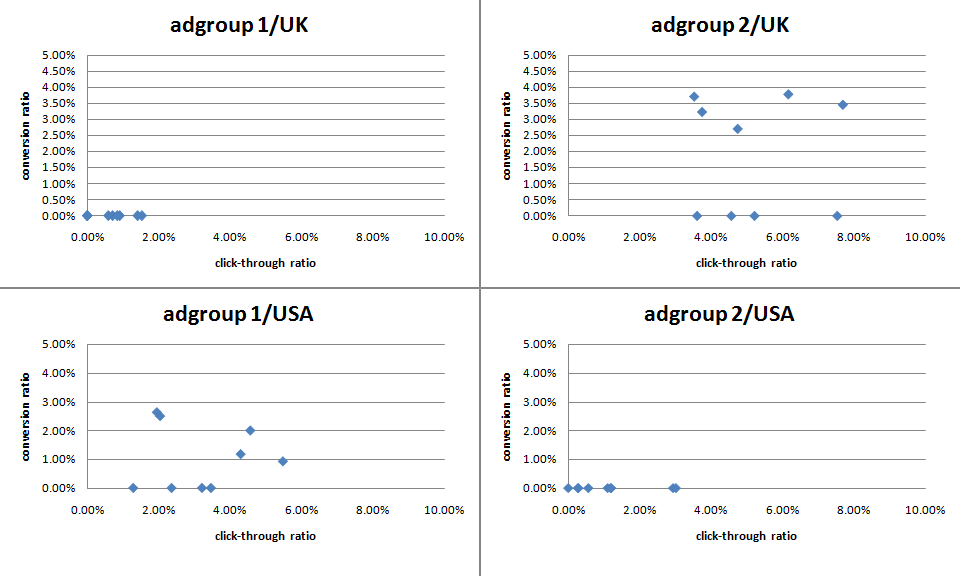
The effectiveness of ads can vary greatly. Back in mid-December I challenged some Business Of Software forum regulars to ‘pimp my adwords’ with a friendly competition to see who could write the best new ads for my own Google Adwords marketing. The intention was to inject some fresh ‘genes’ into my ad population while providing the participants with some useful feedback on what worked best. Although it is early days, the results have already proved interesting (click the image for an enlargement):
adwords ad results

The graph above shows the CTR v conversion ratio of 2 adgroups, each running in both USA and UK campaigns. Each blue point is an ad. The ads, keywords and bid prices for each ad group are very similar in each country (any prices in the ads reflect the local currency for the campaign). Points to note:

  • There were enough clicks for the CTR to be statistically significant, but not for the conversion rate (yet).
  • The CTRs vary considerably within the same campaign+adgroup. Often by factor of more than 3.
  • Adgroup 1 performs much better in the USA than in the UK. The opposite is true for adgroup 2.
  • Adgroup 1 for the USA shows an inverse correlation between CTR and conversion rate. I often find this is the case – more specific ads mean lower CTR but higher conversion rates and higher profits.

‘Pimp my adwords’ will continue for a few more months before I declare a winner. I will be reporting back on the results in more detail and announcing the winner in a future post. Stay tuned.

Beware upgradeware

fungi.jpgSome years back my wife bought a PC and got a ‘free’ inkjet printer with it. It was a really lousy printer, but hey, it was free. When it ran out of ink we tried to get a new inkjet cartridge, but the cheapest set of cartridges we could find was £80. That was 4 times the price of other comparable cartridges at the time. Some further research showed that you could buy the printer for £20 – with cartridges! Their ugly sales tactics didn’t work. We threw it in the dustbin and bought an Epson inkjet, which gave years of sterling service using third party sets of cartridges costing less than £10.

When I started my company I had a thousand decisions to make. One of them was which software to use to create and maintain my new product website. It just so happened that my new ISP (1and1.co.uk) was offering a bundle of ‘free software worth £x’ when you signed up (I forget the amount). It included a web design package (NetObjects Fusion 8 ) and an FTP package (WISE-FTP). Hoorah, free (as in beer) software and 2 less decisions to make. I was weak. Instead of spending time checking out reviews and evaluating competitors, I just installed and starting using them. It didn’t occur to me that they might be using the same sales tactics as the manufacturer of the lousy printer. In this imperfect world, if something appears too good to be true, it usually is. And so it was in this case. I grew to hate both these pieces of software.

WISE-FTP was just flaky. It kept crashing and displaying German error messages, despite the fact that I had installed the English version. No problem, I just uninstalled and installed FileZilla which is free (as in beer and speech), stable and does everything I need and more.

NetObjects Fusion was flaky and hard to use. By saving after every edit I could minimise the effects of the regular crashes and I assumed that I would learn how to work around other problems in time. But I never did. By the time I decided that the problems were more due to the shortcomings of NetObjects Fusion as a software package, rather than my (many) shortcomings as a web designer, it was a little late. I had already created an entire website, which was now stored in NetObjects Fusion’s proprietary database. Some of the bugs in NetObjects Fusion are so major that one wonders how much testing the developers did. My ‘favourite’ is the one where clicking a row in a table causes the editor to scroll to the top the table. This is infuriating when you are editing a large table (my HTML skills haven’t yet reached the 21st century).

In despair I eventually paid good money to upgrade to NetObjects Fusion 10. Surely it would be more stable and less buggy after two major version releases? Bzzzzt, wrong. The table scrolling bug is still there and it crashed 3 times this morning in 10 minutes. Also, every time I start it up the screen flashes and I get the ominous Vista warning message “The color scheme has been changed to Windows Vista Basic. A running program isn’t compatible with certain visual elements of Windows”. Even just trying to buy the software upgrade off their website was a confusing nightmare. The trouble is that it is always easier in the short-term to put up with NetObject Fusion’s many shortcomings than to create the whole site anew in another package.

For want of a better term I call this sort of software ‘upgradeware’ – commercial software that is given away free in the hope that you will buy upgrades. This is quite distinct from the ‘try before you buy’ model, where the the free version is crippled or time-limited, or freeware, for which there is no charge ever. Upgradeware is the software equivalent of giving away a printer in the hope that you will buy overpriced cartridges. Only it is less risky, as the cost of giving away the software is effectively zero. It seems to be a favoured approach for selling inferior products and it is particularly successful when there is some sort of lock-in. It certainly worked for NetObjects in my case.

Norton Anti-virus are the masters of upgradeware. Norton Anti-virus frequently comes pre-installed on new PCs with a free 1-year subscription. The path of least resistance is to pay for upgrades when your free subscription runs out. By doing these deals with PC vendors, Symantec sell vast amounts of subscriptions, despite the fact that Norton Anti-virus has been shown in test after test to be more bloated and less effective than many of its competitors. And if you think Norton Anti-virus doesn’t have any lock-in, just try uninstalling it and installing something else. It is almost impossible to get rid of fully. Last time I tried I ended up in a situation where it said I couldn’t uninstall it, because it wasn’t installed, and I couldn’t re-install, because it was still installed.

I feel slightly better now that I have had a rant about some of my least favourite software. But there is also a more general point – ‘free’ commercial software can end up being very expensive. Time is money and I hate to think how much time I have wasted struggling with upgradeware. So be very wary of upgradeware, especially if there is any sort of lock-in. When I purchased a new Vista PC, the first thing I did was to reinstall Vista to get rid of all the upgradeware that Dell had installed (Dell wouldn’t supply it to me without it). You could also draw the alternative conclusion that upgradeware might be a good approach for making money from lousy software. But hang your head in shame if you are even thinking about it. It would be better for everyone if you just created a product that was good for customers to pay for it up-front.

Ps/ If you fancy the job of converting www.perfecttableplan.com to beautiful sparkly clean XHTML/CSS and your rates are reasonable – feel free to contact me with a quote.

Creative marketing

will it blend?Although developers have traditionally avoided anything to do with marketing (aka ‘the dark side’) both development and marketing require originality, creativity and hard work to do well. Don’t believe me? Lets say you have to market a top of the range blender – how would you do it?

  • Like this? Factual, but hardly compelling.
  • Like this? Subliminal message: you could look like this or sleep with someone who looks like this, if you buy this blender. Yawn.
  • Like this? Genius. I want one.

Your code is sub-optimal!

source gear evil mastermind characterWhen I saw the new Source Gear ‘evil mastermind’ t-shirts, I had to have one for my nerd warddrobe. So I struck a Faustian bargain with Source Gear mastermind Eric Sink. The photo below is part of the bargain. Sorry about that.

Given that version control isn’t the most wildly exciting of topics (no offense intended) I think their comic book campaign is a very imaginative piece of marketing. I wish them every success with it. While I am plugging Source Gear I should mention that they offer a free one-developer licence for Vault. This could be very useful for microISVs out there looking for a source control tool. So far I am pretty happy with Subversion, apart from the ‘don’t come crying to me for help’ approach to merging branches.

I also recommend Eric’s blog and the resulting book as an excellent source of marketing information for techies. It helped me a lot.

Have I earnt my t-shirt yet Eric? This blog has also earned me one sale of PerfectTablePlan and a couple of dollars in referral fees from e-junkie. At this rate I will soon be able to retire from programming to blog full time. Watch out Scoble.

source gear evil mastermind

If you aren’t embarrassed by v1.0 you didn’t release it early enough

releasing v1.0I cringe every time I hear about someone who has spent years writing their ‘killer app’, but still hasn’t released it. My preferred approach is to get a solid, but minimally featured, v1.0 out there and then iterate like crazy based on real customer feedback. There are a number of arguments for and against releasing early:

Against: Feature poverty

A common reason for holding back on a release is “my competitor has features A and B, so I have to have A and B”. BZZZZT. Wrong. If you are trying to compete feature for feature with a competitor who is already in the market, you are at big disadvantage. By the time you have added A your competitor will have added B. Anyway, maybe some of your potential customers don’t want A or B. Perhaps they actually want something simpler. Or they really want C, which you can do in half the time of doing A and B. Microsoft has released a number of products that were derided at v1.0, but went on to dominate the market (Windows, for one).

Against: Reputation

If you release early, won’t you get a bad reputation? Only if you produce shoddy software that crashes all over the place. There is no excuse for that, even at version 1.0. The key is to pare down the features without sacrificing quality. Pick the smallest sub-set of features that will be useful. Then add more features at each subsequent release, based on user feedback.

The truth is, unless you are a big company with a lot of marketing muscle or you have picked a tiny niche, very few of your potential customers will ever hear about version 1.0 of your software anyway.

Against: Support overheads

As soon as you have customers you will have to spend considerable amounts of effort supporting them. The sooner you release the software the sooner you get this overhead.

Against: Release overheads

Creating a stable release is a lot of work, even if you manage to automate some of it. If you do more releases in a given period of time than your competitor you will inevitably spend a higher percentage of your time testing, proof reading and updating your website.

For: Feedback

Every product launch is a huge guess. If you have lots of competitors, you don’t know if you will be able to take customers from them. If you don’t have many competitors, you don’t know if there is a real market for your product. It is also tough to know what features people really want and how much they are prepared to pay. What people say and what they do are often quite different. Even if you manage to figure all that out, every market is constantly changing.

The only reliable way to find out if people will buy your product is to release it. As soon as you have paying customers they will let you know what you need to improve. Even emails from prospective buyers asking “does it do X?” can be very valuable. Many (perhaps most) successful products have ended up quite different to what the developers originally intended.

For: Motivation

Having customers is great for motivation. If you are working for a year or two on a project without customers to push you on, it is very easy to lose focus or run out of steam.

For: Failing faster

Despite the best efforts of all concerned many products fail. In fact I would guess that the majority of commercial products fail to recoup the initial investment. Yours could be one of them. If you are going to fail, you should fail as fast as you can so you can start over on something more profitable. The sooner you release and start asking people for money the sooner you will know if your product is a dog.

For: Cash-flow

The sooner you start selling, the quicker you start to recoup your investment. As a simple (contrived) illustration:

Company1 release v1.0 after 6 months. As they improve the product and website and word-of-mouth kicks in sales increase linearly for the next 18 months: 10 sales in month 1, 20 sales in month2, 30 sales in month 3 etc.

Company2 release v1.0 after 12 months. They have the same sales: 10 sales in month 1, 20 sales in month2, 30 sales in month 3 etc.

In 18 months Company1 will sell 1900 licence, whereas Company2 will sell only 910 licences. But surely Company2 will have a better product when the release it? Even if Company2 sales grow twice as fast (20 sales in month 1, 40 sales in month2, 60 sales in month 3 etc) they will still sell 80 less licences than Company1. Also I believe Company1 will probably have a better product than Company2 12 months or 24 months in because they have 6 months more feedback on what customers really want and will pay for.

Conclusion

It is well known that the sooner you catch a mistake in development, the cheaper it is to fix. I believe this is just as true in marketing. A sure way to find these marketing mistakes is to release. You wouldn’t write a thousand lines of code before you tried to compile it. Why would you spend a year or more on development before testing it in the market? Creating software should be an incremental process.

The best time to release is a trade-off between the various factors above. Obviously your software has to be able to solve a real problem, or no-one is going to buy it. This is going to take longer for an air traffic control system than a back-up utility. But I would always try to release v1.0 in less than 6 months of elapsed time if it is my money paying for the development (I don’t write air traffic control systems). Spending a year or more writing something with no real customer feedback is more risk than I am prepared to accept. If you think it isn’t possible to produce something useful in that time, then maybe you aren’t being creative or brutal enough with the feature set. As a rule of thumb, I would say that if you aren’t embarrassed by the lack of features in v1.0, then you didn’t release it early enough.

Interview

adriana iordan.jpgI was flattered to be asked to do an interview by Adriana Iordan of Avangate (pictured left). How could I refuse given that the previous 3 interviewees were Bob Walsh (author of “Micro-ISV: From Vision To Reality” [1]), David Boventer (founder of ESWC) and Eric Sink (top software blogger and almost legendary founder of SourceGear)? Adriana, if you could interview Joel Spolsky, Bill Gates and Steve Jobs next, that would be perfect. ;0)

The interview is here.

[1] This is Bob’s affiliate link. If you follow the link amazon.com are currently offering Bob’s book together with “Eric Sink on the Business of Software” for $36.28. They are both well worth a read for any budding software entrepreneur. The price is nearly double (pounds for dollars) if you buy them from amazon.co.uk. How can Amazon justify that sort of price difference?

Google Adwords ‘placement performance’ report

Google Adwords placement reportYou can now find out what sites your Google content ads are appearing on, using the new ‘placement performance’ report. This will alllow you to spot under-performing sites in a content campaign. To exclude a site from your campaign click the ‘excluded site(s)’ link at the top of the appropriate campaign page.

My placement report for June shows that PerfectTablePlan has had 25,309 impressions and 0 clickthroughs from myspace.com. Does that make it officially the least cool software ever? ;0)

Google playing fast and loose with broad match?

do_no_evil.gifIf you use Google Adwords you will want to read this article by Dave Collins. If correct (and I have no reason to believe otherwise) it is pretty outrageous. Not content to force up the price of bids artificially by invalidating keywords they are now apparently showing your ads for broad matches you didn’t bid on, i.e. extremely broad matches. This could in turn lead to a lower CTR and more invalid keywords.

Better start examining those logs and polishing those negative keywords…

The importance of targeted website traffic

Anyone who has a website can’t help but care how many people visit it. It’s great for our vanity to know that someone else is seeing our creation. Also, if you are running a business, more hits equals more sales doesn’t it? Well, not necessarily.

Take as many hits as you like and multiply it by a 0% chance of purchasing and you still end up with no sales. What matters is not just the number of visitors, but also the quality. Visitors that have a high likelihood of buying your software are said to be ‘targeted’. What you need is targeted traffic (preferably lots of it).

Targeted traffic is particularly important when you are paying per visitor e.g. using pay per click schemes such as Google Adwords. If you are paying $0.40 per click and your software retails at $40 you need more than a 1% conversion rate or you will just be donating to Larry and Sergey’s 767 fund.

I can illustrate the importance of targeted traffic with three examples from my own table plan software website.

1. Earlier this year I agreed for PerfectTablePlan[1] to be used as part of the demonstration of D-Wave’s prototype quantum computer in return for some free publicity. The controversial demonstration got huge publicity in the IT and high-tech communities. Sadly PerfectTablePlan didn’t get a mention in the press release as I was expecting, but it did get a mention in the D-Wave founder’s blog.

  • Click throughs from D-Wave founder’s blog: 566
  • Sales: 0
  • Conversion rate: 0%

2. I hang out on the JoelOnSoftware Business of Software forum quite a bit (especially when there are boring jobs I should really be doing). People often click through to the PerfectTablePlan website from my signature.

  • Click throughs from Business of Software forum: 4,757
  • Sales: 1
  • Conversion rate: 0.02%

3. PerfectTablePlan is built using the Qt framework by Trolltech and gets a mention on their cool apps page.

  • Click throughs from Trolltech coolapps page: 1,922
  • Sales: 2
  • Conversion rate: 0.1%

The data above is based on web stats and using cookies to track the initial referrer of sales. I don’t pretend it is hugely accurate, for example it doesn’t take account of someone clicking through to my site and then emailing the URL to a friend who then buys the software. But it is accurate enough for current purposes.

Adding all 3 examples together the conversion rate averages 0.04%, or about £0.01 revenue per click. So I would have lost a lot of money if I was paying for these clicks through Adwords. What these 3 examples have in common is that they were untargeted. The people clicking through to my site were primarily interested in quantum computing, selling software or creating cross-platform software, not creating table plans.

From better targetted traffic (e.g. people searching for “table plans” on Google) I do much better, with a conversion rate typically in the range 1% to 10%, depending on how well targeted it is. That is 25 to 250 times better than the less targeted traffic.

So, next time you are boasting about the number of hits on your site (or bemoaning the lack) remember that hit counts is a flawed metric. Like LOC (lines of code) it is easy to measure, but not terribly meaningful. You need quality as well as quantity.

[1] Actually an adapted version interfacing with their D-Wave quantum solver, rather than using PerfectTablePlan’s own genetic algorithm.