Category Archives: software

A Few Good Links – Why you need them and how to get them

link buildingIn this guest post Christoph Engelhardt talks about why link building is an important part of online marketing and the most effective ways to do it.

When you are promoting your product online, there is a myriad of different ways to do it: Display Ads, Google Adwords, Facebook Ads, Social Media, Email Marketing, Online PR, and SEO – to just name a few.

Deciding on the right method for your business can be tricky. They are all so different. Some of those methods can be turned on and off like a faucet; others are more like a flywheel that need a lot of pushing to get going, but will keep delivering results after you’ve stopped.

Hopefully you’re in it for the long haul, so I’m going to talk about a strategy that is more of a flywheel: link building. Building links on the internet is a long-term strategy that factors into multiple traction channels.

Inside this article you will learn:

  • How to supercharge your PR, SEO, and Content Marketing with outreach marketing.
  • How you can get more links to your website without angering the Google gods.
  • At least 3 different ways to find high-quality outreach and link building opportunities.
  • The secret to drafting the perfect outreach email.

I’ve been in online business for more than a decade now. I’ve been struggling with moonlighting multiple products to profitability, online marketing and SEO long enough to call myself “somewhat of an expert” on those topics. ;-)

I want to share with you what I have learned in those years to help you avoid making the same mistakes I made.

Let’s get started.

SEO and link building in particular are often seen as scammy online marketing tactics and I won’t deny that there is some merit to that argument. SEO for the first 10 years has been a lot like the Wild West – minus the random killings. There was no one to effectively enforce the “law of the land” and spammers thrived.

Yes, you could cheat your way to the top of Google’s search results in the past. BUT, it is getting harder and harder with every passing day. Getting to #1 on Google today means you have to “dot the i’s and cross the t’s” in technical SEO (more on what this is later) and get some buzz going for your product – i.e. build some links.

“Link building” as a term is loathed by white-hat SEOs, as it implies spamming comment sections on random blogs and free web directories. They would much rather talk about “earning links” through “Content Marketing” and “Social Amplification”. That’s fine by me, but make no mistake: Having a rich and diverse link profile for your website is still THE major ranking factor for Google’s search results.

Spreading your links around the world wide web isn’t a problem per se. Links are what make the world wide web a WEB in the first place. But the way you do it makes all the difference: If you’re leaving useless comments on unrelated blogs, you’ll do more harm than good. If you get your product reviewed (without paying for it) on a major website where your target audience hangs out, the value gained can hardly be put into words.

Fundamentally, whenever you do any sort of online marketing you are building links. Sharing your content on social media? You’re sharing a link back to your content, because you want people to click that link. Buying Adwords? You’re buying links right on Google’s website. Sharing your news release in a PR campaign? You’re spreading your links.

This means that, if you have a website, you’ve probably started building links without thinking too much about it. All you need to do is be more intentional and active in your efforts.

Why you should include outreach marketing in your marketing mix

Building links helps you in two distinct ways: a) you’re getting referral traffic directly via the links you get, b) the links you get improve your rankings in the search engines, bringing you additional organic SEO traffic.

In the long term, the SEO benefits will often have a greater effect on your traffic than the referral traffic you receive through the links. This is because a great link profile will lift your website to the top of Google across 100’s or 1000’s of keywords (all other things being equal)! That is why link building is related to SEO in most people’s minds. Traditionally it was done almost exclusively to get that sweet #1 spot on Google.

However, you should not neglect the sheer amount of traffic you can get from a well-placed link. Depending on where you get that link from (and we will talk about this in a minute) a single link can send you 1000’s of visitors.

In fact, I advise everyone to completely neglect the SEO benefits when they think about where to get a link from. When you try to get a link from another website, here are the questions you should ask yourself:

  • Is this a trusted website in your niche?
  • Does that website have a big enough audience to send you meaningful traffic?
  • Is that website’s audience interested in your product at all?

You don’t want to get a link from a website outside your niche – especially not from a 3P-website (porn, poker, pay-day loans), no matter how good their SEO metrics are. Similarly, getting a link from Joan Doe’s blog that has two readers (her mom and her dog). Finally, you shouldn’t chase after getting featured on TechCrunch, even if they are a big ass website and you’re doing something in tech, because their readers are most likely not interested in what you have to offer. They are killing their time with their butts firmly planted in an office chair and are not looking to buy stuff.

See how I don’t even mention SEO in there? Focus on getting your links in front of your target audience. If you focus your outreach marketing on having a direct ROI from the referral traffic you get, you will be taking good care of the SEO-side of things automatically.

Calculating the ROI of outreach marketing

I hope that I have convinced you by now that outreach marketing is not a scam and you can do it without causing harm to your website or your brand (assuming you do it right).

But before you rush off to get your outreach marketing going, we need to talk ROI. You’d be ill-advised jumping into anything without at least computing the possible ROI before you do it. After all, you might have other (more valuable) options to spend what limited time you have.

First you need to know how much you’re going to invest into getting one link. Say you’re investing two hours to write a guest post and an additional half-hour for outreach and administrative work related to getting that link and you value your time at $50 per hour. This means you’re investing (roughly) $125 into getting this single link.

This number obviously depends on the website we’re talking about: Some websites like directories or profile pages won’t take you more than 10 minutes to get a link from (and links from them are worth less to you), while getting featured on a popular website in your niche might costs you an arm and a leg (but it might be worth it).

Now we know the costs, but how do we calculate (well… guesstimate) the value of one link?

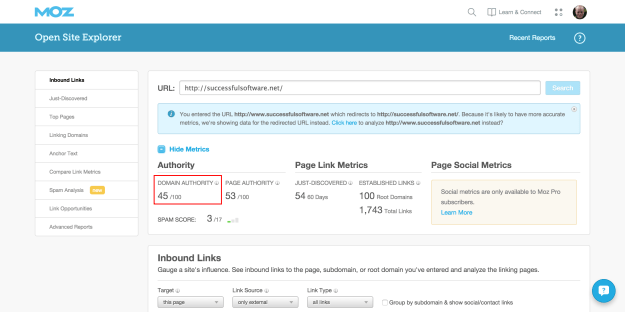
There are two ways you can do so, let’s explore them – assuming we want to get a link from this blog: www.successfulsoftware.net .

  1. Go to www.opensiteexplorer.org
  2. Enter the URL of the website you’re trying to get a link from into the box (i.e. www.successfulsoftware.net) and hit RETURN.
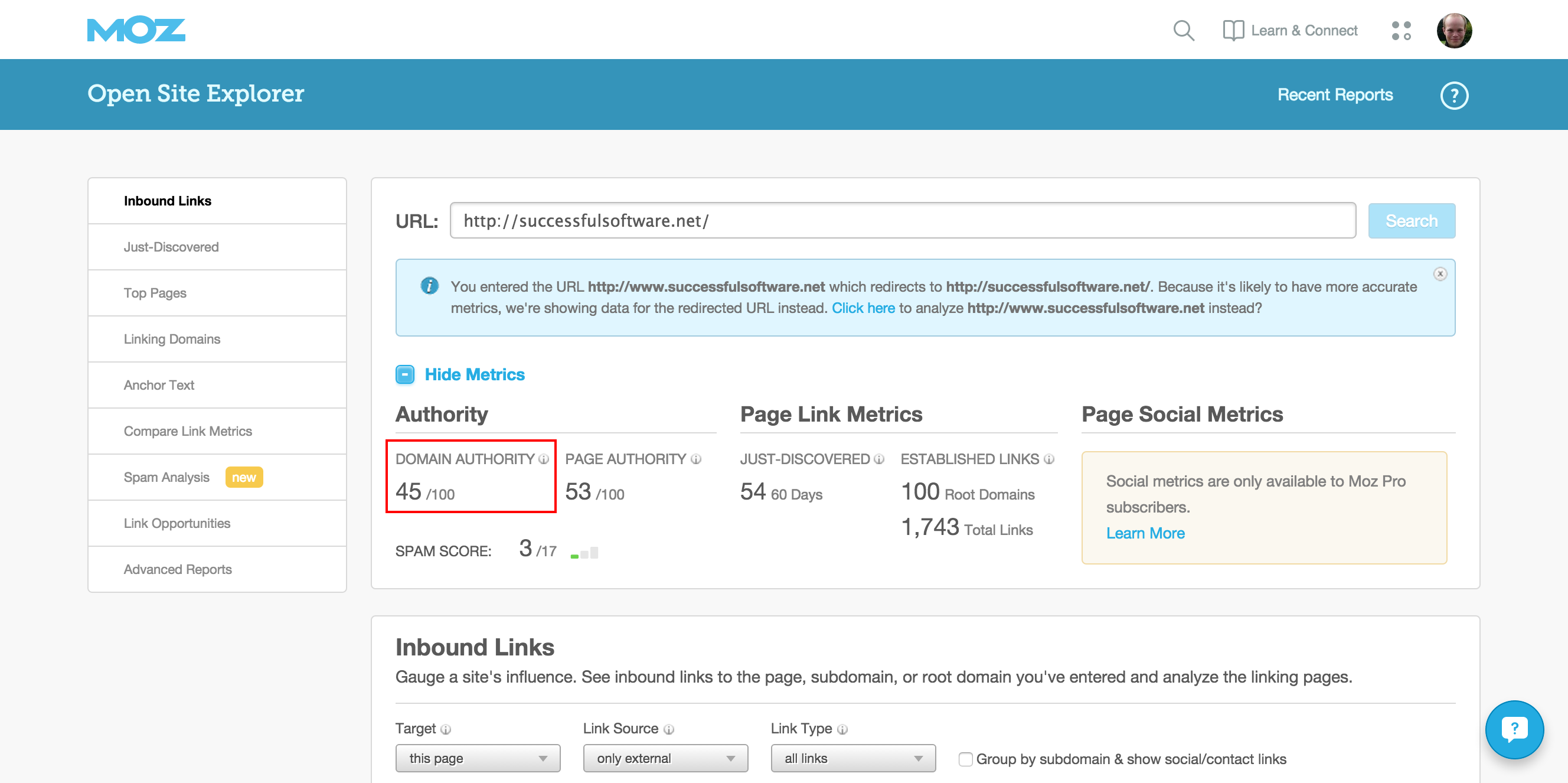
  3. Search for the “Domain Authority” value (45).
  4. Multiply that value by $2.5 (Read my full research here).

03_checking-da-with-opensiteexplorer

03a_highlighted-domain-authority-in-opensiteexplorer

This gives you a rough guesstimate of the dollar value of any link on the web – in the case of Andy’s website that’s roughly $110. It’s a great rule of thumb for small and medium sized websites. The problem with this method is, that Domain Authority is capped at 100 – so no link can be worth more than $250 with this method. But clearly, getting featured on the White house website or Google’s blog will have a slightly (!) higher value than that.

The second approach is more complicated, but it takes into account the specifics of your business. We are going to work our way backwards from the sale for this one.

  1. We need your customer lifetime value (LTV – say $200) and your conversion rate from visitor to sale (CR – say 1%)
  2. Multiplying LTV * CR we get the average value per visitor (VPV – that’s 0.01 * $200 = $2) for your business
  3. Dividing the cost for the link by the value per visitor (cost / VPV) we get: $125 / $2 = 62.5

This tells you, that you need to get at least 63 visitors from the link to break even on your time investment. That isn’t too big a number and it can be even lower, if you have a higher LTV or when you get the link in front of just the right audience (which will increase the conversion rate for that cohort).

The only question that remains – and that I sadly can’t answer for you – is this: Will you get 63 people to click on that link on that website? If you can answer this question with a “Yes”, I think you should chase that link down.

Lastly, remember that we don’t take SEO into account here at all. It is hard to measure the effect of a single link, so consider it gravy on top.

Now that we’ve covered the fundamentals, it is time to talk a bit more in-depth about where to get links from and which websites you should definitely avoid.

As mentioned before, you don’t want to get any links from websites in dubious niches like poker, porn and payday loans. These are not good company for a respectable website. You also don’t want to have too many incoming links from the 1000’s of free web directories (startup directories anyone?) out there as it may harm your standing with the SEO gods. Having a few (high-quality, say ProductHunt) directories link to you isn’t a problem, but having 100’s or 1000’s certainly is.

The same goes for comment spamming random blogs around the internet, creating dozens of free blogs on WordPress.com or Tumblr, and poorly written, mass-produced guest posts all across the web. Just don’t. That’s not to say that blog comments or guest posts don’t have value. You just need to do it right. If it can be automated (or outsourced for $0.50/hour to developing countries), you’re doing it wrong. The rule of thumb is to get links that take significant work to acquire. This will keep you in good standing with the SEO gods.

The way to go about link building/link earning/outreach marketing today is to find suitable websites, find a contact there, develop a relationship and eventually you will get a link from it. Case in point: Andy and I go back well over a year. We’ve been to conferences, chatted a lot, he gave me advice on discuss.bootstrapped.fm, we even had lunch together when I visited his home town. NB: I wasn’t after getting a link from Andy – in this case it just happened – but building a relationship always comes before building a link. [Editor’s note: I approached Christoph to write an article for this blog]

Here are some ideas where you can get your links placed:

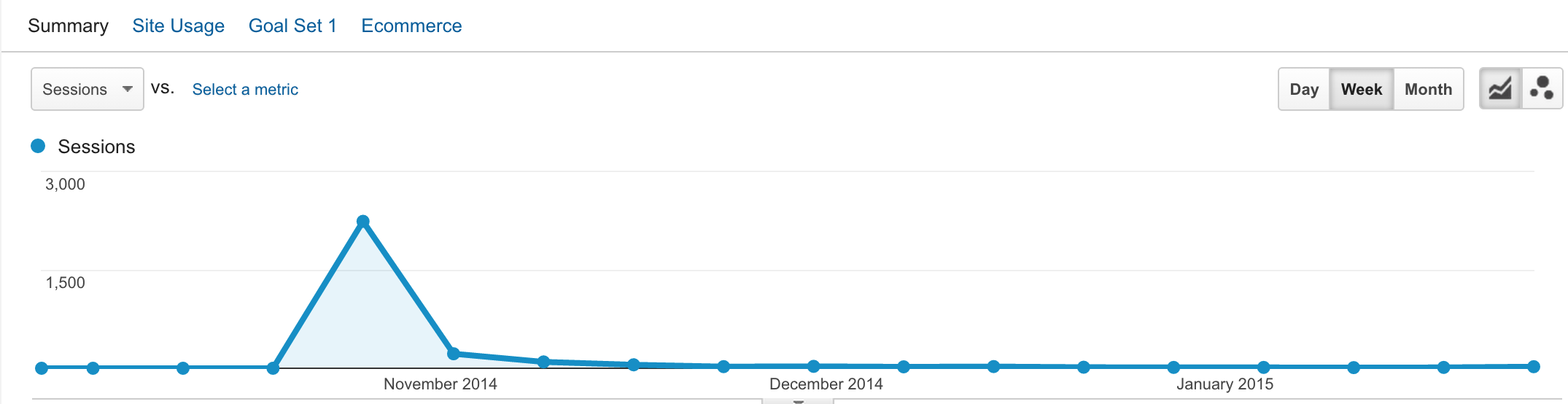
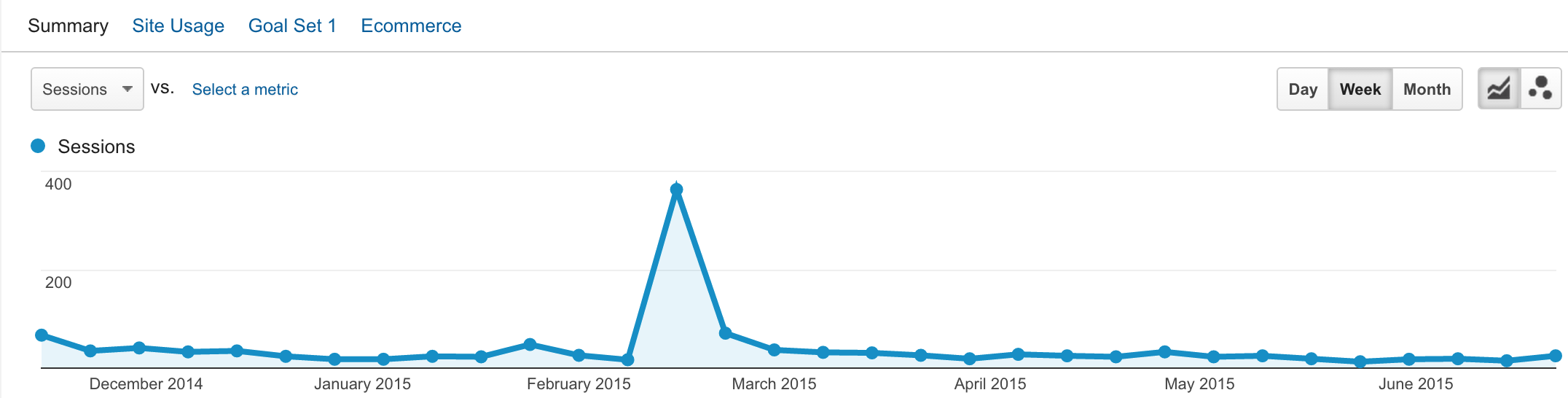
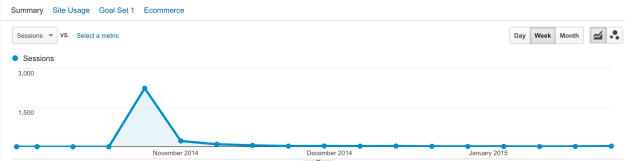
Website content (blog posts, news articles, etc) usually results in a spike of traffic and then it slows down to a crawl. Lists and partner directories on the other hand will give you a more constant flow of traffic.

Just look at these two images below: One is from LinksSpy getting published on ProductHunt – and the other is the traffic from when someone included LinksSpy on their ProductHunt list (with a small spike in the middle when that list was itself mentioned on a newsletter).
01_traffic-spike-producthunt

02_constant-flow-producthunt

Finding Outreach Opportunities

But how does one find these websites? I’m quite sure you could name a few websites in your niche off the top of your head, but that will ultimately give you maybe one or two links – which won’t turn you into an overnight success. You need more; you want more.

Option A is to just Google for it. Use terms like “best $PRODUCT_NICHE in 2015” or “$NICHE blog”. If you want to get really smart(-y) you can use one of the tips from Ann Smarty and search for “blog for us $PRODUCT_NICHE”. You can also use blog directories like AllTop and look for opportunities there. Here’s a quick link you can use: Google search for blogging opportunities (Replace “NICHE” with your own niche after the page loads)

Option B is to use MyBlogU, where people are constantly searching for industry experts to do interview round-ups. Just search through the list and see if you can make a meaningful contribution to any of the interviews. You’ll usually get a nice mention in the process. (Bonus for content marketers: You can post your own interview questions and convert the answers into a blog post with built-in content promotion – all the experts will want to share it)

Option C is a bit more involved. Using OpenSiteExplorer and the URLs of your competitors you can find the places where they get their links from. Knowing where they got their links from allows you to contact the very same websites and get the same links.

This list isn’t complete – there are way more ways to find outreach opportunities. But these three will allow you to find the first few, get your feet wet and experience the success that comes with building links. You can always go deeper later on.

Options A and B are pretty much straight-forward, but you’re likely wondering by now “why would I want to get the same links my competitors already have?”

Well, there’s a reason your competitors are ranking ahead of you in Google’s search results. Aside from them nailing technical/on-site SEO (Read my blog post on bare minimum SEO for designers where I describe the basics), they have more and better links than you have. A little spying on your competition to see what works can’t hurt.

Secondly, getting links from the same websites as your competition will (theoretically) put you on par with them. In reality you won’t be able to replicate the link profile of another website and you wouldn’t want to either, as they might have a bunch of dodgy links. What you can do is combine the best links from a number of competitors, effectively giving you a better link profile than any of your competitors.

When I say “competitor” I use that term loosely. It can be either an actual competitor, another website that ranks ahead of you in the search results, a website in your industry or any number of things. You can use all of them to find valuable link opportunities.

How to Find Websites Linking to your Competition

There is a number of websites that show you the backlink profile of any given website. There is Moz’s OpenSiteExplorer (Which I have mentioned above), then there is MajesticSEO, OpenLinkProfiler, and Ahrefs. They all give you information which websites link to the website (your competitor’s website) under scrutiny, but with varying levels of detail. I generally found Ahrefs to be most accurate, but OpenLinkProfiler and Moz are free(-mium), so we will just use those for now.

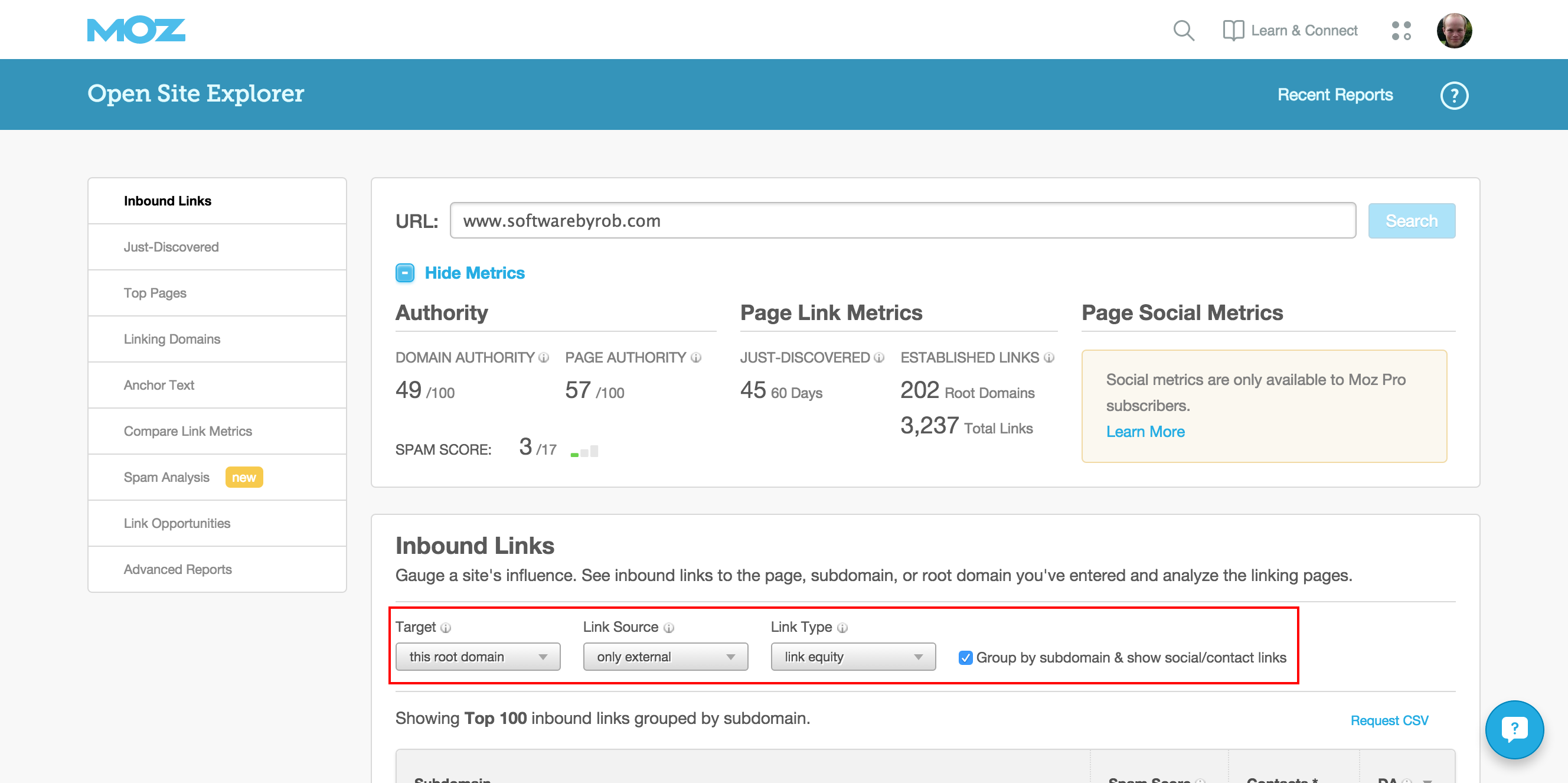
Here are the steps you need to take in OpenSiteExplorer to get the valuable links for your competitors:

  1. Open OpenSiteExplorer in your browser
  2. Enter your competitor URL in the form field. e.g.: “www.softwarebyrob.com
  3. Set the following parameters:
    • Target: this root domain
    • Link Source: only external
    • Link Type: link equity
    • select “Group by subdomain & show social/contact links”
  4. This will give you the following search results

04_competitive-analysis-settings-for-opensiteexplorerThis list groups the incoming, external links by the domain they originate from. Additionally links that do not pass SEO juice are filtered out.

Looking through this list you will find some interesting websites you can ask for links. You can also see where the links were published (e.g. blog posts, partner lists). Repeat the process for as many competitors as you like.

When you examine multiple competitors make a special note for each website that links to more than one competitor. For example rachelandrew.co.uk links to the following “competitors” for Andy’s website:

These websites (the ones that link to many competitors) are often a good selection for your first batch of outreach targets. They have given links freely in the past and they have talked about your competition, which suggests they will be open to a cooperation with you. Incidentally, LinksSpy was built to find these websites.

Caveat: You still need to apply sound judgement whether you want a link from a given website or not. Some websites might be ‘dodgy’ and you would risk getting slapped by Google if you get a link from them. Or maybe they are really great websites and you would love to get a link from them, but you know that you won’t get a link from the New York Times a week after launching with six active users.

Putting the “Outreach” into “Outreach Marketing”

By now you should have a list of at least a hundred outreach targets. There are two more steps remaining on your way to making millions of dollars, getting world-famous, and saving the planet. That’s your plan – right?

As a first step you need to find contact details (i.e. the email address) of an author on that website. A few ways to find the right email address:

  • Look around for a “Contact Us” page.
  • Check if the author’s name is a link (if so check that page for his email address).
  • Check the author’s social media profiles.
  • Try to guess the right email address (e.g. firstname@mydomain.com will often work – Rapportive works great for this!).

If all else fails, you can always try your luck with “contact@mydomain.com” or “support@mydomain.com“.

Drafting the Perfect Outreach Email

Lastly, you (just) need to send the actual outreach email. If you’re cold emailing someone, it is best to not ask for favours/links right in the first email. What I recommend instead is to ask for their expert’s opinion on an article you have written. Everyone likes to be seen as an expert and to be asked for their opinion – as long as the topic interests them. Five out of ten times they will – at least – share your article. At this point you’ll be off to a good start: You’ve already got some value (social media mention!) and started to built a relationship that might end in a link for you.

So here are a few tips on how to write a great first outreach email:

  • Include the person’s name in the salutation (“Hi Andy” beats the hell out of “Hi/Hi there/Hiya!”).
  • Keep it short.
  • Do some research. It is really annoying to get emails from people who obviously haven’t bothered to find out what your blog/website is about and who the audience is.
  • Find something you genuinely appreciate about them/their work and mention it.
  • Be sincere. Don’t write something if you don’t mean it.
  • Don’t ask for a link. Repeat: DO NOT ASK FOR A LINK.
  • Keep. It. Short.

Motivational tip: When doing outreach marketing, always set your goal as “send X emails per day”. Don’t focus on “get X positive replies per day” as this is demotivating. “Send X emails per day” makes every email sent a small success, whereas with “get X positive replies” every email sent (without a reply) is a small defeat.

Get started with Outreach Marketing now

Wow. That certainly was a LOT to swallow. So here’s a short recap for you:

  1. Link building/outreach marketing is a long-term strategy that boosts your SEO and PR efforts.
  2. You can do it in an ethical way without spamming blogs/people.
  3. Searching for “$NICHE write for us” on Google and competitive link analysis as described above are excellent ways to find outreach opportunities.
  4. Drafting a good outreach email involves research and the email should be focused around the person you’re contacting.
  5. The immediate goal of outreach marketing is not to get a link, it is to build a relationship. Links and social shares will follow.

You’ve got all the information you need:

  • You have a big list of outreach opportunities now.
  • You have the contact details for each opportunity.
  • You know how to craft an outreach email.

All that is left now, is for you to go out and hit those contacts. Build relationships and you’ll get links.

Christoph Engelhardt is the founder of LinksSpy.com – a SaaS application built to help SEO and PR agencies dig up the most valuable outreach opportunities for their clients’ websites.


It’s great to be in the software products business

hard at work on my software businessThose of us who own software product businesses sometimes grumble about what a difficult business it is. Although its indoor work with no heavy lifting, it has it’s frustrations: software piracy, customers who moan about paying a whole $0.99 for thousands of hours of work, buggy third party software, RSI, chargebacks and the catastrophic consequence of accidentally offending the great god Google, to name but a few.


But reading Kitchen Confidential brought home to me just what a hard business it is to run a restaurant. You have to make a major financial outlay to fit out the restaurant and kitchen. You have rent and staff salaries to pay every month, regardless of whether customers come or not. Staff turnover is generally very high in the catering business, so you are continually having to hire new staff. You have to deal with drunken, unreasonable and dishonest customers. Possibly also drunken, unreasonable and dishonest staff, who have ready access to sharp knives and boiling liquids. Theft by staff can be a real problem. You have highly perishable stock. If you don’t order enough, you have to turn people away. If you order too much, you have to throw away the excess or risk poisoning your customers. You have endless deliveries from suppliers, which you have to check to ensure they are the correct amount and quality. You have to keep the restaurant clean. Extremely long hours are standard. Even if you are doing well, you can’t seat more people than the restaurant can physically hold. A restaurant that has to turn people away Fridays and Saturdays might be empty on Monday. And success brings its own problems as you can only increase the scale of the operation by expensive and disruptive  measures such as opening a new restaurant or moving venue. The relentless overheads of staff, rent and stock mean that cash flow is a huge issue. It’s no wonder that restaurants fail so frequently.

Running a software product business is pretty cushy by comparison. You can start your own software product business with just a PC and a generous dollop of time. Nearly all the issues related to manufacturing, suppliers, stock and shipping go away when you are dealing with electrons rather than atoms. If you do make a mistake, you can usually put it right just by making another release. The worst a disgruntled customer is likely to do is post a snarky comment on a forum or send you a nasty email. High margins and low overheads means that cash flow is much less of an issue than for most other businesses. Software businesses also scale much more easily than other businesses. You aren’t tied to a particular location and don’t even need to rent an office building (billion dollar company Automattic has a fully distributed workforce and no company office).

The software business is a great business to be in!


7 Reasons Software Developers Should Learn Marketing

1. Improved career prospects

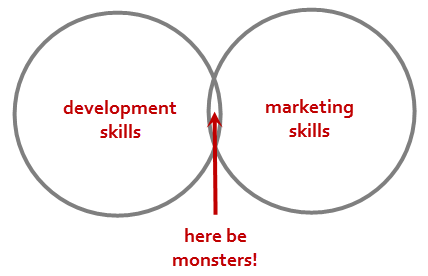
The intersection of people with development skills and marketing skills is pretty small. Being in this intersection can only help your career prospects.

development marketing skillsAlso an in-depth understanding of software is very helpful when you are marketing software, compared to a marketer who doesn’t really understand software.

2. It’s not rocket science

The basics of marketing boil down to:

  • Find out what people want/need/will pay for.
  • Get people’s attention cost effectively.
  • Communicate what your product does.
  • Choose the right price.

None of these things are as simple as you might think, if you haven’t tried them. But its not rocket science to become competent at them. Hey, if the average marketing person can do it, how hard can it be? ;0)

3. Less reliance on marketing people

If you don’t have any marketing skills then you are completely reliant on your marketing people to do a good job at marketing the software you have poured your soul into. Are you comfortable with that? How do you even know if they’re doing a good job?

4. Number crunching

Developers tends to be well above average in their analytical and mathematical skills. Online marketing tools such as Analytics, AdWords and A/B testing generate vast amounts of data. Being good at crunching numbers is a big bonus for some aspects of marketing.

5. It’s interesting

When I started out as a professional developer some 30 ago, the thought of being involved in the sordid business of marketing would have appalled me. But, as I have got more and more involved in the marketing side of things, I have found it really rather interesting and creative. There is a lot to learn, including: pricing, positioning, customer development, segmentation, partnerships, email marketing, SEO, AdWords, social media and conversion optimization. I think of development as hacking computers and marketing as hacking humans.

6. Diminishing returns on development skills

The more time you spend as a developer, the better you are going to get at it. But you will run into diminishing returns. E.g. you won’t improve as much between your 9th and 10th year of programming as you did between your 1st and 2nd year. Learning a completely new skill avoids diminishing returns.

7. You’ll need it if you ever start your own software business

If you ever start your own software business you will quickly find that marketing skills are at least as important as development skills. So it’s a huge plus if you already have some marketing chops. Even if you have a VC sugar daddy who is going to give you enough money to hire marketing staff, you’ll still need some marketing skills to know who to hire.

If you are employed as a developer full time, I recommend you jump at any chance to get involved in marketing or go on a marketing course. I also run a training course for people wanting to start their own software business that includes a lot of material on marketing.

South West Bootstrappers meetup

I am organizing a regular meetup in Swindon (UK) for people who are running (or are interested in running) their own bootstrapped (i.e. not VC funded) software product business. Come along and talk shop with other aspiring and experienced bootstrappers. It doesn’t matter if you are developing for web, Windows, Mac or mobile.

The first meetup is on the evening of Tuesday 16th June 2015. You can find out more and RSVP at meetup.com/South-West-Bootstrappers/.

swindon meetup

‘Start your own software business’ training course 2015

trainingI am planning to run my ‘Start your own software business’ training course again this year, probably in September. It is an intensive weekend course, at a hotel in my home town of Swindon (in the UK). It is aimed at people who want to start (or at an early stage of starting) a software company selling desktop or web software. It builds on my 10 years of experience running my own software company and consulting to other software companies. It’s the course I wish I had attended when I started my business.

I know a lot of courses are online now. But I think you get more from face-to-face training. More intensive. More interactive. Less distractions. Also you get to meet other people in the same boat. I have run the course twice before and the feedback was very positive. You find out more and read comments from previous attendees here.

Fill in the form on the training page if you are interested. I am happy to answer any questions in the comments, by email or on twitter.

Keyword Funnel is now FREE

Adwords Keyword FunnelI launched Keyword Funnel last year. It was only my second software product launch in 10 years. Keyword Funnel is a utility to help AdWords advertisers efficiently add hundreds or thousands keywords to their campaigns. It was based on some tools I wrote for running my own AdWords campaigns.

It was a commercial flop. I sold a few licences, but not many. Most telling was the lack of any engagement. There were very few emails from website visitors and not many people who visited the website downloaded the free trial. There wasn’t even much interaction from the people that did buy licences. This was very much in contrast to my PerfectTablePlan product, where there was much more engagement straight away.

I could have tried to pivot or push on through using some of the stuff I have learnt over the last 10 years, but it felt like kicking a dead horse up a hill. Better to focus my finite energy and resources on more fruitful areas. I also decided that I just didn’t like AdWords enough that I wanted to spend all day thinking about it (and that was before my recent falling out with Google). I didn’t want to take money from people for a product that had no real future and for which I had lost enthusiasm. So I pulled the plug within a few months of launch. But it seems a shame to waste the work that went into it, so I am re-releasing it as a free product in the hope that someone will find it useful and to increase my luck surface area. You’re welcome.

As far as I can determine, the reasons it failed are:

It didn’t solve a real problem for enough people. This is the reason most products fail. I like to run my AdWords campaigns with hundreds or thousands of ‘long tail’ keywords. I assumed that plenty of other people did to. And, if they didn’t, they would once they had a tool that made it practical to do so, especially in the face or ever increasing competition and bid prices. But not many other people seem interested in long tail campaigns. I should have researched this more.

The AdWords market seems to be sharply divided into amateurs (people running small campaigns for their own products) and professionals (people running multiple large campaigns for other people). The amateurs have a million other things to do and want to spend as little time as possible on AdWords. In fact most of them seem to set up a campaign and then completely ignore it (bad idea). The professionals are happy to spend hundreds of dollars per month on a tool, but they want it to do everything, including creating ads and setting bids. There doesn’t seem to be much of a market in between for low cost utilities, such as Keyword Funnel. I’m not sure how I could have found this out without trying to sell into this market.

I found it hard to get any traffic. I am not an ‘Internet famous’ authority on AdWords. I wrote to various AdWords bloggers offering them free licences. But most of them seemed to be associated with other AdWords tools and weren’t going to promote a competing tool. I also tried an AdWords campaign, but unsurprisingly the competition was very strong.  It was hard to get clicks at a price I could afford as competitors with more expensive products could afford to spend a lot more per click. Also conversion rates on the clicks I did get were poor.

The user interface wasn’t perhaps as intuitive as it could have been. I didn’t really think enough about workflow.

Failing is never fun, but I knew it was a very real risk when I started and I did learn some useful lessons.

Before I wrote any code, I tried to do some validation of the product by talking to friends and people at conferences who used AdWords, including some AdWords professionals. There seemed to be some interest and I managed to get 60 people signed up to the beta mailing list. But I found it hard to get people to understand my vision of the product. That should have been the first warning signal. But, being a developer at heart, I used that as an excuse to build a beta.

I did the validation back-to-front. I mostly pitched them my idea for Keyword Funnel and then tried to gauge their interest. That doesn’t really work very well. What I should have done was ask people what problems they were having with AdWords and then waited to see if any of them mentioned ‘adding lots of keywords’, ‘grouping keywords into ad groups’ etc.

As I released new beta versions of the product, the initial interest seemed to peter out. I probably should have killed it at this point. But I persuaded myself that, having come this far, I might was well release it (paying customers being the only true validation). This was more down the the ambiguous nature of the feedback than sunk cost fallacy.

I followed my own advice and cut some corners in the development, but not enough. The planned 2 months part-time, ended up being 6 months part-time. I wasted time on activities such as: having a logo designed, writing licensing code, writing detailed documentation and setting up payment processing. In retrospect I should have waited until I was sure there was a market for Keyword Funnel before I bothered with any of that. When I launched my new Hyper Plan product I released a public beta within 5 weeks of starting work on it (part-time). I offered it free for several months (it just died on a certain date). I only added licensing code and set up payment processing when I felt there was sufficient interest to justify the effort. Hyper Plan just has a 1 page quick-start guide and the logo was designed in 10 minutes by me (both still on the ‘to do’ list to improve soon).

It is hard to get noticed in a new market. I knew this already, but perhaps I had forgotten how much hard work it was in the early days of PerfectTablePlan. As I already have an audience of thousands of event planners with PerfectTablePlan, it is much easier to cross-sell them Hyper Plan than it would be to create that audience from scratch.

Having had one successful (in my terms) product, I was perhaps a bit arrogant and didn’t spend as much time researching the market as I should have done. But validating a software product is hard, especially when it’s a bit different to everything else out there (I’m not interested in copying existing products). I had no real idea how successful any of my products would be before I launched them. PerfectTablePlan was much more successful than I expected. Keyword Funnel much less successful than I expected.

While the opportunity cost of Keyword Funnel was quite high, in terms of cash, I only spent a couple of thousands dollars. This was mostly on the website design and I reused a lot of that for Hyper Plan.

You can download Keyword Funnel here. Despite its lack of commercial success, it does (I think) do some pretty cool things:

  • Cleans up lists of keywords which you can import from various sources (e.g. removes foreign characters, capitalization and duplicates).
  • It has a nice keyword multiplier (much better than the Google equivalent IHMO).
  • Removes an unwanted keyword from all phrases in a single click.
  • Allows you to analyze all the phrases a keyword appears in.
  • Groups keywords into related ad groups.
  • Produces output in a form you can read straight into AdWords via AdWords Editor.

It’s completely free, you don’t even have to give me your email address. Maybe I will find a way to make some money off it at some point in the future (NB/ I am not interested in taking on AdWords consulting work at present).

Thankfully my new Hyper Plan product is doing much better than Keyword Funnel did. I wrote a bit about my approach to launching Hyper Plan here. It is too early to tell if it well do as well as PerfectTablePlan, but I am very happy with how it is doing so far.

Google bans hyperlinks

Summary: My AdWords account was suspended after ten years of continuous advertising. I was told that hyperlinking from my domain to any another domain was a breach of Adwords policy. This is clearly ridiculous and not what their policy says. But I had to appeal higher up and it took 11 days to get my suspension overturned.

I have been advertising my PerfectTablePlan seating plan software continuously on Google AdWords since the 7th March 2005. Just shy of 10 years. Google emailed me on the 20th Feb. But it wasn’t a thank you for 10 years of loyal custom. It was to tell me they had suspended my account.

Hello,

We wanted to alert you that one of your sites violates our advertising policies. Therefore, we won’t be able to run any of your ads that link to that site, and any new ads pointing to that site will also be disapproved.

Here’s what you can do to fix your site and hopefully get your ad running again:

1. Make the necessary changes to your site that currently violates our policies:

Display URL: perfecttableplan.com

Policy violation: Software principles
Details & instructions: https://support.google.com/adwordspolicy/answer/50423?hl=en

2. Resubmit your site to us, following the instructions in the link above. If your site complies with our policies, we can approve it to start running again.

There was no detail about what I had done wrong. As far as I was aware, I complied with their policies. I had a look through the linked page, but it was about “Malicious or unwanted software”, “Low value content” etc. I couldn’t see anything that obviously applied to my website or software. My software is bona fide. I’ve been selling it for 10 years. It was used to help plan the seating at one of the official events for the Queen of England’s Diamond Jubilee, don’t you know!

I went to the AdWords support page to try and work out who I could talk to. A chat pop-up appeared. So I did an online chat with a Google AdWords employee. He told me that I needed to:

  1. Add a link to the uninstall instructions on my download page. I told him that my uninstall was completely standard for the platforms I support (Windows and Mac). But he insisted.
  2. Remove some links that were ‘redirections’ from my reviews page.
  3. Explain the value of what my software did. I pointed out that this is what the entire website is for. He backed off on that one.

Google doesn’t put uninstall instructions on the download pages of its own software (exhibit A). I was annoyed by the hypocrisy. Also their policy says you mustn’t:

[make] it difficult for users to disable or uninstall the software

It doesn’t say you need to include uninstall instructions. However I wrote a page of uninstall instructions and linked to it from the download page.

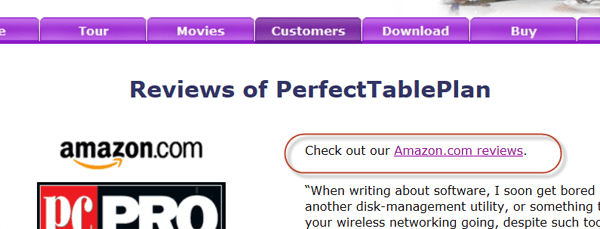
I looked at my reviews page. There were 16 links pointing to genuine reviews of my software on various blogs, download websites, magazine websites and Amazon. However some of the links pointed to pages that no longer existed and a few were redirected at the other end. All the redirections seemed completely harmless (for example one was just a redirection to the the same page, but http instead https). But I removed all the links except this one:

amazon_reviews_resized

This link just pointed to http://www.amazon.com/gp/product/B0017YOSE2/. No redirection at the other end.

I then emailed AdWords support on the 21st Feb to say that I had complied with their requests. I heard nothing for several days. I tweeted them on the 24th and they asked me to fill out an online contact form with my details. I did that on the 25th.

The next day I was woken around 8am by a phone call from AdWords support. I think it was the person I did an online chat with. The line wasn’t great, English obviously wasn’t his first language and I hadn’t had my morning coffee. So it wasn’t a great conversation. But, as far as I understood it, he told me that he couldn’t remove the suspension because I was ‘redirecting’ people from my review page to amazon.com. I tried to point out that it was just a hyperlink and it went exactly where it said it would. But he seemed to be saying that I wasn’t allowed to hyperlink to any external domain from my perfecttableplan.com domain. That is obviously ludicrous and I just about managed to stay civil. Surely I had misunderstood. Soon after I received this email:

Hi Andy,

As per the conversation we had over the phone. I would suggest you to remove the link from your website wherein it redirects me to a different website.
If I click on the link it is taking me to Amazon.com, which is a redirection from your website.

The policy says it has to be on the same website but I guess it is deviating a bit from it.
You can provide information about your products and services in the website but ensure those are not clickable.

Please see the link for policy forum for bridge page here.

Once the changes are done, please write back to me so that we can consult and get this done for you at the earliest.

Have a lovely day ahead.

I emailed back:

I have now removed the link to Amazon.com from this page, as directed:
http://www.perfecttableplan.com/html/reviews.html

> Please see the link for policy forum for bridge page here.

It says:

“Landing pages that are solely designed to send users elsewhere

# /Examples/: Bridge, doorway, gateway, or other intermediate pages”

The review page isn’t a landing page. It isn’t linked directly from any of any of my Google ads. To get to it the user has to:
1. click on the ad
2. click on ‘customers’ in the navigation bar
3. select ‘review’
4. click on the Amazon.com hyperlink (there is no automatic redirect)

Also I am only linking to that page so they can read independent reviews of my product. I don’t [want] them to buy it from Amazon!


Please re-review my site at your earliest convenience.

The reply by email was:

Andy,

I understand your point, but from your website the link is taking to Amazon.com. When I click on the link I am taken to this page.

You can write in as for further information please visit this link xyz.com/reviews.. [1]

The link should not be clickable. It is taking from your website to a new webpage.

Request you to change it so that we can review and get it enabled.

Awaiting your response.

Have a great day ahead.

I replied:

I was phoned by someone from Google this morning and have now removed that link.

Can you clarify the situation regarding links to other sites. Does the AdWords policy mean that no site advertising on Adwords can ever hyperlink to another site (surely not)? Assuming that isn’t the case, what hyperlinks are allowed and what hyperlinks are not allowed?

He replied:

Hi Andy,

Thanks for writing in, hope you are doing great.

With regards to your email I would like to confirm that any links that are taking a user to a new website is not allowed.
You can provide links, which are not clickable.

The user must not get redirected to a new website.

Hope this answers your query.

I have bolded the offending line for emphasis. There it is in black and white. No hyperlinks.

I replied:

So I can’t have a clickable hyperlink to *any* non http://www.perfecttableplan.com page from *any* http://www.perfecttableplan.com page without breaching AdWords policy? Is that correct? Please clarify.

He replied:

Hi Andy,

Thanks for writing in again.

With regards to your email I would like to confirm that any links which are taking a customer to a different website are not allowed.
If the link is taking the advertiser to any specific page of your website then it is alright but it should not redirect any other website.

Hope this helps.

Feel free to drop in your questions or queries. I will be glad to assist you on them.

Have a great day ahead.

There it is again. A world wide web without hyperlinks between domains? This is clearly absurd.

I approached AdWords expert Aaron Weiner from Software Promotions. He agreed that this was a complete misinterpretation of their policy and kindly offered to talk to his Google contacts in the US to see if they could help resolve it. On the 28th Feb he forwarded me this email from Google:

I have taken a look at the site and the previous interactions that your client has had with our team. I apologize that the communication has not been very clear for your client – I am going to take ownership of it from here and make sure that we get this site back up ASAP.

From what I can see now, the site appears to be compliant with our policies. I have contacted our policy team to have them review it right away. I have also asked them to clarify the issue with linking to third party reviews. Obviously we would not want an ad to direct to a different domain, but I do not see any problem with linking to reviews once the user has landed on your site. I am going to get some clarification on this to see if we are missing something,

Thank you for your patience and please let me know if you have any questions. I will be in touch soon.

On the 3rd March I got an email from Google:

Great news! We’ve re-reviewed your site and determined that the following site complies with our Advertising Policies

Followed by this email forwarded by Aaron:

Thank you for your patience while our policy team reviewed your website. They confirmed that the site is compliant with our policies and you will see that it is now re-enabled. I checked the ads this morning and I can see that they are serving.

I also confirmed with them that there is no policy against linking to third-party reviews on your website. You can add those links back to the reviews on your site.

I read through the chat that you had with ******* and I think that there may have just been some misunderstanding as to the specific problem with the site. I sincerely apologize for the confusion caused by that. I have reached out to ******* to clarify the policy with him.

It’s pretty shocking that a Google employee (or contractor) should have a such a poor grasp of the  policy they are enforcing. It shakes my faith in Google. Previously I thought that, even if they were a little bit evil, they were at least competent with it.

Also the entire situation was handled badly. They could have sent me an email clearly stating the policy violation and giving me a few days grace to fix it. Surely I deserve that much after 10 years as a paying customer?

My account was suspended for a total of 11 days and I wasted quite a lot of time and mental energy. For what? I removed a few hyperlinks from my reviews page and added a link to some uninstall instructions. How is that going to help anyone?

I talked to a number of other software authors and found that quite a few of them had also had their AdWords suspended for policy violations, such not having uninstall instructions. Oliver Grahl of PDF Annotator, who has also been suspended previously, commented:

“Every day, live your life as if it was your last day (getting traffic from Google). One bit in their databases can ruin a whole business and all the lives behind it. Pretty scary.”

I understand that Google is engaged in a continual battle with people trying to game the system to their advantage. But they need to be careful that legitimate businesses don’t end up as collateral damage. Training their staff adequately would be a good start.

Hyper Plan v1 launched

Hyper PlanI quietly launched Hyper Plan v1 yesterday. I thought I would write a bit about the approach I have taken, as it might be of interest to others planning product launches. It is also a good way for me to gather my thoughts for later reference.

Validation

I like the idea of validating a product without actually creating it first. I did that for my start your own software business training course, waiting until I had enough deposits before I actually sat down and wrote the course (all 460 slides of it + exercises). But I didn’t know how to do that with Hyper Plan. Validating software is harder.

No-one was telling me that they needed a better visual planning tool. It was just an idea for a piece of software that I wanted. I could see that a lot of people spend a lot of time sticking Post-It notes to walls. But I couldn’t see any other software quite like what I had in mind. And I had no idea if other people would buy the product I had in mind. So it is quite risky. It would be much less risky to make a variation on an existing successful product. But I just can’t get excited about that. Also I have a steady income from PerfectTablePlan, so I can afford to take some risks.

I talked to various people I knew about my idea. But it was difficult to get far without having some software to show them. Also I didn’t want to ask friends for money, so this limited the value of the feedback. I could have phoned up some businesses and told them “It’s like a planning board, but in software” and asked for some money. But I didn’t really see that getting me far either.

I could have started an AdWords campaign and put up a landing page. But it was hard to describe exactly what the product was going to be. Partly because it was different to anything else I had seen. But also I didn’t know myself! I had lots of ideas and design scribbles, but I didn’t really know what the end product was going to look like in detail without creating it first.

So I decided to build something quickly, iterate on feedback and see what happened when I asked for money (the only true validation). Even if it failed, at least I get to do some programming!

Beta

I started coding on 08-Sep-14. By mid October I had thrown up a website with the first beta version for Windows and Mac. I allowed people to download the beta in return for giving their email address. The beta put up a warning that it would expire on 17-Jan-15. This meant I didn’t initially have to write any trial/licensing code. I made it clear that the plan was to have a commercial version for sale before then. I emailed the list each time there was a new release and encouraged them to send feedback.

I put out a number of beta releases and got some very useful feedback. A lot of the feedback was from fellow mISVs giving me a hard time about the shortcomings of the early UI, but that was still very welcome. The first release was very rough and ready. But it improved significantly in terms of UI and features with each release. I put out 5 beta releases over October, November and December. The world didn’t beat a path to my door, but the feedback was encouraging enough that I kept going.

Building v1

Hyper Plan is written in C++ and Qt and compiles into Windows and Mac binaries. I have written about why I decided to develop it as a desktop tool elsewhere. It is around 20k lines of C++ code. About 100 lines of that code are platform specific, mostly to try to improve the look and feel on Mac OS X.

I also planned the marketing, wrote a quick start guide, created the website and built installers for Windows and Mac. Not bad for 18 weeks, part-time around various other commitments (mostly PerfectTablePlan and a little bit of consulting)! It helps that I was using technology and tools that I have used extensively before.

I have tried to follow my own advice and cut some corners:

  • I did the Hyper Plan logo myself. It isn’t great.
  • The website is fairly basic. I’m not a web designer.
  • I did the website video+voiceover myself. It isn’t great.
  • The software doesn’t have all the features I would like it to have.
  • The software UI could be more polished.
  • There is minimal documentation (just a quick start guide).

I can improve on all of these later. However the software seems very solid, with only 1 crash reported in third party testing (now fixed).

I would have liked to have got to v1 even quicker, but (inevitably) quite a few shortcomings in my original ideas had to be addressed during the beta to make it a useful product. Also, I couldn’t resist a bit of gold plating (animations with easing curves, oh yeah!).

Trial

I decided to go for a fully functional, time limited trial for Hyper Plan on the grounds that the more invested in it people become, the more likely they are to buy it (see this article for a discussion of the merits of different trial models). I didn’t want the standard 30 consecutive days trial, as I know many people install software, forget about it for 30+ days and then can’t continue with the trial. So I went with 7 days of non-consecutive use. I may A/B test longer trial lengths in future.

Pricing

I am a big fan of multiple price points. But I don’t yet know enough to segment the market for this product. So I decided to go with a single price point. I can always split the product into multiple price points later on (e.g. add a more expensive ‘professional edition’), as I did for PerfectTablePlan.

The product is positioned (in my mind at least) as a better alternative to sticking Post-It notes to the wall and a cheaper and simpler alternative to fully fledged project management tools. This rather limits what I can charge for it. I wasn’t sure whether to price the product at $30 (for an impulse buy) or $50 to try to send a signal that it is aimed more at serious users. So I split the difference and went for $40. Also that gives me some room to experiment with discounts. I may experiment with different prices in future.

Ecommerce

Avangate has been doing the payment processing for PerfectTablePlan for some years now and I have been generally very happy with their service. Also they protect me from the horrors of the new EU VAT legislation. So it was a no-brainer to use them as the payment processor for Hyper Plan. They set me up with a separate account/control panel for Hyper Plan.

Expenditure

I haven’t added it all up yet. But the total expenditure to date for Hyper Plan is a few hundred dollars. This was mostly third party testing by testlab2.com, the cost of the hyperplan.com domain (which I have been sitting on for a few years) and fees for sending out email newsletters. I already had icons, a hosting account and a web template from previous projects, so there was no additional cost there. Obviously the opportunity cost of my time is a lot more.

Marketing

Initially I plan to concentrate on:

  • cross-selling to my PerfectTablePlan customers
  • SEO (content + back links)
  • AdWords

Some of the keywords I would like to get traffic on have an estimated top of page 1 bid price of £23 in AdWords. Yikes. But I have a lot of experience with AdWords. Hopefully I can pick up some well targeted and much cheaper clicks with a long tail strategy (using the Keyword Funnel software I developed). Only time will tell.

I have quite a few other ideas that I can try. But I am still very much validating if this product has a market and, if so, what I have to do to get the elusive ‘product-market fit’.  I don’t plan to spend much effort and money on marketing until I have that better figured out.

Version 1 launch

292 people had given their email address to download the beta by yesterday. Most of the sign-ups came from mentions of Hyper Plan in my PerfectTablePlan newsletter, on this blog and on a couple of forums. I didn’t do any paid advertising and, as yet, there is very little organic traffic to the Hyper Plan website.

There was no big launch. No press release. No party. Not even a tweet. I just announced v1 to my mailing list of 292 people yesterday morning. I offered a discount to anyone who purchased a license in the next 7 days. I had absolutely no idea how many sales I would get.

I got 12 sales and a couple of enquiries about organizational licenses yesterday. That is better than I expected for day 1. So I am quietly encouraged that there may be a market for this product. But it is very early days yet. Thankfully I have PerfectTablePlan paying all the bills, so there is no pressure to hit any revenue targets.

Always Be Selling

Obviously I am not going to miss the chance to try to flog you a license, dear reader. Are you interested in visual planning software? Do you know someone that might be? Hyper Plan is very versatile. I have used it for planning Hyper Plan development and marketing, my daily TO DO list and tracking Xmas present purchases. It is also highly suitable for agile/Kanban/Scrum type planning. You can find out more here and download the free trial here.

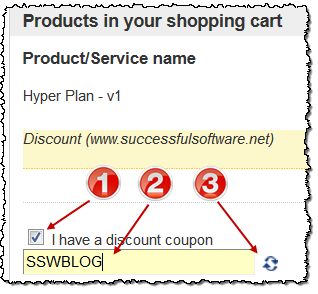
If you buy a license by the end of 22-Jan-15 you can get 20% off (feel the marketing!). Use the coupon SSWBLOG in the shopping cart to get the discount.
discount

Feedback

If you have any comments on the product or website, I would be happy to hear them.

10 years a microISV

I have been running my own one-man software company for 10 years today. Coincidentally it is also my 49th birthday, so it is perhaps a good time for a bit of reflection.

I did a physics degree and then worked full-time as an employee for nearly 20 years. I developed systems in FORTRAN, C and then C++ for operational research, satellite image processing, printed circuit board design, environmental modelling and distributed systems. I learnt a lot and met some great people, but I yearned to strike out on my own.

I set up my own company in January 2005. I was a techie and had very little experience on the business, sales and marketing side of things. It was quite scary.

I released v1 of my table planner software PerfectTablePlan at the end of February 2005. It was very rough and ready, but I sold my first licence in less than 24 hours. PerfectTablePlan has exceeded all my expectations and is still selling well. I have sold over 40,000 licences with revenue well into 7 figures (£) to date.

I started this blog in April 2007. It has had over 2 million hits to date and has been helpful for promoting my consulting. But mostly I do it because I like writing, when I can find the time.

I started offering a consulting service in January 2008. I have provided consulting to lots of other software businesses, mostly 1 day engagements concentrating on marketing. That has been very interesting and has added some variety to my work. It has also been helpful to find out what works and doesn’t in other businesses.

I ran a weekend face-to-face training course for people wanting to start their own software business in November 2013 and March 2014 in the UK. The course is 460 slides + various exercises. I enjoyed doing it and the feedback was very positive. But it was hard work to get enough people in one place at one time to make it viable. I could do it online, but I think it would lose a lot of the interactivity that made it work so well. I would like to run it again in 2015. Email me if you’re interested.

I released v1 of my AdWords keyword tool Keyword Funnel in March 2014. This was a commercial quality re-implementation of various tools I had written to help myself run my long tail AdWords campaign for PerfectTablePlan. The plan was to produce v1 within a couple of months, part-time. But it ended up taking nearer to 6 months. Feedback became more patchy and ambivalent as I got closer to v1. But, having got that far, I decided to push it out anyway. It didn’t sell well, for various reasons which I might go into in a future post. I also decided I didn’t want to spend all day thinking about AdWords. So I stopped selling it and took the site down. But it seems a shame to have wasted that work, so I may resurrect it later this year as a free product.

I am just about to release v1 of my visual planning software Hyper Plan. I have worked on this part time since September 2014. I am very pleased with how it has turned out. But I have no idea how successful it will be (as was the case with PerfectTablePlan and Keyword Funnel). I think a lot of people could benefit from it, but it is in a crowded market. Watch this space.

I have attended various conferences for small software businesses and spoken at MicroConf (Europe), ESWC and SIC. It is always great to meet other people in the business.

I am a moderator and regular contributor on the Business of Software and bootstrapped.fm forums.

All sorts of strange and wonderful things have happened, including:

  • PerfectTablePlan has been used for some very famous organizations for some very famous events (which I sadly don’t have permission to mention). It has seated royalty, celebrities and heads of state.
  • PerfectTablePlan was used as part of a demonstration of the (controversial) first commercial quantum computer by D-Wave.
  • A mock-up of PerfectTablePlan, including icons I did myself, was used without my permission by Sony in their ‘Big day’ TV comedy series.
  • I got to grapple with some interesting problems, including the mathematics of large combinatorial problems and elliptical tables. Some of my customers are now seating 4,000 guests and 4000! (4000x3999x3998 .. x 1) is a mind-bogglingly huge number.
  • A well known wedding magazine ran a promotion with a valid licence key clearly visible in a photograph of a PerfectTablePlan CD. I worked through the night to release a new version of PerfectTablePlan that didn’t work with this key.
  • I found out that CDs are edible.
  • An early article I wrote for the blog generated 56k hits in a day and got me a mention in the Guardian newspaper.

I employed my wife as bookkeeper a few years back. But decided I didn’t want to take on any other employees. I outsource a few things that I can’t do, but I still do most things myself.

It has been hard work and a bit of a roller coaster ride. But overall, it has been great! I wonder what the next 10 years will bring?

See also:

Lifestyle programming

AdWords Rot

Adwords RotAn AdWords account that starts off making a worthwhile profit for the owner is often neglected and, within a year or two, is losing money. Potentially a lot of money. I have seen it happen again and again. If you are running a Google AdWords campaign, you have to at least monitor it. Better still, actively maintain it. Otherwise the rot will soon set in.

Here is an example of an AdWords campaign that was professionally set up and then left to coast, unmanaged. You can see that the cost per converted click (blue) rose, while the number of conversions (orange) fell a little. The average cost per conversion (trial) rose by a factor of 3 in just 4 years. What was once a profitable account was now wasting a lot of money. Ouch.

adwords conversion graph 2

The main reason for the rot is that Google are continually changing AdWords, and they may opt you in to new features without asking you. For example they automatically opted display advertisers into showing ads in free-to-play AppStore games. B2B business owners were paying thousands of dollars for clicks made by bored children in Flappy Bird and the like. I have seen accounts where thousands of dollars have been spent on these worthless clicks. And these were  small companies. Other reasons include:

  • Your display ads might start showing on a new website where they convert badly.
  • Poor targeting. Perhaps a new product, film or band has appeared with a name similar to your product.
  • Increased competition and bid price inflation can reduce a healthy amount of traffic to a trickle, reducing profitability.
  • Click fraud.

So you really need to keep an eye on your AdWords account. At an absolute minimum you should monitor the number of conversions and the cost per conversion and investigate any unfavourable changes. To keep your account in good shape over time you need to actively maintain it, e.g.:

  • Delete any keywords with poor click through rates (typically I delete keywords with a CTR of 0.5% or less after 200 or more impressions).
  • Delete any keywords with poor quality scores (typically I delete keywords with a QS of 3 or less).
  • Delete any keywords or ads with poor conversion rates.
  • Examine the dimensions>search terms report for negative keywords to add.

You can easily set up filters and get automated reports sent to you to make this fairly painless. These checks should be done perhaps once a week for a new or high budget campaign and perhaps once a month for a mature or low budget campaign. You can also make your life easier by setting up AdWords so that Google is doing most of the heavy lifting for you. For example you can use CPA bidding and you can set the ad rotation setting to Optimize for conversions: Show ads expected to provide more conversions.

A mature account that has been well set-up and has a budget of around $1k per month, probably only needs an hour a month to maintain. Alternatively, if you can’t spare an hour or two a month to manage your AdWords campaign, do yourself a favour and shut it down. Now.