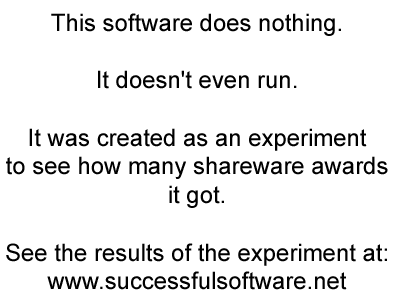
 I put out a new product a couple of weeks ago. This new product has so far won 16 different awards and recommendations from software download sites. Some of them even emailed me messages of encouragement such as “Great job, we’re really impressed!”. I should be delighted at this recognition of the quality of my software, except that the ‘software’ doesn’t even run. This is hardly surprising when you consider that it is just a text file with the words “this program does nothing at all” repeated a few times and then renamed as an .exe. The PAD file that described the software contains the description “This program does nothing at all”. The screenshot I submitted (below) was similarly blunt and to the point:

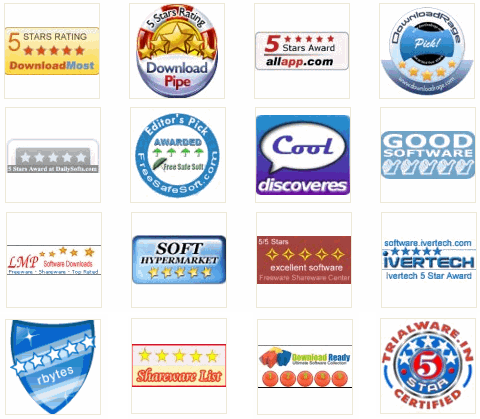
Even the name of the software, “awardmestars”, was a bit of a giveaway. And yet it still won 16 ‘awards’. Here they are:

Some of them look quite impressive, but none of them are worth the electrons it takes to display them.
The obvious explanation is that some download sites give an award to every piece of software submitted to them. In return they hope that the author will display the award with a link back to them. The back link then potentially increases traffic to their site directly (through clicks on the award link) and indirectly (through improved page rank from the incoming links). The author gets some awards to impress their potential clients and the download site gets additional traffic.
This practise is blatantly misleading and dishonest. It makes no distinction between high quality software and any old rubbish that someone was prepared to submit to a download site. The download sites that practise this deceit should be ashamed of themselves. Similarly, any author or company, that displays one of these ‘awards’ is either being naive (at best) or knowingly colluding in the scam (at worst).
My suspicions were first aroused by the number of five star awards I received for my PerfectTablePlan software. When I went to these sites all the other programs on them seemed to have five star awards as well. I also noticed that some of my weaker competitors were proudly displaying pages full of five star awards. I saw very few three or four star awards. Something smelled fishy. Being a scientist by original training, I decided to run a little experiment to see if a completely worthless piece of software would win any awards.
Having seen various recommendations for the rundenko.com submit-everywhere.com submission service on the ASP forums I emailed the owner, Mykola Rudenko, to ask if he could help with my little experiment. To my surprise, he generously agreed to help by submitting “awardmestars” to all 1033 sites on their database, free of charge.
According to the report I received 2 weeks after submissions began “awardmestars” is now listed on 218 sites, pending on 394 sites and has been rejected by 421 sites. Approximately 7% of the sites that listed the software emailed me that it had won an award (I don’t know how many have displayed it with an award, without informing me). With 394 pending sites it might win quite a few more awards yet. Many of the rejections were on the grounds of “The site does not accept products of this genre” (it was listed as a utility) rather than quality grounds.
The truth is that many download sites are just electronic dung heaps, using fake awards, dubious SEO and content misappropriated from PAD files in a pathetic attempt to make a few dollars from Google Adwords. Hopefully these bottom-feeders will be put out of business by the continually improving search engines, leaving only the better sites. I think there is still a role for good quality download sites. But there needs to be more emphasis on quality, classification, and additional content (e.g. reviews). Whether it is possible for such a business to be profitable, I don’t know. However, it seems to work in the MacOSX world where the download sites are much fewer in number, but with much higher quality and more user interaction.
Some download site owners did email me to say either “very funny” or “stop wasting my time”. Kudos to them for taking the time to check every submission. I recommend you put their sites high on your list next time you are looking for software:
www.filecart.com
www.freshmeat.net
www.download-tipp.de (German)
This is the response I got from Lothar Jung of download-tipp.de when I showed him a draft of this article:
“The other side for me as a website publisher is that if you do not give each software 5 stars, you don’t get so many back links and some authors are not very pleased with this and your website. When I started download-tipp.de, I wanted to create a site where users can find good software. So I decided the visitor is important, and not the number of backlinks. Only 10% of all programs submitted get the 5 Suns Award.”
Another important issue for download sites is trust. I want to know that the software I am downloading doesn’t contain spyware, trojans or other malware. Some of the download sites have cunningly exploited this by awarding “100% clean” logos. I currently use the Softpedia one on the PerfectTablePlan download page. It shouldn’t be too difficult in principle to scan software for known malware. But now I am beginning to wonder if these 100% clean logos have any more substance than the “five star”awards. The only way to find out for sure would be to submit a download with malware, which would be unethical. If anyone has any information about whether these sites really check for malware, I would be interested to know.
My thanks to submit-everywhere.com for making this experiment possible. I was favourably impressed by the thoroughness of their service. At only $70 I think it is excellent value compared to the time and hassle of trying to do it yourself. I expect to be a paying customer in future.
** Addendum 1 **
This little experiment has been featured on reddit.com, digg.com, slashdot.com, stumbleupon.com and a number of other popular sites and blogs. Consequently there have been hundreds of comments on this blog and on other sites. I am very flattered by the interest. But I also feel like Dr Frankenstein, looking on as my experiment gains a life of its own. If I had known the article was going to be read by so many people I would have taken a bit more time to clarify the following points:
- I have no commercial interest in, or prior relationship with, the three download sites mentioned. I singled them out because I infer from emails received that they have a human-in-the-loop, checking all submissions (or a script that passes the Turing test, which is even more praiseworthy). I offered all three a chance to be quoted in the article. Today I received a similar email from tucows.com, but they were too late to make the article. I don’t know if they read the article before they emailed me.
- I have no commercial interest in, or prior relationship with, the automatic submission service mentioned. I approached them for help, which they generously provided, free of charge.
- The only business mentioned in which I have a commercial interest is my own table planning software, PerfectTablePlan.
** Addendum 2 **
23 awards ‘won’ at the latest count.



 The Internet is a cornucopia of useful resources for software developers and marketers. As well as all the documentation, forums, blogs and wikis there are some great audio and video resources. Here are some of my favourites:
 Although developers have traditionally avoided anything to do with marketing (aka ‘the dark side’) both development and marketing require originality, creativity and hard work to do well. Don’t believe me? Lets say you have to market a top of the range blender – how would you do it?
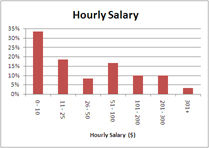 The Business of Software blog has published the results of a survey of 96

 You’ve got this great idea for a software product. You are pretty confident that you can crank out version 1.0 working full-time on your own from the spare room, and you are fairly confident that people will buy it. But you’ve also got a well paid full-time job ‘working for the man’. It’s cosy and familiar in that cubicle. Is it worth risking your career and savings to set out into uncharted waters on your own? Do you take the red pill or the blue pill?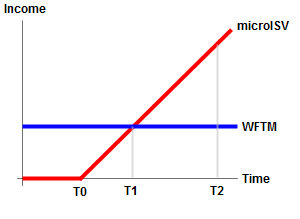




 I don’t remember when or where I first saw an editor with syntax highlighting. But I do remember that I was ‘blown away’ by it. It was immediately obvious that it was going to make code easier to understand and syntax errors easier to spot. I would now hate to have to program without it. So I was interested to try version 1.1of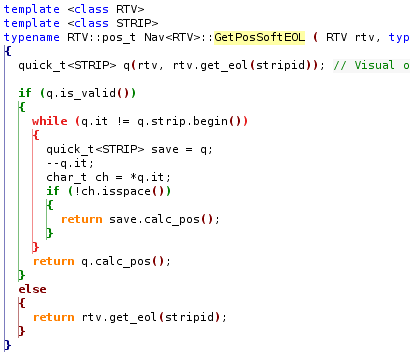
 Software cracks are a real problem for software vendors large and small. I have
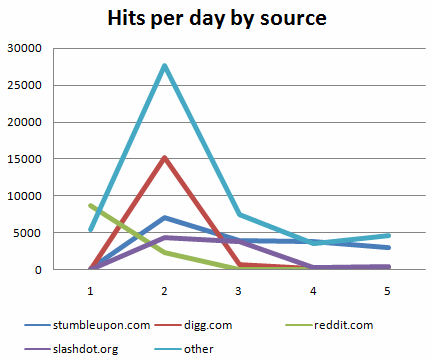
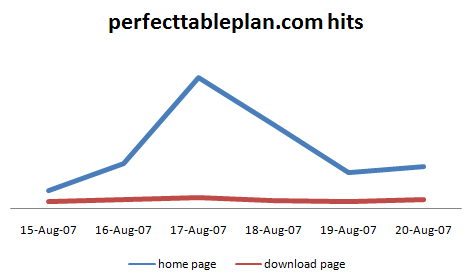
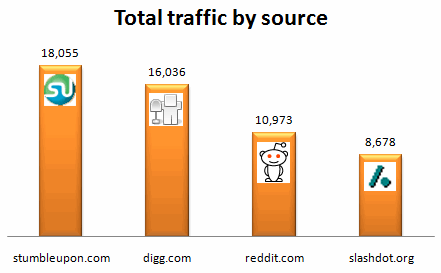
 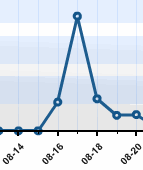 Social news and bookmarking sites, such as reddit.com, digg.com, slashdot.org and stumbleupon.com, use voting by users or selection by editors to rank interesting stories. Much to my surprise, I recently had an article from this blog featured prominently on all four of these popular sites. This generated a large amount of traffic and gave me an interesting opportunity to turn the tables, by using my hit statistics to rank these sites.


 Successful Software
