
Tag Archives: Google

A test of Cost Per Action (CPA) vs Cost Per Click (CPC) in Google Adwords

CPA vs CPCThe traditional approach to Google Adwords is to set a bid price for each keyword. This is known as Cost Per Click (CPC). Google then then uses the bid prices in conjunction with a secret formula (the quality score) to decide how high to rank your ad in the Adwords results. If you bid more, your ad will appear higher and typically get more clicks, but your cost per click will increase. So setting an optimal bid price is important. Bid too little and you won’t rank high enough to get a decent number of clickthroughs. Bid too much and you will potentially end paying more to Google than you recoup in sales.

An alternative approach is to tell Google Adwords how much you are prepared to pay for a particular action, e.g. a sign-up, download or sale. This is known as Cost Per Action (CPA) or Conversion Optimizer. Google will then automatically calculate your bid prices and attempt not to exceed the CPA you set (although this isn’t guaranteed).

CPA sounds great. I can stay in bed a bit longer while the mighty Google brain does the bid tweaking for me. Unfortunately I wasn’t able to use CPA. I  count sales as conversions (not downloads) and I have my adwords account split into a number of campaigns by geographic region and by type (e.g. search vs content). Having my campaigns structured like this, rather than one monolithic campaign, makes for more flexibility (e.g. different ads, phrases and bid prices for different geographical areas) and more useful reports (e.g. separate reports for search and content). But it also meant none of my Adwords campaigns made the minimum threshold for conversions per month.

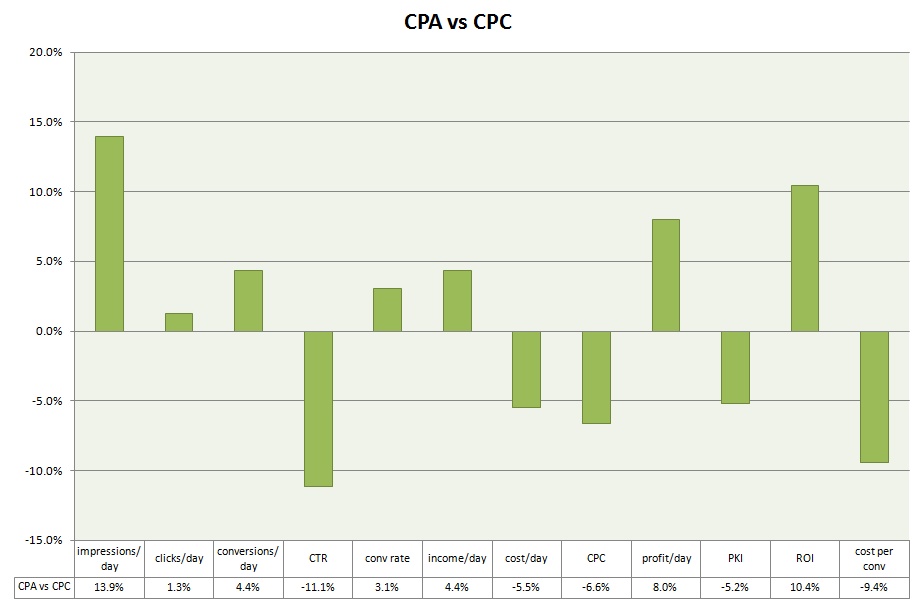
When Google dropped the minimum threshold for CPA to 30 conversions per campaign per month, one of my Perfect Table Plan search campaigns became eligible. So I did an experiment. I ran a campaign for 4 weeks using CPC, then 9 weeks using CPA, then another 4 weeks using CPC. I set the CPA bid to roughly the average cost per conversion I got for CPC. I was curious to see if Google would find sweet spots that I had been missing or whether they would bid as high as they could to take as much money off me as possible. Summary: CPC outperformed CPA on all key metrics, including: 4.4% higher conversions, 9.4% lower cost per conversions and 8.0% higher profit.

The detailed results are as follows:

metric CPC  (vs CPA)
impressions/day +13.9%
clicks/day +1.3%
conversions/day +4.4%
CTR -11.1%
conv rate +3.1%
income/day +4.4%
cost/day -5.5%
CPC -6.6%
profit/day +8.0%
PKI -5.2%
ROI +10.4%
cost per conversion -9.4%

In graphical form (click to enlarge):

CPA vs CPC graph 50pc

Notes:

  • The values given are taken by computing (CPC metric – CPA metric)/(CPA metric). E.g. ROI of +10.4% means that CPC had a 10.4% higher ROI than CPA.
  • Only a single (geographically based) search campaign was measured. The total number of conversions during the time period of the test was in 3 figures.
  • I only measured sale conversions. This gives me less data than measuring downloads, but I think it is unsafe to assume the number of downloads correlates closely to the number of sales.
  • The PerfectTablePlan sale price is £19.95/$29.95. To calculate profit I only counted 75% of the price of a sale (the other 25% was assumed to cover the cost of support, ecommerce fees and other overheads associated with the sale).
  • Each of the time periods was a multiple of 7 days to avoid any issues with different results on different days of the week.
  • I ran CPC for an equal amount of time either side of the CPA test to try to balance out any seasonal factors.
  • Google conversion tracking uses Cookies and is therefore not 100% accurate.
  • PKI is Profit Per Thousand Impressions.
  • ROI is Return On Investment.

It wouldn’t be wise to draw any sweeping conclusions from one test with a limited amount of data. However I believe the results show:

  • A CPA campaign running for 9 weeks wasn’t able to outperform a mature CPC campaign. The CPC campaign had been running for over 4 years, but one would have thought CPA would have been able to use that pre-existing  data. CPA might have performed better if given longer. It would probably also have done better against a less mature CPC campaign.
  • Google didn’t rob me blind using CPA bidding. The CPA cost per day was only 5.5% higher.
  • The results weren’t hugely different. On the basis of the above results one might still conclude that CPA is superior to CPC as it requires less time to manage.

GoogleCheckout price increase

googlecheckoutIt was always on the cards that Google was going to raise the prices of their payment processing service, GoogleCheckout. Up till now I had effectively used GoogleCheckout for free, as they offset their 1.5% + £0.15 processing fee against my Adwords spending. But they are dropping the Adwords offsetting and introducing a new tiered pricing structure.

As I put most of my payments through PayPal I will probably be on the highest price tier of 3.4% + £0.20 per transaction. This means that a £19.95 sale will cost me £0.88 (4.4%) through GoogleCheckout as opposed to the £0.68 (3.4%) I pay through PayPal. I wouldn’t mind the higher fees if I got a better service than PayPal. Unfortunately GoogleCheckout still has all the flaws I commented on back in April 2007, namely:

  • Google still don’t accept payments in more than one currency (e.g. as a UK resident I can only accept payments in £). Expecting anyone outside the UK to pay in £ is a very bad idea.
  • Delays between customer purchase and payment clearance result in angry and/or confused emails from customers wondering why their licence key hasn’t arrived. This has improved since the early days of GoogleCheckout, but it is still an issue.
  • Google’s option to anonymise the customer email address is a royal pain in the backside for the vendor.  It causes me of lots of wasted time and unecessary emails.
  • The customer *has* to sign up for a GoogleCheckout account (unlike PayPal).
  • There is a £7 chargeback fee (PayPal don’t charge a chargeback fee).
  • Customers prefer PayPal.

About the only advantage of GoogleCheckout is the GoogleCheckout badge that appears alongside your Google Adwords ad. In their email to me explaining the price rise Google claim:

Advertisers who use Checkout have the opportunity to display the Checkout badge on their ads, which has proven to  be an effective way to differentiate ads and attract user interest. Checkout users click on ads 10% more when the ad displays the Checkout badge and convert 40% more than shoppers who have not used Checkout in the past.

My own measurements showed a worthwhile effect from the GoogleCheckout badge, but I am not convinced it is worth the additional problems and expense of GoogleCheckout just to get the badge.

I already push PayPal more than GoogleCheckout (e.g. you have to click a link from my US dollar payment page to see a GoogleCheckout button). The price increases will probably result in GoogleCheckout being pushed further into the background for use just as an alternative for those that don’t like PayPal. I don’t know if Google will punish me by removing my Adwords badge.

Note, in order to continue to use GoogleCheckout from 5 May 2009 onwards, you must login to your account and accept the new Terms of Service between 18 March and 4 May.

Google 2001

To celebrate their 10th anniversary Google have put up their search index from January 2001 (their oldest surviving index). These were the good ‘ol days when Google indexed a mere billion or so web pages, iPod meant Image Proof of Deposit Document Processing System and the iPhone was produced by a company called InfoGear. Try Googling your product name and see what comes up.

While I don’t regard myself as a Google fan-boy I am continually amazed by the speed and accuracy of their search engine. It must be one of the most impressive and successful pieces of software ever written. It is indexing billions of pages while fighting a never ending war against those trying to game the system. Yet I can get pretty good answers to many questions in a fraction of a second, and Google sends traffic to my blog posts within hours of posting. I’m not even sure niche products such as my own would be financially viable without Google. Some of their other tools, such as Google maps, are also pretty impressive. Happy tenth birthday Google!

via a post on BOS by Gerry Smith

Google Chrome

Google continue on their path to world dominance by releasing their own browser today. It is open source and builds on elements of Apple Webkit and Mozilla Firefox. Currently the beta is only available for Windows. Whether this is going to help web app developers by adding more capabilities and setting new de facto standards, or hurt them by further fragmenting the market and creating more compatibility issues, remains to be seen. For more details see the Google Chrome blog post or the Google Chrome ‘comic book’.

PayPal vs GoogleCheckout revisited

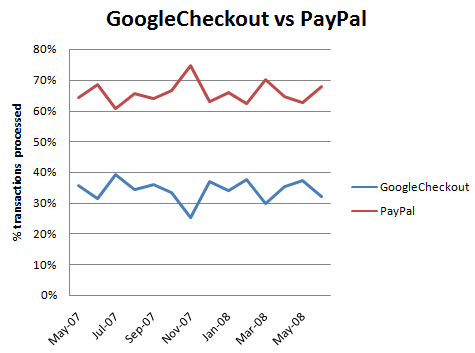
I wrote back into December 2007 that 70% of my customers prefer PayPal over GoogleCheckout, given the choice. I re-checked the figures today to see if GoogleCheckout was gaining traction with my customers. It isn’t.

% of UK customers[1] choosing PayPal vs GoogleCheckout by month

I’m glad. Despite PayPal’s recent flakiness (since improved) and higher transaction fees[2], I still prefer them as a payment processor due to Google’s confidential email option (which a pain in the butt for support), lack of multi-currency support, chargeback fees and slow processing of many orders. It is useful to have an alternative to PayPal though.

[1] GoogleCheckout only lets me accept payment in pounds sterling, so I only offer it to UK customers.

[2] For a £19.95 transaction PayPal charges me £0.68 and GoogleCheckout charges me £0.45. But Google currently refunds transaction fees for 10x my adwords spend, meaning I don’t pay any transaction fees at all to Google in a typical month.

Microsoft adCenter over reporting conversions

I have long suspected that Microsoft adCenter is over reporting conversions. Here is the confirmation from my adCenter reporting:

I am guessing that the purchaser visited the ‘thank you for your purchase’ page (which contains the conversion tracking script) 5 times, for whatever reason. I can’t think of any other way this situation could occur – the conversion tracking isn’t set up to take account of multiple purchases in one transaction. How difficult would it be to only count the first visit? Google can do it.

Being cynical, perhaps the over reporting suits Microsoft? But it makes it much more difficult for me to assess the real effectiveness of keywords and ads. Another good reason to concentrate my efforts on Google Adwords instead.

First charge-back from GoogleCheckout

google_checkout2.gifI have just had my first charge-back through GoogleCheckout. I shouldn’t moan at one charge-back in 8 months use as my secondary payment processor – except:

  • the credit card address was in the UK, the IP address was in the Netherlands and the email address was .ru (Russian Federation)
  • the payment failed authorisation twice, before succeeding a third time

Despite the above, Google apparently just processed the payment automatically, without referring it for further checks. How many Google Phds does it take to write a scoring system that can figure out that this was a suspect transaction? To rub a bit more salt in the wound Google have debited a £7.00 charge-back fee on top of refunding the payment.

I guess Google must need the money.

GoogleCheckout takes 22 hours 28 minutes to clear a payment

GoogleCheckout

I am a big believer in having more than one payment processor. I use PayPal as my main processor with GoogleCheckout and 2Checkout as alternatives (GoogleCheckout for pounds sterling and 2Checkout for dollars). But I haven’t been overwhelmed by GoogleCheckout so far. This is how long the last 10 payments for PerfectTablePlan through GoogleCheckout took to clear:

  • 4 hours 5 minutes
  • 5 minutes
  • <1 minute
  • <1 minute
  • 22 hours 28 minutes
  • <1 minute
  • <1 minute
  • <1 minute
  • 1 minute
  • <1 minute

That is quite some variation. I assume it is due to some orders being flagged for manual fraud checking. This is response I got from Google when I complained:

…for your protection, Google may review certain orders before passing them to you for processing. Some reviews may take slightly longer as Google performs more comprehensive analysis of the order to minimise your exposure to fraud risk.

Our specialists are working hard to address all orders in a ‘Reviewing’ state as quickly as possible. These reviews may take up to 24 hours…

So 22.5 hours appears to be acceptable as far as Google is concerned. But they managed to reply to my support email within a few minutes.

GoogleCheckout may be cheap (effectively free to Google Adwords customers at present) but keeping my customers waiting up to 24 hours for their licence isn’t acceptable to me. It makes me look bad. Go and hire some more people Google – you can afford it. Otherwise PayPal are going to wipe the floor with you as soon as you start charging comparable fees.

Despite the leisurely time they take over fraud checks they still managed to pass a payment with a postal address in Scotland, an IP address in the Netherlands and a Romanian email address. I am still waiting to see if I am going to be charged a £7.50 fee by Google for the privilege.