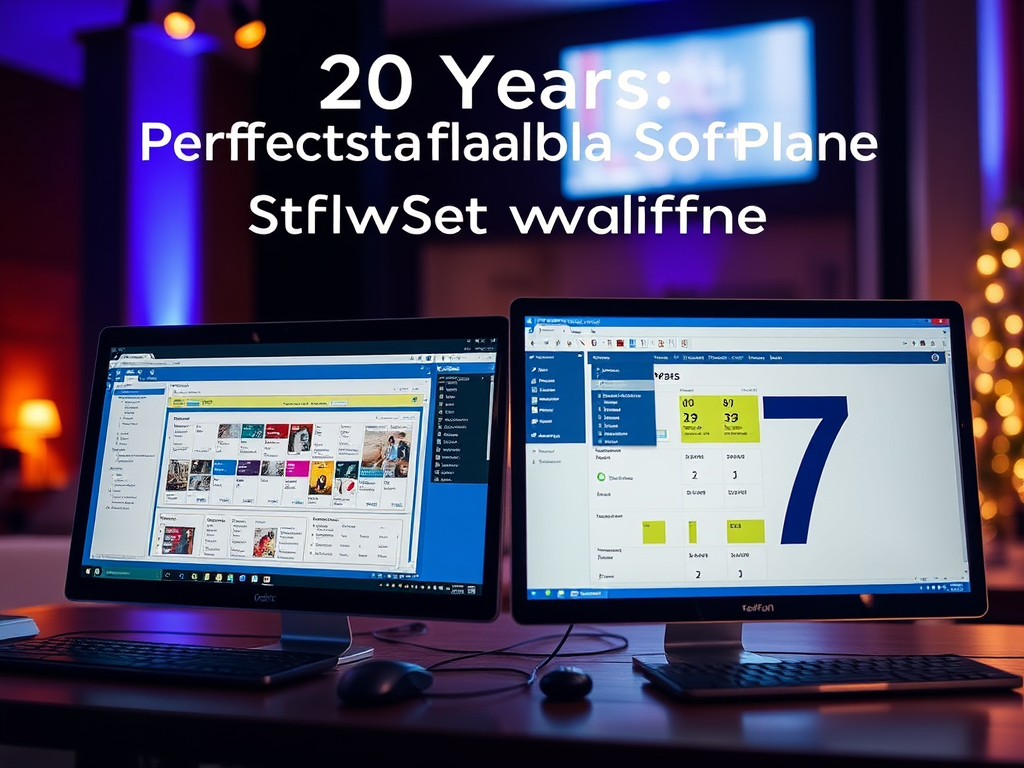
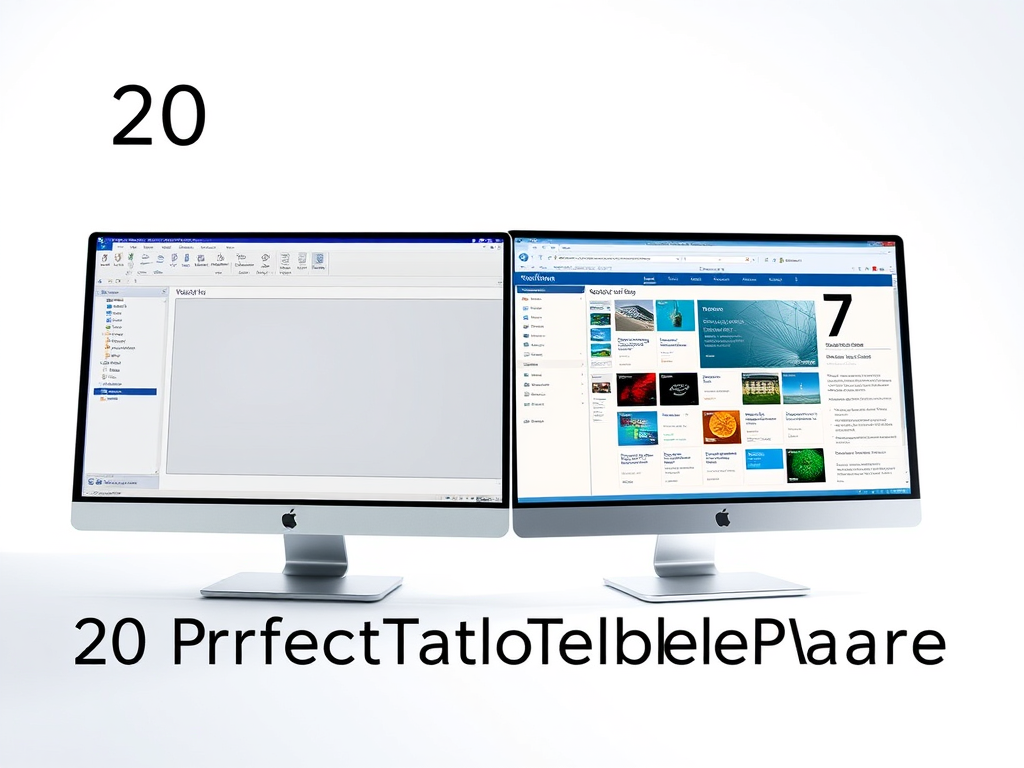
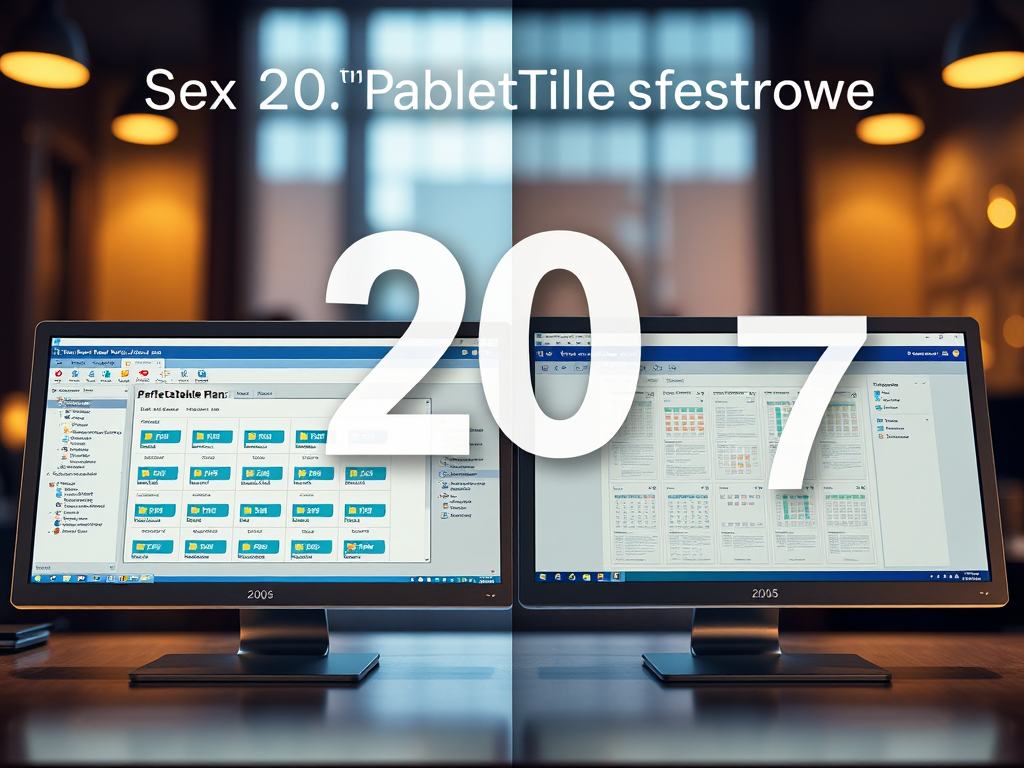
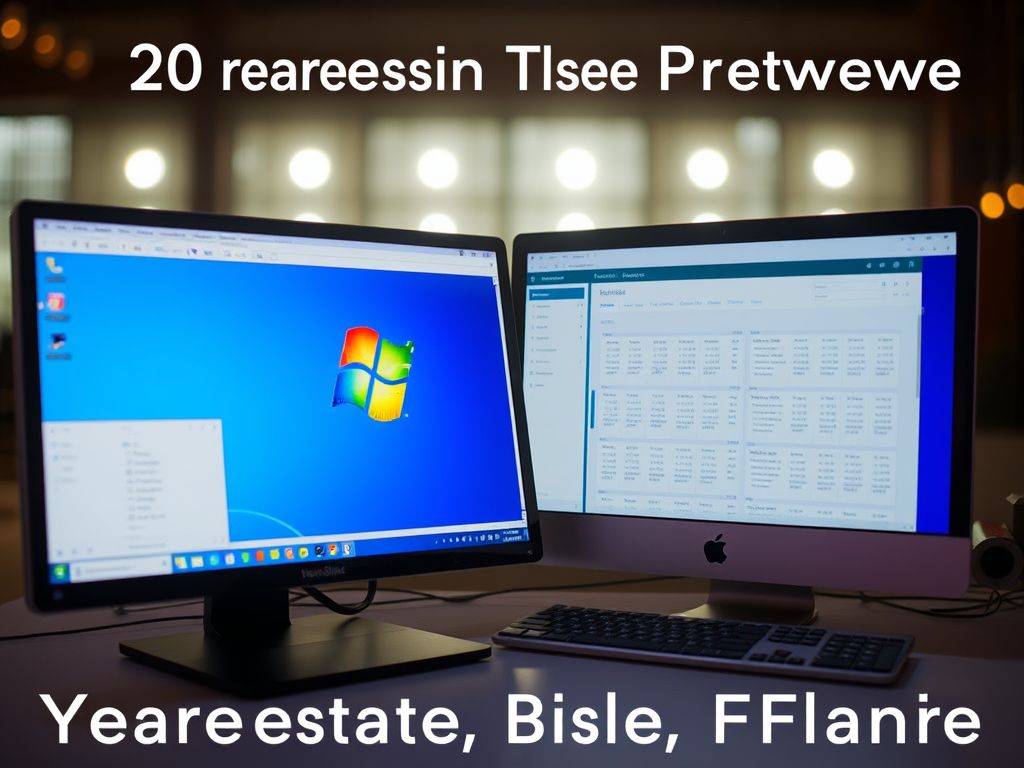
WordPress offered to generate an image for my last blog post. Here is the prompt it suggested:
“Generate a high-resolution, highly detailed image capturing the essence of “20 Years of PerfectTablePlan Software.” The main subjects should be two screenshots side-by-side: one showcasing PerfectTablePlan version 1, reflecting a vintage desktop interface with a Windows aesthetic from 2005, and the other displaying version 7 with a sleek, modern design. The lighting should be bright and inviting, emphasizing the contrast between the older and newer software. The style should blend nostalgia with innovation, showcasing the journey of the product over two decades. Ensure the image has sharp focus and intricate details to attract the reader’s attention.”
And here 5 images it came up with, from that prompt:
They are simulateously very impressive and hilariously awful. Quite apart from the weird text (“sex 20”?), none of the screenshots look even slightly like PerfectTablePlan. I think I’ll pass!
I released version 1 of my table seating planning software, PerfectTablePlan, in February 2005. 20 years ago this month. It was a different world. A world of Windows, shareware and CDs. A lot has changed since then, but PerfectTablePlan is now at version 7 and still going strong.
PerfectTablePlan v1
PerfectTablePlan v7
I have released several other products since then, and done some training and consulting, but PerfectTablePlan remains my most successful product. It’s success is due to a lot of hard work, and a certain amount of dumb luck.
I was getting married and I volunteered to do the seating plan for our wedding reception. It sounded like a relatively straightforward optimization problem, as we only had 60 guests and no family feuds to worry about. But it was surprisingly difficult to get right. I looked around for some software to help me. There were a couple of software packages, but I wasn’t impressed. I could do better myself! So I wrote a (very rough) first version, which I used for our wedding.
Things weren’t going great at my day job, at a small software startup. Maybe I could commercialize my table planner? I was a bit wary, as my potential competitors all seemed rather moribund and I didn’t think I would be able to make a living off it. But I thought I could do everything worth doing in 6-12 months and then start on the next product. Wrong on both counts!
Web-based software was still in its infancy in 2005. So I decided to write it as desktop software using C++ and cross-platform framework Qt, which I had plenty of experience in. Initially, I just released a Windows version. But I later added a Mac version as well. Qt has had its commercial ups and downs in the last 20 years, but it has grown with me and is now very robust, comprehensive and well documented. I think I made a good choice.
I financed PerfectTablePlan out of my own savings and it has been profitable every year since version 1 was launched. I could have taken on employees and grown the business, but I preferred to keep it as a lifestyle business. My wife does the accounts and proof reading and I do nearly everything else, with a bit of help from my accountant, web designers and a few other contractors. I don’t regret that decision. 20 years without meetings, ties or alarm clocks. My son was born 18 months after PerfectTablePlan was launched and it has been great to have the flexibility to be fully present as a Dad.
CDs, remember them? I sent out around 5,000 CDs (with some help from my father), before I stopped shipping CDs in 2016.
During the lifetime of PerfectTablePlan it became clear that things were increasingly moving to the web. But I couldn’t face rewriting PerfectTablePlan from scratch for the web. Javascript. Ugh. Also PerfectTablePlan is quite compute intensive, using a genetic algorithm to generate an automated seating plan and I felt it was better running this on the customer’s local computers than my server. And some of my customers consider their seating plans to be confidential and don’t want to store them on third party servers. So I decided to stick with desktop. But, if I was starting PerfectTablePlan from scratch now, I might make a different decision.
Plenty of strange and wonderful things have happened over the last 20 years, including:
PerfectTablePlan has been used by some very famous organizations for some very famous events (which we mostly don’t have permission to mention). It has seated royalty, celebrities and heads of state.
A mock-up of PerfectTablePlan, including icons I did myself, was used without our permission by Sony in their ‘Big day’ TV comedy series. I threated them with legal action. Years later, I am still awaiting a reply.
I got to grapple with some interesting problems, including the mathematics of large combinatorial problems and elliptical tables. Some customers have seated 4,000 guests and 4000! (4000x3999x3998 .. x 1) is a mind-bogglingly huge number.
A well known wedding magazine ran a promotion with a valid licence key clearly visible in a photograph of a PerfectTablePlan CD. I worked through the night to release a new version of PerfectTablePlan that didn’t work with this key.
I once had to stay up late, in a state of some inebriation, to fix an issue so that a world famous event wasn’t a disaster (no I can’t tell you the event).
The lowest point was the pandemic, when sales pretty much dropped to zero.
Competitors and operating systems have come and gone and the ecosystem for software has changed a lot, but PerfectTablePlan is still here and still paying the bills. It is about 145,000 lines of C++. Some of the code is a bit ugly and not how I would write it now. But the product is very solid, with very few bugs. The website and user documentation are also substantial pieces of work. The PDF version of the documentation is nearly 500 pages.
I now divide my time between PerfectTablePlan and my 2 other products: data wrangling software Easy Data Transform and visual planner Hyper Plan. Having multiple products keeps things varied and avoids having all my eggs in one basket. In May 2024 I released PerfectTablePlan v7 with a load of improvements and new features. And I have plenty of ideas for future improvements. I fully expect to keep working on PerfectTablePlan until I retire (I’m 59 now).
It is the Royal Wedding tomorrow and everything has gone Royal Wedding crazy here in the UK. I did send the happy couple a complimentary copy of my Perfect Table Plan software a while ago. I haven’t heard anything back, but I will be checking my support emails tomorrow morning, just in case. ;0)
I am doing my bit to cash in honour the occasion by putting the Home Edition of Perfect Table Plan on one-day discount site BitsDuJour on the big day. 51% off for 29th April only.
After the discount, BitsDuJour’s commission and support costs, I won’t be making much per sale. But I figure it might be worth it for the exposure to a different audience. Also some of the purchasers might upgrade later. My product is rather different to most of the other products featured on BitsDuJour, so it will be interesting to see how it does.
Will you, or anyone you know, be planning a seated event (wedding, charity gala, award ceremony etc) in the future? If so, you can get the 51% discount here.
Mike Dulin has just uploaded an MP3 of an interview we did at SIC 2009 for Sharewareradio.com. In the 15 minutes we discuss marketing, how I got started with PerfectTablePlan, ads, the wedding industry, newsletters, the ASP, this blog and more. There are some problems with the recording levels, but hopefully that doesn’t detract too much.
I was recently interviewed by Bob Walsh and Patrick Foley for The Startup Success Podcast, episode 25. We cover a wide ange of topics including: microISVs, conversion ratios, being specific, PerfectTablePlan, usability, the global recession, software award scams, ‘works with vista’ certification, stackoverflow.com and twitter. I wonder how much I have to pay them to edit out the ‘ums’?
I need some help with a mathematical problem. A geometry problem to be specific.
Congratulations on reading this far. One of the features of Perfect Table Plan is the drawing of tables and seats on scale floor plans. The user can optionally specify how many seats and let the software calculate a sensible table size so that all the seats touch the table and their neighbouring seats. This saves the user time and produces tidy looking floor plans. Calculating the table size is trivial for square or rectangular tables. It is a bit more complicated for circular tables. But, after a bit of head scratching, I managed to work it out. Placing the seats around the circle is then trivial.
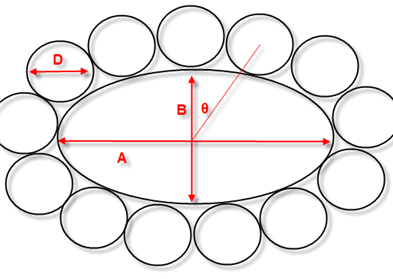
But my customers keep asking for oval (elliptical) tables, with that callous disregard customers have for how difficult a problem might be [1]. Here is the problem.
We have an ellipse E with axes A and B surrounded by N identical circles of diameter D. Each circle touches the ellipse and each of its 2 neighbours at one point, as shown above. Given N, D and the ratio A/B what is A? Given A, what is the angle THETA subtended by the centre of each circle to the centre of E?
I doubt there is an exact analytic solution to this problem. I have some vague ideas about how to tackle it. I can work out the approximate circumference C’ of an ellipse E’ that passes through the centre of all the seats (axes A+D and B+D) using the formula derived by Indian mathematical prodigy Ramunajan.
From this we should be able to work back to A. As N becomes large C’ will tend to N*D. For smaller N, C’ will diverge from N*D so we might have to use an iterative method[2] to calculate A, but we can use the approach above to get a starting value for A and then iterate numerically from there.
I am less sure about how to work out the angle THETA for each circle. But if we pre-compute the angles of, say, 100 equally spaced points around E we could use these to interpolate the position of N circles where N is <= 100. It might be OK to place the first circle at THETA=0 for all values of N>0, I’m not sure.
Several hours on Google didn’t turn up a solution. Surely I am not the only person to have tackled this problem in human history? Can anyone point me at a workable solution? Preferably with code.
Alternatively can somebody write me the code to solve the problem? Maybe there is someone out there with a mathematical background that would relish the challenge? I am prepared to pay for working code that I can use in PerfectTablePlan (a few hundred dollars, negotiable).
To simplify things we can assume a fixed value of A/B, say 1.5 .
It needs to work for N from 1 to 99.
The solution doesn’t need to be exact, but it has to look OK to the human eye. No overlaps and no big gaps.
Low values of N might need to set up as special cases. E.g. it isn’t possible to get all the circles to touch if N <=6 (and possibly higher values of N depending on A/B).
The solution must be returned in a reasonable time, ideally under 0.001 seconds and definitely less than 0.01 seconds. It can store pre-computed values, e.g. in an array. But it mustn’t require excessive memory.
The code needs to be in a form I can easily convert to C++. C, Java, BASIC or Python should be fine. Haskell not so much.
Ideally it should come with a simple GUI that allows me to set the value of N and D and see the result visually.
If you want to be paid I need to be able to buy all rights to the code and it mustn’t be released into the public domain (i.e. don’t post the code on this blog). In the unlikely event I get more than one set of working code, I will pay for the best solution according to the above criteria. Contact me for more details.



 It is the Royal Wedding tomorrow and everything has gone Royal Wedding crazy here in the UK. I did send the happy couple a complimentary copy of my
 I was recently interviewed by Bob Walsh and Patrick Foley for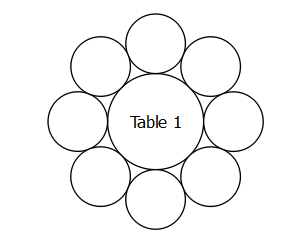

 Successful Software