
Category Archives: marketing

TrialPay results

trialpayTrialPay is an interesting idea. In basic terms:

  • merchants (e.g. microISVs like me) want to sell products, such as software
  • customers want to get a product without paying for it
  • advertisers (such as Netflix and Gap) want to sell their goods

TrialPay brings the 3 together by letting the customer get the merchant’s product for ‘free’ by buying something from the advertiser. The advertiser then pays the merchant, with TrialPay taking a cut. The merchant gets paid, even though the customer might not have been prepared to pay the price of their product. The customer gets your product ‘free’ by buying something else, which they might have wanted anyway. The advertiser gets a new customer. TrialPay get some commission. Everyone is happy. I decided to give it a try and signed up in October last year.

get_it_free

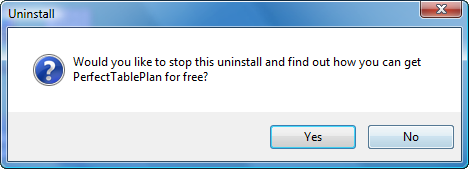
I decided not to mention the TrialPay offer on my main payment page. I could visualise eager potential buyers of my table plan software, credit card in hand, being distracted by the TrialPay ‘Get it free’ logo. Off they would wander to the TrialPay pages and become so engrossed/confused/distracted by the offers there, they would forget all about my product. Sale lost. Instead I modified my Inno setup Windows installer to pop up the following dialog when someone uninstalls the free trial without ever adding a licence key:
trialpay_uninstall

If they click ‘No’ the software uninstalls. If they click ‘Yes’ they are taken to the PerfectTablePlan TrialPay page. I hoped that this would entice some of those who had decided not to part with $29.95 to ‘buy’ PerfectTablePlan anyway through TrialPay.

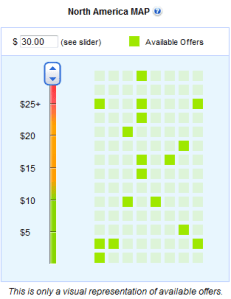
TrialPay allows you to set the mimum payout to any level you like. You can also vary the payout by customer country (e.g. less for poorer countres). The lower the minimum payout you set, the more advertisers deals are available to customers (and presumably the higher the chance of a conversion).

The Minimum Acceptable Payout (or MAP) is the lowest amount you are willing to accept per transaction and determines which advertiser offers are available to your customers. The lower the minimum, the more offers that will appear for your product and the more likely a user is to find an offer that compels him to complete his transaction. While you may set a low MAP, your average payout will greatly exceed the minimums you set. (from the TrialPay website)

It quickly became apparent that very few advertisers offer deals that pay the $29.95 I charge for my product (possibly none, in some countries).
trialpay map

I set a minimum payout of $25 in rich countries and $20 in poorer ones. After a few weeks with no TrialPay conversion I reduced the mimum payout to $20 in rich countries and $15 in poorer ones. TrialPay suggested that a $2 minimum payout was optimal in Africa and Central America if I was accepting $20 in the USA. $2? I don’t think so. That doesn’t even cover the cost of answering a support email. Especially if they aren’t a native English speaker.

I also gave the TrialPay option a mention in my PerfectTablePlan newsletter. Most of the recipients already have licences, but I hoped that that they might forward it to friends and colleagues.

The results to date have not been encouraging. Lots of people have gone to the PerfectTablePlan TrialPay page (approximately 1 for every 10 downloads), but the conversion rate has been dismal. The total number of TrialPay sales since I signed up over 7 months ago is two, for a total of $43.60. That certainly isn’t worth the time it took me to sign up, modify the installer and test the ecommerce integration with e-junkie. I am not sure why the conversion rate was so poor:

  • The TrialPay landing page isn’t compelling enough?
  • The advertiser offers aren’t attractive enough?
  • The concept of TrialPay is too complicated?
  • People are suspicious of ‘free’?

TrialPay’s poster child LavaSoft claim an impressive  5,000 additional sales per month through TrialPay. At $26.95 per licence this is an additional $1.6 million per year. But the numbers look a bit less impressive on closer inspection. 5,000 additional sales/month from 10 million visitors/month is only an extra +0.05% conversion rate[1]. And TrialPay probably didn’t pay out the $26.95 per licence Lavasoft normally charge. It is also noticeable that TrialPay only seems to get a mention on the download page of their free product, not the products they charge for.

Obviously the only way to know for sure whether TrialPay will work for you, is to try it. Your results might be very different from mine. If you do still want to try TrialPay, you can find out some details of how to integrate it here [2].

[1]I am being a little unfair here, as the quoted 10 million visitors probably aren’t just for Lavasoft’s Ad-Aware product.

[2]Note there is a bug in some older versions of Inno setup which means you can’t continue with the uninstall if they click “No” when you display a dialog, as shown above. So, if you are using Inno setup (which I recommend highly), make sure you are using v5.2.3 or later.

Interviewed on the Startup Success Podcast

startup-success-podcastI was recently interviewed by Bob Walsh and Patrick Foley for The Startup Success Podcast, episode 25. We cover a wide ange of topics including: microISVs, conversion ratios, being specific, PerfectTablePlan, usability, the global recession, software award scams, ‘works with vista’ certification, stackoverflow.com and twitter. I wonder how much I have to pay them to edit out the ‘ums’?

Download the MP3

Twitter backlash begins?

Vodpod videos no longer available.

From current.com via Sean Prescott on the ASP members forum.

It didn’t take long for Twitter to move from hype to backlash (although blaming Twitter for the current recession is perhaps a little unfair). Dave Collins offered a $100 Amazon voucher to anyone who could convince him there was a business case for spending his time on Twitter. None of the responses convinced me it was a good use of my time. My favourite was from Mark Roseman:

I find myself sometimes drifting back towards improving my software, answering email (email! can you believe it?) from customers, or other arcane activities, but I know these are just procrastination techniques, dragging me away from the truly important work of Twittering.

To me the real question isn’t whether Twitter has any value, but whether it is the most useful thing you can be doing with your time. What business value does Twitter have?:

  • Updating your customers: What is wrong with a newsletter? I would like to think a lot of my customers love my software, but surely even its most ardent fans don’t need updates several times per day? Only a stalker needs to know what you are doing in real time.
  • Following others: I tried using Twitter to follow a few people who write excellent blogs. This experiment only proved that even intelligent and articulate people can’t write anything useful in 140 characters. Following the links posted can be entertaining, but is a black hole for productivity.
  • Monitoring conversations: I can set up a search and appear, genie like, every time someone types the relevant phrase. But this sort of 1:1 marketing doesn’t scale very well and it can come across as creepy/spammy.
  • Increasing your online presence: Twitter is touted as another way to increase your online ‘foot print’. I can see some value to ‘tweeting’ a link to each post you write for Twitter searches to find, but I doubt it would lead to much additional traffic.

Isn’t Twitter just ICQ for “web 2.0”? How long before Twitter is overrun with spam from bots? Will they ever fix their scaling issues (I saw the ‘fail whale’ a fair number of times in my limited dabblings)? Can Twitter save us from swine flu?

Perhaps the real business value of Twitter is that it distracts your competitors while you get on with improving your product, improving your marketing and giving great support.

The truth about conversion ratios for downloadable software

conversion funnel?Overview

An anonymous survey of software vendors shows that the average sale to visit ratio is very close to the much quoted “industry average” of 1%. However the data shows large variations between products and across different sectors (e.g. Windows vs Mac OS X).

The data

The data set comprises 92 valid survey responses to an 8 question survey in April 2009. The survey was advertised through a request on this blog, posts on  BOS, ASP, MACSB, OISV and BOSnetwork forums and emails to the author’s contacts. The results are inevitably biased towards small software vendors, due to the places where the survey was advertised. As the survey was anonymous it is impossible to verify the accuracy of the data. However it is unlikely that many vendors would have completed a survey that wasn’t anonymous.

The survey consisted of 3 compulsory questions (unique visits, downloads and sales over a given timeframe) and 5 optional questions (the time frame of the data, primary market, primary OS, licence price and trial type). One record had 0 visits (an iPod app), another had 0 downloads (presumably a web app) and a few had numbers that I didn’t consider statistically valid for some purposes (e.g. <500 visits per month or <3 sales transactions per month).  I did the best I could with the data available, ignoring obvious outliers in some cases.

The data set comprises a total of:

  • 8.1 million unique website visits
  • 2.2 million downloads
  • 110 thousand sales transactions

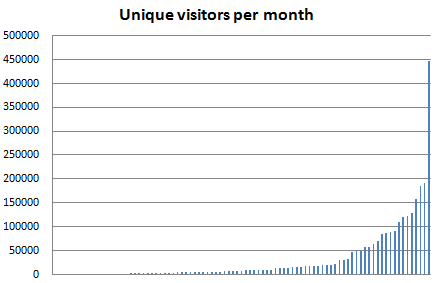
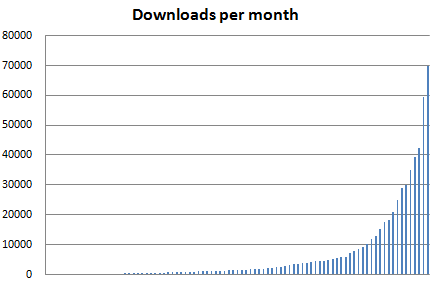
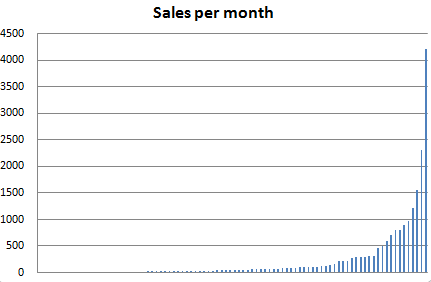
Where a time frame for the results was given it is possible to work out the range of visitors, downloads and sales per month.

metrics_all_visitors

metrics_all_downloads

metrics_all_sales

Interestingly the distribution of monthly visits, downloads and sales across the different products all follow the Pareto 80:20 power law quite closely:

  • 22% of the products account for 80% of the visits
  • 21% of the products account for 80% of the downloads
  • 19% of the products account for 80% of the sales

This gives me some faith that the data is reasonably accurate and representative of the industry as a whole.

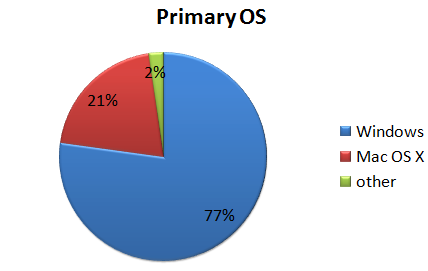
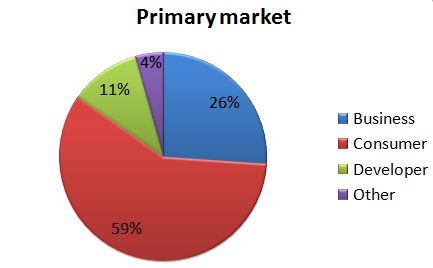
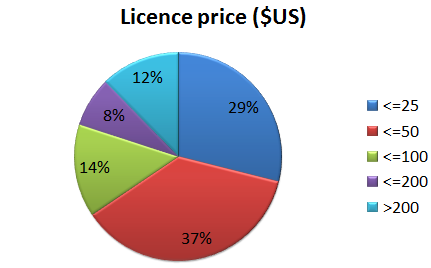
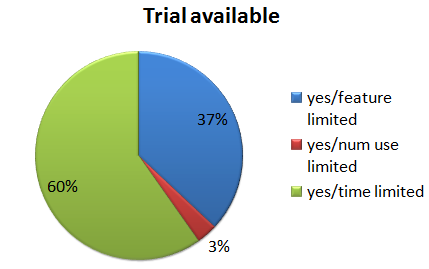
The data is broken down by OS, market, price and trial type as follows:

metrics_all_os

metrics_all_market

metrics_all_price1

metrics_all_trial

Analysis

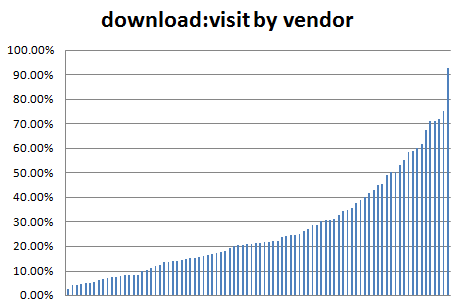
The average (mean) ratio of downloads:visits across all products is 28%. 50% of products are in the range 12.1% to 35.3%.

metrics_download_visit_ratio

I am surprised at how high the average ratio is. This could partly be due to products that receive a high percentage of downloads from download sites, without the downloader ever visiting the product site. Conversely sites where visitors make frequent returns after purchase (e.g. to read forums) will have a lower downloads:visits ratio.

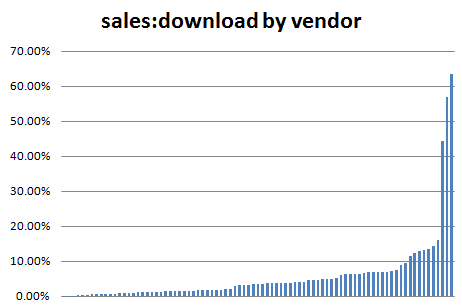
The average ratio of sales:downloads across all products is 4.5%. 50% of products are in the range 1.3% to 6.4%.

metrics_sale_download_ratio

The average sales:downloads ratio is noticeably lower than the average downloads:visits ratio. The sales:downloads ratio is noticeably skewed on the right of the graph – a sales:downloads ratio >20% seems very high.

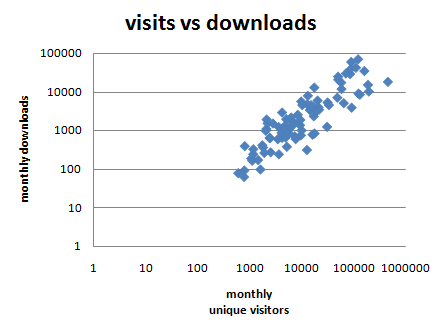
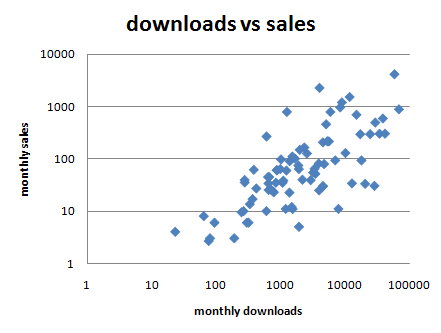
The (logarithmic) scatter plots below show that the downloads:sales ratio varies a lot more than visits:downloads ratio.

metrics_visits_vs_downloads

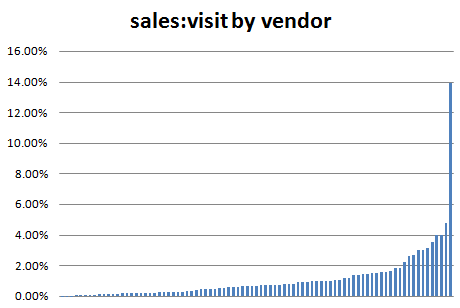
metrics_downloads_vs_salesThe average (mean) sales:visits ratio of all products is 1.16%[1]. However one of the product ratios is an obvious outlier at 13.94% (see below). With this outlier removed the average sales:visits conversion ratio across all the products is 0.99%. 50% of products are in the range 0.28% to 1.39%.

metrics_sale_visit_ratio

0.99% is suspiciously close to the mythical ‘industry average’ of 1%. But I haven’t (consciously) massaged the results to get this figure.

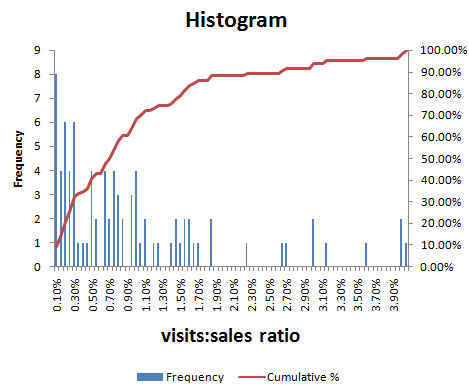
You can work out how you compare to this data set using the red (cumulative) graph in the histogram below. For example, if your product sales:visits ratio is 1.5%, then it is higher than approximately 80% of the products in the data set.

conversion-ratio-distribution2

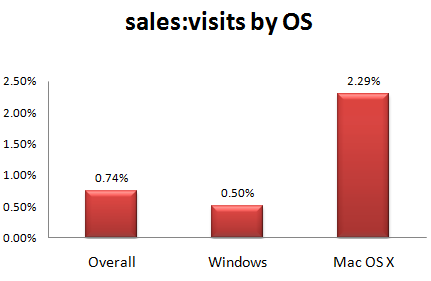
We can also look at how the ratios vary across sectors. Surprisingly the average Mac product conversion ratio is more than 4 times the Windows product conversion ratio.

metrics_sale_visit_ratio_by_os1Even if we try to compare like for like, and only compare consumer products selling for <= $50, the ratios are still 2.27% for Mac and 0.51% for Windows. Possible reasons for this large disparity include:

  • Mac owners more ready to spend money.
  • There is less competition in the Mac software market.
  • Mac vendors have a higher percentage of purchasers  who never visit their site due to higher quality of Mac download sites.
  • It is a statistical blip (there are a lot less Mac products in the survey).

My own experience with selling a cross-platform product (Perfect Table Plan) on Windows and Mac OS X is that the Mac sales:visits ratio is approximately double that for Windows.

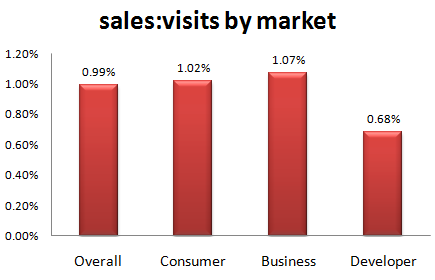
The sales:visits ratio is similar for business and consumer products, with developer products lagging behind. However there are too few developer products in the data set to draw any real conclusions.

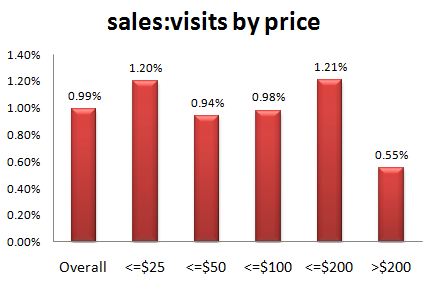
metrics_sale_visit_ratio_by_market1The sales:visits ratio does vary across the price range. However there are too few products with price >$50 in the data set to draw any real conclusions.

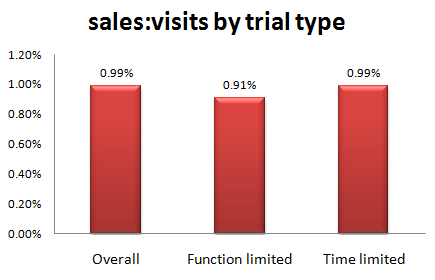
metrics_sale_visit_ratio_by_price2The sales:visits ratio does not seem to vary significantly by trial type. There were insufficient ‘number of use’ trial products to include them.

metrics_sale_visit_ratio_by_trial1

Conclusion

One has to be careful about drawing conclusions from a relatively small and unverifiable data set. However the results certainly seem to support the much-quoted “industry standard” sales:visits conversion ratio of 1%. But there are huge variations between products.

The fact that the sales:downloads ratio is both lower on average and more variable than the downloads:visitors ratio implies that getting people to download is the easy bit and converting the download to a sale is a tougher challenge.

The average sales:visits conversion ratio is noticeably higher for Mac OS X products than Windows products. This is supported by anecdotal evidence and the author’s own experience with a cross-platform product. However the number of Mac respondents to the survey is too small for the result to be stated with any great confidence. Also remember that the Mac market is still a lot smaller than the Windows market before you rush off to start learning Cocoa and Objective-C.

These ratios can be useful for a number of purposes, including: identifying a bottleneck in your conversion funnel (is your downloads:visitors ratio low compared to other products?); estimating how much traffic you might need for a viable business; or estimating how much you can afford to bid on Google Adwords. And it is useful to track how these ratios change over time (I track mine on a monthly basis). But make sure you compare like with like if you are comparing your ratios with other products. For example, a 10% sales:downloads ratio might be achievable for a niche business product, but unrealistic for a casual game. And remember that these ratios are only one part of a bigger picture. There are other, more important, metrics. Profitability for a start.

The data set is available here:

Raw data (some invalid records deleted), CSV format

Processed data, Excel XLSX format

Feel free to publish your own analysis. Thank you to everyone that took part in the survey.

[1] Calculating the mean of all the ratios probably isn’t the way a proper statistician would do it. But anything more seems overkill given the limited size and unverifiable nature of the data set.

Is the average visitor conversion ratio really 1%?

We have probably all heard that the industry standard conversion rate is 1%. But where did this data come from? Is that the visitor to sale ratio or download to sale ratio (I have seen it quoted for both) and just how standard is it across the industry? I have put together a survey in an attempt to find out.

There are 8 questions in the survey, but only 3 are compulsory. It should only take you a few minutes to complete and it is completely anonymous. The results will be posted on this blog, assuming I get enough responses to make it worthwhile. If you are selling downloadable commercial software on the web then please spare a few minutes to do the survey.

Click here to go to the survey

** Update : the survey is now closed **

GraphicDesignerToolbox

I launched my product a year ago, but so far haven’t had much luck selling it. I desperately needed advice from a person that could take a look at my situation and help figure out what’s wrong and how to move on. Andy Brice has been through all this and knew exactly what I was struggling with.

Simon Strandgaard, www.GraphicDesignerToolbox.com

gdt-screenshot

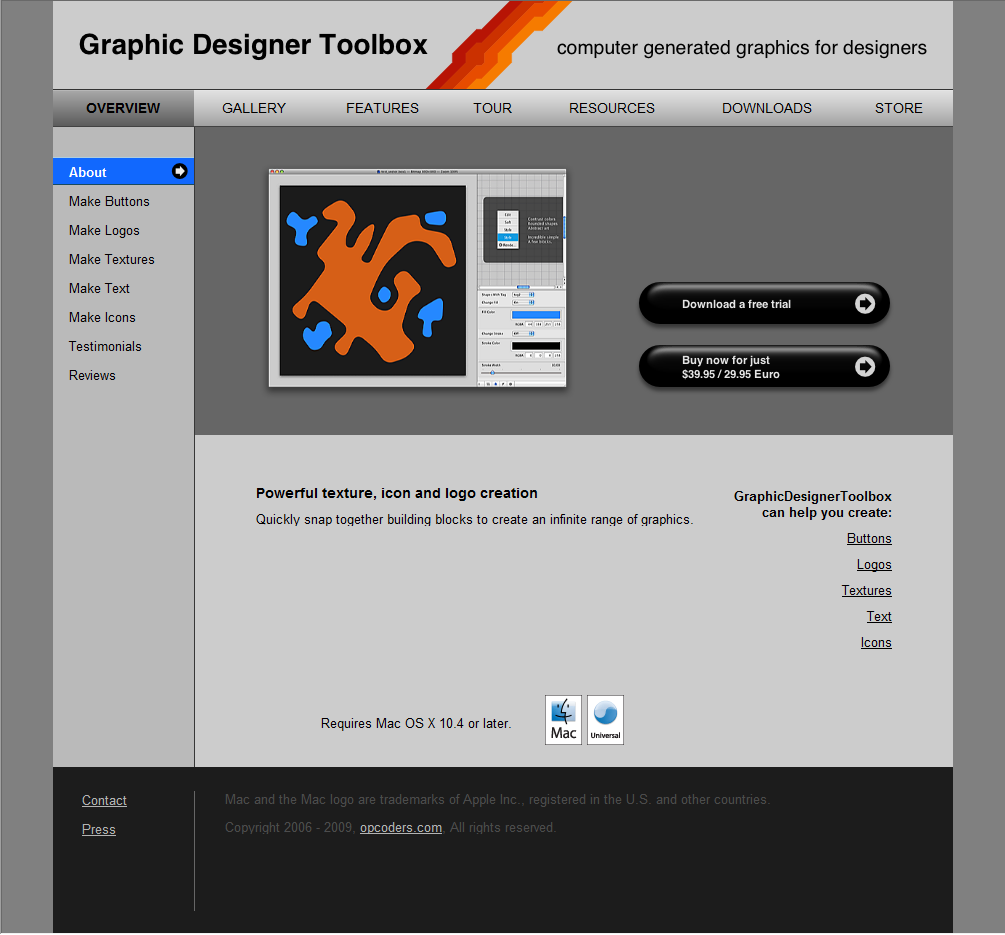
GraphicDesignerToolbox is a Mac OS X application for creating computer generated graphics. It allows users to snap together generative and filter blocks to create a vast range of different types of images, without any drawing or programming. It is an impressively slick and well engineered piece of software. But sales were unsatisfactory. I did some consulting for the author, Simon Strandgaard, focussed on improving the marketing and the user’s initial experience of the product. As a result he has made a lot of changes, including:

  • Re-thought the product positioning, marketing message and target customer.
  • Renamed the application to GraphicDesignerToolbox (from the less descriptive ToolboxApp).
  • Moved the website from ToolboxApp.com to GraphicDesignerToolbox.com.
  • Commissioned a new application icon.
  • Completely rewritten the website.
  • Improved the initial user experience with a quick tour and easy to load samples.
  • Improved the product documentation.
  • Changed the trial model.
  • Increased the price.
  • Released version 1.0.

You can see captures of old and new versions of the website below:

toolboxapp_cropped1

Old home page - click to enlarge

graphicdesignertoolbox

New home page - click to enlarge

It is has been very rewarding to see the product and marketing improve so much in just three months. Especially as someone else was doing all the hard work! I think the changes are a huge improvement all round and I wish Simon and GraphicDesignerToolbox every success. v1.0 was released today and Simon tells me he has sold as many licences today as in the previous 5 months.

If you have a Mac you can head over to GraphicDesignerToolbox.com and download the trial.

I will be speaking at SIC 2009

sic2009I will be giving a talk entitled “10 mistakes microISVs make” at the Software Industry Conference 2009 (July 16-18, Boston). The talk will be based around 10 of the most common mistakes I see as a member of the microISV community, as a buyer of software and as a consultant to microISVs (some of which I have made myself).

SIC is the largest conference aimed at microISVs, shareware authors and other small software vendors. This will be the first time I have been to SIC and I am really looking forward to it.

Registration for SIC is only $229 if you register before 1st April.

The two types of reseller

resellersIn theory, the Internet allows customers to find products without the need for middlemen (unless you count Google). In reality, the age of full disintermediation has not yet arrived, and perhaps never will. Middlemen are still important. One of the more important types of middlemen for a software vendor is the reseller. However it is important to realise that there are two completely different types of reseller. One can be very useful to you as a software vendor, the other is generally a pain in the backside. They should be treated accordingly.

Value added resellers

A value added reseller buys your product and then resells it to their customers. Usually they will buy from you at a discount and resell to their customer at full price, pocketing the difference. Typically a reseller will expect between 25-50% discount depending on a range of factors including what services they provide (e.g. localisation and support), the price of the product  and volumes sold. Often the discounts are on a sliding scale, with the discount increasing with sales volume. This type of reseller can add value for you and the cusomer in various ways. They may:

  • have expertise in markets that you don’t
  • be able to reach markets that you can’t, due to barriers of language, culture or geography
  • localise your product and marketing materials
  • provide first level support.
  • sell your software as part of a package including other services, software and/or hardware.

However there are a few things you have to look out for:

  • You don’t want to end up competing directly against your own resellers in existing markets.
  • Resellers may undercut you on price.
  • Beware of offering any sort of exclusivity.
  • Customers may sign up as resellers just to get a discount for a single purchase.

You can try to avoid direct competition with resellers by only picking resellers in different markets. You may also be able to specify certain terms and conditions, for example that they can’t bid against you on certain phrases in Google Adwords. But, depending on the law where you live, you can’t tell a reseller what to charge the customer. For example, under UK law, this is considered  ‘price fixing’ and is illegal. So make sure you charge a reseller a percentage of your recommended price, not a percentage of their sale price, to make price cutting less attractive. For example, if your product retails for $50, charge the retailer X% of $50. Not X% of what they sell for. Otherwise they could undercut you by selling for $30, and still make a profit, or even give your software away for free.

Resellers will often ask for exclusivity. Exclusivity can provide extra motivation to the reseller (a reseller won’t want to put a lot of effort into marketing your software if you can pull the plug at any time for no reason), but what if the reseller loses interest in your product?  It happens. You could be left in a very bad position unless you can terminate the agreement. So you should agree some sort of minimum volume of sales for a reseller to retain exclusivity.

Offering a sliding scale discount with no discount for the first purchase will discourage customers from trying to take advantage of reseller discounts.

Value subtracted resellers

The other type of middleman that call themself a reseller are really just acting as outsourced purchasing for your customer. They buy your software on the customer’s behalf so that the poor darlings in the customer’s accounts department only get a single invoice for software sales per month, instead of one per vendor. They don’t add any value at all as far the vendor is concerned.  In fact they just make the vendor’s life more difficult by getting between the vendor and the real customer. I had one reseller of this type who, after some twenty emails exchanged, failed to workout how to buy my software from my website. How dim can you be that you can’t click a ‘buy now’ button and fill in a few details when that is what you do for a living? Hence I call them ‘value subtracted resellers’.

This type of reseller will often ask for a discount. Don’t give it to them. The real customer has probably already instructed them to buy your product, so a discount won’t help to close the sale. Also the reseller might pocket the discount instead of passing it on to the customer. If anything, charge them more.

GoogleCheckout price increase

googlecheckoutIt was always on the cards that Google was going to raise the prices of their payment processing service, GoogleCheckout. Up till now I had effectively used GoogleCheckout for free, as they offset their 1.5% + £0.15 processing fee against my Adwords spending. But they are dropping the Adwords offsetting and introducing a new tiered pricing structure.

As I put most of my payments through PayPal I will probably be on the highest price tier of 3.4% + £0.20 per transaction. This means that a £19.95 sale will cost me £0.88 (4.4%) through GoogleCheckout as opposed to the £0.68 (3.4%) I pay through PayPal. I wouldn’t mind the higher fees if I got a better service than PayPal. Unfortunately GoogleCheckout still has all the flaws I commented on back in April 2007, namely:

  • Google still don’t accept payments in more than one currency (e.g. as a UK resident I can only accept payments in £). Expecting anyone outside the UK to pay in £ is a very bad idea.
  • Delays between customer purchase and payment clearance result in angry and/or confused emails from customers wondering why their licence key hasn’t arrived. This has improved since the early days of GoogleCheckout, but it is still an issue.
  • Google’s option to anonymise the customer email address is a royal pain in the backside for the vendor.  It causes me of lots of wasted time and unecessary emails.
  • The customer *has* to sign up for a GoogleCheckout account (unlike PayPal).
  • There is a £7 chargeback fee (PayPal don’t charge a chargeback fee).
  • Customers prefer PayPal.

About the only advantage of GoogleCheckout is the GoogleCheckout badge that appears alongside your Google Adwords ad. In their email to me explaining the price rise Google claim:

Advertisers who use Checkout have the opportunity to display the Checkout badge on their ads, which has proven to  be an effective way to differentiate ads and attract user interest. Checkout users click on ads 10% more when the ad displays the Checkout badge and convert 40% more than shoppers who have not used Checkout in the past.

My own measurements showed a worthwhile effect from the GoogleCheckout badge, but I am not convinced it is worth the additional problems and expense of GoogleCheckout just to get the badge.

I already push PayPal more than GoogleCheckout (e.g. you have to click a link from my US dollar payment page to see a GoogleCheckout button). The price increases will probably result in GoogleCheckout being pushed further into the background for use just as an alternative for those that don’t like PayPal. I don’t know if Google will punish me by removing my Adwords badge.

Note, in order to continue to use GoogleCheckout from 5 May 2009 onwards, you must login to your account and accept the new Terms of Service between 18 March and 4 May.