
Category Archives: software

Tips on travelling with a laptop

airbus a380I recently returned from a month’s holiday in New Zealand. As a one-man software company I still have to check my email every day, even on holiday. Here are a few tips from my experiences of running my business from a laptop whilst travelling.

Laptop

In theory you can run your business from a Blackberry or a mobile phone that supports email. But it is impossible to answer some support emails if you can’t run your own software. So I took a Toshiba laptop PC with a 13 inch screen with me. I find a 13 inch screen is a good compromise between portability and ease of use. Much bigger and it would have been too bulky. Much smaller and I would have struggled with the screen and keyboard.

The laptop contained my licence key generator and customer database. I owe it to my business and my customers to keep these secure and the Windows password is no protection at all if someone gains physical access to  your machine. So anything sensitive was encrypted using the free Truecrypt software. Whenever I brought the laptop out of hibernation or restarted it I just had to type the password to mount the Truecrypt volume as a virtual drive[1][2].

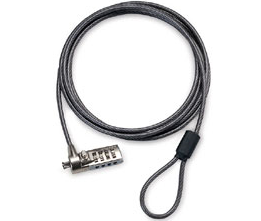
laptop lockI took a combination laptop lock, but I rarely used it. The problem with laptop locks is that the only things strong enough to secure your laptop to are usually in plain view, and a laptop left in plain view is a bit of an invitation. Locked or not. I am also not convinced how strong the laptop security slot is. I suspect an attempted theft would wreck the laptop, even if it wasn’t successful. So I generally prefer to keep the laptop with me or hide it somewhere a crook wouldn’t think to look. I have since found out that laptop locks aren’t even very secure (see here and here). There are still occasions when a laptop lock is better than nothing though. Incidentally, don’t rely on that padlock on your hold baggage either.

The laptop was also invaluable for playing Thomas the Tank Engine DVDs (using Windows Media Player) to keep my little one occupied for part of the very long flights and for backing up photos from the digital camera. I also took a universal power adapter.

Laptop bag

I have a traditional Targus laptop bag with a shoulder strap. But I have found this uncomfortable for carrying a laptop any distance due to the uneven distribution of weight. It also makes it extremely obvious that you have a laptop. A fact I would rather not advertise.

wenger-swissgear-hudson-1wenger swissgear hudson laptop rucksack bagFor this trip I purchased a Swissgear Hudson laptop rucksack from Swiss Army knife manufacturer Wenger. It was much more comfortable to wear with the weight distributed across both shoulders and left both hands free for dealing with passports, boarding passes and a bored two year old. It was small enough to take on to an aircraft as hand luggage, but surprisingly spacious. It also had some useful extras, including: a carry handle, a breathable back and a compartment for an MP3 player. I was impressed with the quality of the construction and finish. My only quibble is that there wasn’t as much padding around the top and bottom of the laptop as I might have liked. So I wrapped my laptop in bubblewrap for additional protection. But on the whole I would recommend this bag highly for travelling.

Back-ups

As well a backup on DVD I also took a 2 Gig USB memory stick that contained everything I would need should my laptop malfunction or be stolen. This included copies of my licence key generator, customer database and various passwords. All the sensitive files were encrypted using the free Axxcrypt software, except my passwords which were encrypted using the free Keepass software. The memory stick also stored various third party software installers (including Axxcrypt and Keepass). I kept the memory stick on a lanyard around my neck when I wasn’t sleeping.

I also stored an additional encrypted back-up on a secure server.

Internet access

Trying to find holiday accommodation that was the right size and budget, in the right location and free at the right time was problematic. Insisting on broadband Internet as well was a step too far. I also wasn’t keen on relying on broadband at accommodation. What if it didn’t work? Relying on Internet cafes seemed an even worse idea. What if I couldn’t find one? And the security issues of using Internet cafes are very real. So I needed my own mobile Internet access.

The roaming charges for using my UK three networks mobile Internet in New Zealand are an outrageous £6/MB. Vodaphone has more sensible roaming charges for some plans, but I couldn’t justify the high monthly price for the occasional trip abroad. So I tried to find a company that would rent me mobile data access in New Zealand for a month, without success. In the end my brother-in-law very kindly sorted me out with a USB mobile modem and a 1GB/mo data plan with Telecom New Zealand. He picked the modem up cheap second-hand on trademe.co.nz and the data plan was of the order of $70NZD/mo, with no minimum term. So, rather than paying >£1000, I ended up paying about £50 (thanks Derek!). There is definitely a business opportunity for someone there.

I am glad I didn’t rely on broadband at the accommodation. It turns out that most of the New Zealand ISPs have restricted SMTP access to prevent spam. So I could receive email via IMAP when plugged in to an xtra.co.nz broadband cable, but I couldn’t connect to their SMTP server to send email. Thankfully I didn’t have this problem with the mobile broadband or I would have been stuck with webmail for a month (the horror!).

Mobile coverage is patchy outside the bigger cities in the South Island of New Zealand, due to the low population density (sheep can’t afford broadband). But I was able to get some sort of signal everywhere we stayed. This might have been helped by the aerial attached to the mobile modem. During the month a I used approximately 40% of the 1GB allowance. I could have used quite a lot less, if necessary.

Stopping over in Singapore I just purchased wifi access from the hotel. It was quite expensive, but I didn’t need it for long. Wifi and hardwired Internet access are available for free in Singapore airport (I couldn’t get the wifi to work, so I just plugged in a network cable).

Conclusion

Running an Internet-based business while travelling isn’t that difficult, with a bit of planning. I doubt my customers even realised I was on holiday. What are you waiting for?

PS/ New Zealand is lovely.

[1] Truecrypt can also encrypt the whole OS, but that seemed excessive for my requirements and I wasn’t sure what impact it would have on performance.

[2] If Truecrypt is so easy to set-up and use, why is it apparently beyond the capabilites of the UK government to encrypt sensitive data?

Photo of Airbus A380 by Claire Brice

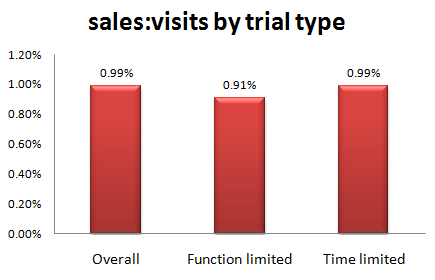
Is the average visitor conversion ratio really 1%?

We have probably all heard that the industry standard conversion rate is 1%. But where did this data come from? Is that the visitor to sale ratio or download to sale ratio (I have seen it quoted for both) and just how standard is it across the industry? I have put together a survey in an attempt to find out.

There are 8 questions in the survey, but only 3 are compulsory. It should only take you a few minutes to complete and it is completely anonymous. The results will be posted on this blog, assuming I get enough responses to make it worthwhile. If you are selling downloadable commercial software on the web then please spare a few minutes to do the survey.

Click here to go to the survey

** Update : the survey is now closed **

Aren’t captchas supposed to be human readable?

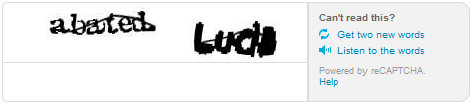
I have been having increasing problems reading the captchas that now permeate everything we do on the web. I realise they are supposed to be hard for bots to read, but it is rather defeating the point if humans can’t read them either. Here are two particularly impressive specimens from twitter.com yesterday:

twitter capcha

twitter captcha

In each case my tired old eyes can just about make out what the first word says, but I haven’t a clue what the second word is. Do you? The above might be slightly lower resolutions than the originals, but not much. Try some more.

In any case, captchas don’t seem to work that well. Most can be cracked by image recognition software and those that can’t can always be beaten by crowdsourcing and free porn. I guess the last hope for captchas is that masturbation really does makes you go blind.

GraphicDesignerToolbox

I launched my product a year ago, but so far haven’t had much luck selling it. I desperately needed advice from a person that could take a look at my situation and help figure out what’s wrong and how to move on. Andy Brice has been through all this and knew exactly what I was struggling with.

Simon Strandgaard, www.GraphicDesignerToolbox.com

gdt-screenshot

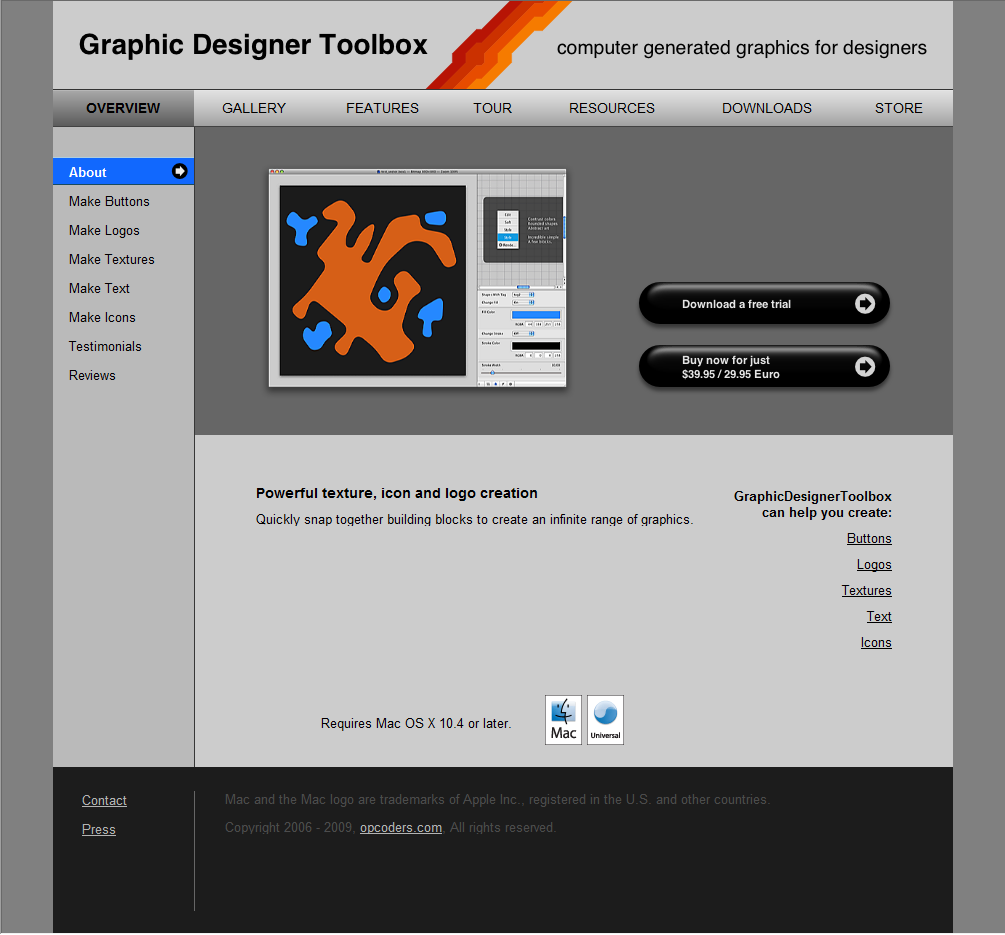
GraphicDesignerToolbox is a Mac OS X application for creating computer generated graphics. It allows users to snap together generative and filter blocks to create a vast range of different types of images, without any drawing or programming. It is an impressively slick and well engineered piece of software. But sales were unsatisfactory. I did some consulting for the author, Simon Strandgaard, focussed on improving the marketing and the user’s initial experience of the product. As a result he has made a lot of changes, including:

  • Re-thought the product positioning, marketing message and target customer.
  • Renamed the application to GraphicDesignerToolbox (from the less descriptive ToolboxApp).
  • Moved the website from ToolboxApp.com to GraphicDesignerToolbox.com.
  • Commissioned a new application icon.
  • Completely rewritten the website.
  • Improved the initial user experience with a quick tour and easy to load samples.
  • Improved the product documentation.
  • Changed the trial model.
  • Increased the price.
  • Released version 1.0.

You can see captures of old and new versions of the website below:

toolboxapp_cropped1

Old home page - click to enlarge

graphicdesignertoolbox

New home page - click to enlarge

It is has been very rewarding to see the product and marketing improve so much in just three months. Especially as someone else was doing all the hard work! I think the changes are a huge improvement all round and I wish Simon and GraphicDesignerToolbox every success. v1.0 was released today and Simon tells me he has sold as many licences today as in the previous 5 months.

If you have a Mac you can head over to GraphicDesignerToolbox.com and download the trial.

I will be speaking at SIC 2009

sic2009I will be giving a talk entitled “10 mistakes microISVs make” at the Software Industry Conference 2009 (July 16-18, Boston). The talk will be based around 10 of the most common mistakes I see as a member of the microISV community, as a buyer of software and as a consultant to microISVs (some of which I have made myself).

SIC is the largest conference aimed at microISVs, shareware authors and other small software vendors. This will be the first time I have been to SIC and I am really looking forward to it.

Registration for SIC is only $229 if you register before 1st April.

The two types of reseller

resellersIn theory, the Internet allows customers to find products without the need for middlemen (unless you count Google). In reality, the age of full disintermediation has not yet arrived, and perhaps never will. Middlemen are still important. One of the more important types of middlemen for a software vendor is the reseller. However it is important to realise that there are two completely different types of reseller. One can be very useful to you as a software vendor, the other is generally a pain in the backside. They should be treated accordingly.

Value added resellers

A value added reseller buys your product and then resells it to their customers. Usually they will buy from you at a discount and resell to their customer at full price, pocketing the difference. Typically a reseller will expect between 25-50% discount depending on a range of factors including what services they provide (e.g. localisation and support), the price of the product  and volumes sold. Often the discounts are on a sliding scale, with the discount increasing with sales volume. This type of reseller can add value for you and the cusomer in various ways. They may:

  • have expertise in markets that you don’t
  • be able to reach markets that you can’t, due to barriers of language, culture or geography
  • localise your product and marketing materials
  • provide first level support.
  • sell your software as part of a package including other services, software and/or hardware.

However there are a few things you have to look out for:

  • You don’t want to end up competing directly against your own resellers in existing markets.
  • Resellers may undercut you on price.
  • Beware of offering any sort of exclusivity.
  • Customers may sign up as resellers just to get a discount for a single purchase.

You can try to avoid direct competition with resellers by only picking resellers in different markets. You may also be able to specify certain terms and conditions, for example that they can’t bid against you on certain phrases in Google Adwords. But, depending on the law where you live, you can’t tell a reseller what to charge the customer. For example, under UK law, this is considered  ‘price fixing’ and is illegal. So make sure you charge a reseller a percentage of your recommended price, not a percentage of their sale price, to make price cutting less attractive. For example, if your product retails for $50, charge the retailer X% of $50. Not X% of what they sell for. Otherwise they could undercut you by selling for $30, and still make a profit, or even give your software away for free.

Resellers will often ask for exclusivity. Exclusivity can provide extra motivation to the reseller (a reseller won’t want to put a lot of effort into marketing your software if you can pull the plug at any time for no reason), but what if the reseller loses interest in your product?  It happens. You could be left in a very bad position unless you can terminate the agreement. So you should agree some sort of minimum volume of sales for a reseller to retain exclusivity.

Offering a sliding scale discount with no discount for the first purchase will discourage customers from trying to take advantage of reseller discounts.

Value subtracted resellers

The other type of middleman that call themself a reseller are really just acting as outsourced purchasing for your customer. They buy your software on the customer’s behalf so that the poor darlings in the customer’s accounts department only get a single invoice for software sales per month, instead of one per vendor. They don’t add any value at all as far the vendor is concerned.  In fact they just make the vendor’s life more difficult by getting between the vendor and the real customer. I had one reseller of this type who, after some twenty emails exchanged, failed to workout how to buy my software from my website. How dim can you be that you can’t click a ‘buy now’ button and fill in a few details when that is what you do for a living? Hence I call them ‘value subtracted resellers’.

This type of reseller will often ask for a discount. Don’t give it to them. The real customer has probably already instructed them to buy your product, so a discount won’t help to close the sale. Also the reseller might pocket the discount instead of passing it on to the customer. If anything, charge them more.

T-shirt update

I’ve have just made the first payout of royalties from T-shirt sales. $106.20 of Zazzle royalties were split evenly between Sightsavers and JaipurFoot. Patrick McKenzie has also made a very generous additional donation as he promised on his blog.

Sales dropped off rapidly after Xmas, so I am probably going to leave programmer-tshirts.com ticking over until Xmas 2009. Thanks again to everyone that bought T-shirts or helped with the publicity. Special thanks to Patrick for setting up the programmer-tshirts.com site on his server.

NB/ You can still buy T-shirts!

The history of marketing, in 3 minutes

The history of marketing, by Scholz & Friends (via the quirky, eclectic and always interesting DarkRoastedBlend.com ). Sound optional.

Outsourcing artwork through 99designs.com

99designsMost software developers have horrible graphics design skills. I am no exception. So I decided to run a contest on 99designs.com for some artwork I wanted to use to promote Perfect Table Plan. I have used DesignOutput.com once before, but I decided to give their competitor a try after seeing the  stackoverflow.com and homedocumentmanager.com logos created through 99designs.

I put up $300 prize money for a humorous cartoon of a seating arrangement gone wrong. Fees cost me an additional $69. The detailed brief is here and I also supplied this rough sketch:

99designs_cartoon

Here is the winner I chose:

99designs_winner

I ran it as a ‘guaranteed’ competition to try and attract more designers I also made an effort to give plenty of feedback on the designs submitted and I let it run the full 7 days. I found the 99designs website easy and intuitive to use. Setting up the competition only took ten minutes or so. My only gripe is that the ‘eliminate’ and ‘choose winner’ buttons are so close together that it would be easy to click the wrong one. You do have to confirm the winning choice however.

Most of the other competitions are for logos and websites, so mine was a little unusual. But I still got over 40 different designs (some variations on a theme) from 20 different designers. You can see the designs here (those that haven’t been withdrawn). The quality of the entries varied, but much of it was really excellent. I am very happy with the winning entry.

99designs seems rather brutal for the designers. 40+ entries is common and some contests get over 1,000 designs entered. This means stiff competition and the designers don’t get anything unless they win. I am guessing that they are mostly students, who are happy for the practice, or living in cheaper parts of the world, where $300 is a significant amount of money. But it certainly offers excellent value for money for those running contests.