
Mailplane

I recently did a day of consulting for Ruben Bakker of  Mailplane. I looked in depth at his marketing and did a screencast of myself downloading, using and buying Mailplane. We also discussed some ideas for a new product. At the end of the process he was kind enough to write me this testimonial:

How can I improve my sales? How can I make my application more profitable? Which of my ideas could be the next software product? With these questions in mind I hired Andy. He evaluated my small business, tested the product, checked the product website/store, and we discussed my strategy. Andy knows the Micro-ISV life and business with all its specialities and constraints. As a result of his work, I’ve now a clear plan and even tools on how to improve my sales. I was already able to put some ideas to work, and they already yielded measurable improvements. And Andy helped me choose my next project, I am now very much looking forward to it.

Ruben Bakker, www.mailplaneapp.com

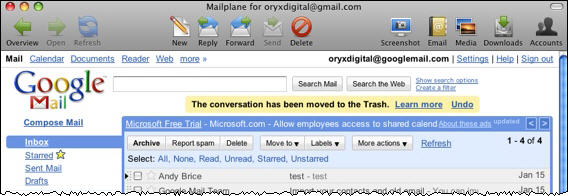
Mailplane is a Mac desktop app that embeds and extends Gmail. For example, Mailplane allows you to drag and drop attachments, something that isn’t possible with Gmail running in a standard browser. This web/desktop hybrid approach potentially gives the best of both world – the richness of a desktop client, with the ability to fall back on the bare web app if required (e.g. from an Internet cafe). I expect to see more web/desktop hybrids in future.

Mailplane is a very polished app and I recommend downloading the free trial if you use Gmail on Mac OS X.

An interesting application of genetic algorithms

I recently watched an interesting BBC documentary called “The secret life of chaos”. It did a good job of explaining how interesting patterns could arise from very simple rules and how these could be further shaped by evolution to create the sort of complexity we see in the living world. It is well worth watching in full.

I have been interested in genetic algorithms for some time and use a genetic algorithm to optimise seating plans in my own PerfectTablePlan software. So I was particularly interested in a segment towards the end, where they showed how naturalmotion.com have used bio-mechanical modelling and genetic algorithms to create virtual humans that can respond realistically to various (unpleasant) physical stimuli, e.g. being shot, being hit or falling off things. The details are sketchy in the TV program, but it appears that they have evolved genetic algorithms that mimic aspects of the human nervous system. For example a human will instinctively put their hands out to cushion a fall or put a hand to an area that has been hit. They then combine this nervous system modelling with physics and a realistic a bio-mechanical modelling of the human anatomy. The results are impressive. You can see them about 2 minutes into the video below.

They claim they can use these models to generate realistic movements for synthetic characters in real time. Their Euphoria software is already being used in computer games, such as Grand Theft Auto IV.

More videos by naturalmotion.com

Haiti disaster relief

David Trump of the ASP is offering free software licences to people who contribute to Haiti disaster relief. This seems like a great idea to me, so I am copying it for PerfectTablePlan. I am going to try it for 24 hours and see how it goes. I am blogging about it here in case other software vendors are inspired to try it.

How to build an igloo

We have had loads of snow here in the UK. Loads by UK standards anyway (I don’t think a Scandinavian would be very impressed). So I decided to take full advantage of the flexibility my job allows and build an igloo. It was my second attempt and it turned out much better than rather wonky one I did a few days ago. This post is a quick overview of the modest amount I have learnt about igloo building, in case you are inspired to build your own.

how to build an igloo

First of all, building materials. The snow needs to be the sort you can squash together to make a snowball. If it is too powdery to stick together, forget it – you won’t be able to make a worthwhile igloo. Try again tomorrow.

Next you need to mark a circular base for your igloo. If you don’t then it is hard to get a decent overall shape. Two twigs and a bit a string is all you need to draw a circular outline. Don’t be too ambitous though, it takes a surpising amount of snow to build an igloo and the amount goes up fast as you increase the diameter. 1.5 to 2 metres diameter is plenty for a first attempt.

Then you need to have a bucket-shaped receptacles in a range of sizes. I used a household bucket as the largest, 2 different sizes of flower pot and a child’s bucket as the smallest. Start with the largest receptacle. Use it as a mould to create ‘snow bricks’. Pack the snow into the mould tightly to make strong bricks. Lay a circle of these bricks as close together as possible, leaving a gap for the door. Then place the next layer of  bricks on top, interleaving them like standard brickwork. Pack the gaps between the bricks with loose snow like mortar in brickwork.

Every few layers you need to swap to a smaller mould. Each layer needs to curve inward a bit more than the previous one to form the dome. It is quite surprising how easy it is to build an arch out of snow. It is stronger and stickier than you might think.

It took 3 adults a couple of hours to complete the igloo. I don’t think the Inuit will be offering us a job anytime soon, but it was very satisfying. Considerably more satisfying than the several hours I spent this morning failing to work out how to get rid of a maximise icon in Mac OS X.

A YouTube video of a similar approach using stacking boxes

Should you offer a money back guarantee?

money back guaranteeA few weeks ago I was going to buy a digitizer tablet for my PC. Then I noticed in the vendor’s terms and conditions that they wouldn’t accept a return once I had opened the packaging. But I couldn’t know if the tablet works until I open the packaging. Duh. I didn’t buy it. Similarly I look for a sensible money-back guarantee whenever I buy software. I don’t remember ever invoking such a guarantee for software, but it is nice to know that I could if I wanted to. Also, I see the lack of such a guarantee as a warning signal that the vendor isn’t confident about the quality of their product.

I offer a 14-day money back guarantee on my own Perfect Table Plan software. The only provisos are:

  • They have to tell me what they didn’t like about my software. This is very useful feedback for me.
  • They have to email me that they have uninstalled the software and won’t use it again. I have no way of checking this, but I want them to be clear in their own mind that they are a liar and a cheat if they carry on using it (if you have read Ariely’s excellent ‘Predictably irrational’ you will know that many people are prepared to be a little dishonest, but few will lie and cheat outright).
  • They have to return the CD, if they purchased one.
  • The guarantee is only valid for 14 days.

But I am fairly relaxed about about all of these. If it is clear that someone thinks they haven’t got their money’s worth out of my software, I will pretty much always give them their money back.

Note that is isn’t a ‘no questions asked’ money back guarantee. I haven’t been quite brave enough to try that yet and really want feedback on why they didn’t like my software. Also the 14 day guarantee is shorter than most. The reason is that a lot of people buy my software for a single use (e.g. their wedding reception) and I don’t want to make it too easy for them to use the software and claim a refund after they have finished with it. However I have heard vendors say that their refund rate actually dropped when they extended the length of their money back guarantee (due to increased procrastination, perhaps). I may test switching to a ‘no questions asked’ and/or longer guarantee period at some point.

The advantages of a money back guarantee to the vendor are:

  • More sales. If they customer is confident they can get their money back they are more likely to buy. I don’t have any numbers to back this up, as I have always had a money back guarantee. But I know I am considerably more likely to buy if there is a money back guarantee. Aren’t you?
  • Less chargebacks. If a customer buys with a credit card they can get their money back anyway. They just have to ring their credit card company and do a chargeback. Your payment processor will then take the payment back and, to add insult to injury, slap a chargeback fee on top. Too many chargebacks and they might even close your account. Better to refund and avoid the chargeback fee.
  • Less bad vibes. No matter how great your software is, some people aren’t going to like it. Maybe your software isn’t a good fit for what they want to do. Maybe they are just having a bad day. Better to give them their money back than to have them bad mouth your product on every forum they can find.
  • Less bad customers. Some customers (thankfully very few, in my experience) cost more in time and mental energy than their licence fee is worth. It is better for you to cheerfully refund them and focus your efforts on more financially and psychologically rewarding customers.
  • Staying legal. You may be legally obliged to give a refund in some circumstances.
  • Good karma. If you aren’t happy, I really don’t want your money.

Generally it costs you nothing to refund a software purchase, apart from a few seconds of your time (depending on your payment processor, some may not refund the processing fee). The only disadvantage of a money back guarantee is that it makes it easier for a customer to cheat you. A lot of vendors worry about this, but in my experience (and of others I have spoken to) this isn’t much of an issue in reality. My refund rate has been consistently around 0.5% (I am not including cases where I refunded because people bought the wrong type of licence, bought 2 licences instead of one etc.). I would be very surprised if dropping my prominent money back guarantee didn’t also drop my sales by a lot more than 0.5%. So, even if all the refunds are fraudulent (which I very much doubt) I am confident that the refund policy increases my profits overall. Sufficiently confident that I don’t intend to run an A/B test any time soon.

Interestingly, my refund rate is 10 times lower amongst customers who have purchased a CD. This could be because these customers are less price sensitive and so don’t see the refund as worth their precious time. Or it could be because of the extra hassle of having to send the CD back (I know a wily B2B vendor who includes a CD with every purchase for exactly this reason). Probably it is a combination of both.

Some vendors think that they don’t need a refund policy if they have a free trial. I don’t agree. When I buy software I want a free trial AND a money back guarantee in case I only discover a problem after purchasing. Also I know (from a survey) that some 25% of my customers don’t even try the free trial of my software before they buy. I expect I would lose a lot of these sales without a money back guarantee.

I think the case for a money back guarantee is even stronger for B2B software. Customers buying B2B software typically aren’t spending their own money, so they are probably less likely to ask for a refund. Especially as this would mean admitting to their boss and peers that they made a mistake buying your software in the first place. Certainly I have a lower refund rate to businesses than to consumers.

From a business point of view, I think the only case where you can justify a no refund policy is when you have a high cost of sale, e.g. enterprise software that requires a lot of configuration. In that case you could include a non-refundable set-up fee that covers your costs, but still have a money back guarantee on the remainder of the purchase.

No doubt refund rates vary according to product type, price range, customer demographics, geographic market and a range of other factors. But , reading forums and talking to other vendors, the typical refund rate seems to be in the range 0.1% to 1%. If your rate is much above 1%, perhaps there is a problem with your product you need to address? If your rate is much less than 0.1%, perhaps you aren’t marketing your product aggressively enough?

In the early days I found it hard not to see refund requests as an insult to my product. But now it really doesn’t bother me and I cheerfully make the refund. I just add the key to a ‘blacklist’ in the software so it won’t work in any future releases.  I don’t attempt to disable it in the current release. I don’t see implementing a ‘phone home’ strategy to make this work as being a profitable use of my time.

In summary, by not giving a money back guarantee you might avoid a small number of customers cheating you. But I think you are very likely to be losing a lot more in chargebacks, missed sales, ill will and missed feedback than you save in fraudulent refunds. Try it. You can always revert back in the unlikely event that your refunds go up significantly more than your sales. And if you have a money back guarantee you should shout about it on your website. Having a money back guarantee and not advertising it prominently seems like the worst of all worlds to me.

Interview for Shareware Radio

Mike Dulin has just uploaded an MP3 of an interview we did at SIC 2009 for Sharewareradio.com. In the 15 minutes we discuss marketing, how I got started with PerfectTablePlan, ads, the wedding industry, newsletters, the ASP, this blog and more. There are some problems with the recording levels, but hopefully that doesn’t detract too much.

Brain teaser

Amongst my Christmas presents was a book, “Einstein’s riddle, paradoxes, puzzles and conundrums” by Jeremy Stangroom. One of the first puzzles in the book is this logic problem, attributed (almost certainly incorrectly) to a young Einstein:

There are 5 houses painted in 5 different colours. A person with a different nationality lives in each house. The 5 owners each drink a certain type of beverage, play a certain sport and keep a certain pet. No owners have the same pet, play the same sport or drink the same beverage.

  1. The Briton lives in the red house.
  2. The Swede keeps dogs as pets.
  3. The Dane drinks tea.
  4. The green house is immediately[1] on the left of the white house.
  5. The owner of the green house drinks coffee.
  6. The person who plays football rears birds.
  7. The owner of the yellow house plays baseball.
  8. The man living in the centre house drinks milk.
  9. The Norwegian lives in the first house.
  10. The man who plays volleyball lives next to the one who keeps cats.
  11. The man who keeps the horse lives next to the man who plays baseball.
  12. The owner who plays tennis drinks beer.
  13. The German plays hockey.
  14. The Norwegian lives next to the blue house.
  15. The man who plays volleyball has a neighbour who drinks water.

Who owns the fish?

Whatever its origins, it is a cracking puzzle. It took me the best part of an hour to solve it. If your brain is under-stimulated from Christmas TV but you are forbidden from programming, I recommend you give it a go. The answer is here (no peeking!).

Normal service will be resumed on this blog soon.

[1] See Atul’s comment below.

Free computer wallpaper

I got bored of looking at the standard Windows and Mac desktop wallpaper, so I decided to re-purpose some of the photographs I have taken on my travels. I have created standard and widescreen versions. They should be high enough resolution even for most developers’ monitors. Happy Christmas.



Licensing

You can freely use these images as wallpaper on your computer. However they may not be modified, used for any other purpose or distributed (except via http://www.successfulsoftware.net) without my explicit written permission. I retain the copyright and all other rights to these images.

Instructions

Left click on a thumbnail of the appropriate size/aspect-ratio for your monitor.

Right click on the full-size image and select:

  • FireFox: Set as desktop background
  • Internet Explorer: Set as background
  • Safari: Use image as desktop picture

1920 x 1200 wallpaper

These images are suitable for wide screen monitors (aspect ratio 8:5) including:

  • 1920 x 1200
  • 1680 x 1050
  • 1440 x 900
  • 1280 x 800

Stirling Falls, New Zealand.

Window reflection.

Peak 43, Nepal.

Palm, Queensland, Australia.

Lenticular clouds near Mount Sefton, New Zealand.

Kalahari sand at sunset, Namibia.

Heron Island, Queensland, Australia.

Waves, Hawaii.

A MiG-29 Fulcrum performing the 'cobra' manoeuvre.

Dead Vlei, Namibia.

Dead Vlei, Namibia.

Boyd Falls, New Zealand.

Great Barrier Reef, Queensland, Australia.

Great Barrier Reef, Queensland, Australia.

Aquarium, Plymouth, UK.

1600 x 1200 wallpaper

These images are suitable for standard monitors (aspect ratio 4:3) including:

  • 1600 x 1200
  • 1152 x 864
  • 1024 x 768
  • 800 x 600

Stirling Falls, New Zealand.

Window reflection.

Peak 43, Nepal.

Palm, Queensland, Australia.

Lenticular clouds near Mount Sefton, New Zealand.

Kalahari sand at sunset, Namibia

An MiG-29 Fulcrum performing the 'cobra' manoeuvre.

Boyd Falls, New Zealand.

Great Barrier Reef, Queensland, Australia.

Aquarium, Plymouth, UK.

Notes

Creating wallpaper wasn’t as easy as I thought (nothing ever is). You need images that are in landscape format, are not too saturated, contrasty or busy and are cropped and resized to exactly the right width and height. Thankfully I had some tools to help – I used PicCrop to do the cropping, BatchPhoto for batch creation of the thumbnail images, Xplorer2 for batch file renaming and Photoshop Elements for everything else. Some of the images are only available in wide screen format as they didn’t work as well in a 4:3 format.

All the photographs were taken by me with a Minolta Dynax 7D digital camera or scanned from slides taken by me with a Minolta Dynax 700si. Goodbye Minolta cameras, I miss you.

New links page

I have put together a page of categorised links to blog posts and articles that I think might be useful to developers and marketers of commercial software in general, and microISVs/indie developers in particular. I intend to add more links from time-to-time. My rules for inclusion are secret, arbitrary and capricious, so please don’t ask to have your link added.

Outsourcing software testing

Every time I write a post for this blog I carefully check it for typos. I then get my wife to proof-read it. She always finds at least one typo. Often there will be whole words missing that my brain must have interpolated when I checked it. I read what I thought I had written. She is unencumbered by such preconceptions.

Similarly, it isn’t sufficient to do all your own testing on software you wrote, no matter how hard you try. You will tend to see what you intended to program, not what you actually programmed. Furthermore your users have different experiences, assumptions, and patterns of usage to you. Even in the unlikely event that you manage 100% code coverage in your testing, those pesky users won’t execute those lines of code in the same order you did. I have spent hours testing a program without finding a bug, only to see someone else break it within minutes or even seconds.

So it is essential to involve people other than the original programmer in testing, in addition to (but not instead of) the testing programmers do on their own code. This poses something of a challenge to one-man-bands such as my own. I don’t have other programmers, let alone QA staff, to call on. I can, and do, use volunteer customers for beta testing. But, in my experience, beta testing is not an effective substitute for professional testing:

  • It is haphazard. I never hear from ~90% of my beta testers.
  • You can’t control beta testers sufficiently, for example you can’t set them tight deadlines, make them concentrate on a particular feature or do their testing on a particular operating system
  • The quality of bug reports from customers is often poor. Customers often don’t understand (or don’t have the patience) to describe a bug in enough detail for you to reproduce it.
  • Professional testers know how to break software.
  • The new release should be as polished as possible before any customers see it. Your beta testers will be some of your most enthusiastic customers. You don’t want to use up that goodwill by sending them buggy software.

Consequently I like to pay third party testers to test my own PerfectTablePlan product after I have finished my own testing and before I do any beta testing. Previously I have used softwareexaminer.com, but they are no longer in business. So I decided to try a couple of other offshore testing companies I had heard about:

testlab2.com
qsgsoft.com

The problem with paying a testing company is that it is hard to assess the quality of their work until it is too late. If they report few bugs it could because there are few bugs or because they didn’t do a very good job of testing. By using 2 companies to test the same software release I was also testing the testers (I didn’t tell them this).

I paid each company to do approximately 3 days testing on the Windows and Mac versions of PerfectTablePlan. I was very pleased with the results. Both companies found a useful number of bugs in the software. They were also able to test on platforms that I didn’t have access to at the time (64 bit Windows 7 and Mac OS X 10.6). I didn’t keep an exact score, but I would say that QSG found more bugs, while TestLab2 was more responsive.

QSG found some quite obscure bugs. They were even able to tell me how to reproduce a very rare and obscure bug that I had been trying to track down for months without success. Communications were sometimes a little slow (at least partly due to us being in different time zones) but it wasn’t a huge issue. My only real grumble is their billing. Despite several reminder emails from me I am still waiting to be invoiced for the work several months later. I like to pay my bills promptly and then forget about them.

TestLab2 didn’t find quite as many bugs, but I was impressed with their responsiveness. They installed Mac OS X 10.6 within a few days of it being released, so they could test PerfectTablePlan on it. When I emailed them on  a Saturday about a last minute bug fix for Mac OS X 10.6 they tested the fix the same day. That is great service.

TestLab2 and QSG are based in Ukraine and India, respectively. At around $15/hour they are about a third the price of equivalent US/European companies I contacted (who might also outsource the work to Eastern Europe and India, for all I know). Some people believe outsourcing work to countries with lower costs of living is evil. I’m not one of them. I sell my software worldwide and I am also happy to buy my services worldwide, especially if I can get significantly better value for money by doing so. While there are rational arguments to be made about problems caused by differences in culture, language and time zone caused by outsourcing to other countries, I didn’t find any of these to be a major issue in this case. Most of the other arguments I have heard boil down to the simple ugly fact that some westerners feel they are entitled to a disproportionate share of the global pie. But I don’t see any reason why someone in Europe or North America is any more deserving of a job than someone in Ukraine or India.

With the help of these two companies I was able to put out a really solid PerfectTablePlan v4.1.0 release, despite the large number of new features. In fact, I am only just putting out a v4.1.1 with some bugs fixes several months later. I plan to use both companies again. I hope readers of this blog will give them some additional work to ensure they stay in business. But not so much that they don’t have time to do my next round of testing!