TestLab² offer

The blog is being sponsored this month by TestLab², a software testing and QA company based in the Ukraine. I have used TestLab² on a number of occasions for third party testing of PerfectTablePlan releases on both Windows and Mac OS X. They found a number of bugs that I hadn’t been able to find on my own (testing your own software is always problematic) and gave me additional confidence that I hadn’t let any embarrassing bugs make it through into the final binaries. Their prices are very reasonable (from $20/hour) and I have always found them to be very professional and responsive (see my previous write-up on outsourcing testing). They also have access to operating systems that I don’t have set-up, e.g. Windows 8 and Mac OS X 10.8.

Special offer

Quote “successful software” when you ask for an estimate and they will give you a 20% discount. This offer is valid for first-time customers, for the next 14 days only.

TestLab².com website

The microISV test

Ok, so you’ve set yourself up as a one man software company and you’ve made some sales. But are you a real microISV/micropreneur/indie/startup? Take the test below and find out.

  1. You checked the number of sales you made overnight before you had your breakfast this morning.
  2. You measure the price of desirable objects (cars, houses, Xboxes) in terms of the number of licences you need to sell.
  3. You’ve outsourced some work to someone with no idea what they look like and only a vague idea where they live.
  4. When booking a hotel you are more interested in how good the Internet connection is than how good the restaurant is.
  5. Your product has at least 20 five star awards from download sites.
  6. You know what CTR, CPC and CPM mean.
  7. You have begged all your friends and family to ‘like’ your product’s Facebook page.
  8. You set up your computer or phone so it makes a special noise each time you get a sale.
  9. Your software has been cracked at least once.
  10. You have suggested to a particularly problematic customer that one of your competitors might have a more suitable product.
  11. You’ve done technical support while wearing a dressing gown/bathrobe (or less).
  12. You have Google alerts and Twitter searches set up for your product name.
  13. You start to get anxious after not checking your email for more than half a day.
  14. The last time you set an alarm clock it was because you were going on holiday and didn’t want to miss the flight.
  15. Your relatives think you don’t have a ‘real job’.
  16. You own at least 10 domain names.
  17. You have had to fix problems with your software or website while on holiday.
  18. You have had a least one chargeback.
  19. Your software has been flagged as malware by at least one anti-virus package.
  20. You use at least 3 different email addresses in the course of a day.
  21. You have explained what you do to someone and they said “And you make a living from that???”.
  22. You have used Google translate to answer a support email in a language you don’t understand.
  23. You use “we” when talking about your company, even though its really only you.
  24. Someone told you a half-baked idea they had in the shower that morning and said they would be willing to give you 50% of the profit if you did 100% of the work to  implement it.
  25. The last time you wore a suit and tie was to a wedding or a funeral.

I scored 25/25, of course (it’s my test). How did you do? Are there any other questions I should have added? Let me know in the comments.

Thanks to fellow microISVs Steph, Oliver, Terrell, Clay and Ian for suggesting some of the above.

A curated list of 200 articles for microISVs and startups

I have been steadily adding to the curated list of links on this site. Currently there are links to 200 articles, loosely categorized into topics such as ecommerce, market research, product naming, Pay Per Click and SEO. I have tried to select articles that contain ‘actionable’ information, rather than wafflely articles about ill-defined subjects such as time management and motivation. Some of the articles linked to were written by me, but the majority weren’t. I hope you find something useful. I would be surprised if you don’t.

Go to the links page

Pivot Tables demystified

pivot tablesOnline businesses generate a lot of data. Sales data, marketing data, traffic data etc. Pivot tables can be a useful tool for analysing and extracting useful information from this sea of data. A lot of people seem to have heard of Pivot Tables without understanding what they are or how to use them. Despite the slightly cryptic name they are really just a way of summarizing tables of data. Nothing to be intimidated by. I’m going to try to demystify them here with a simple example.

Let’s imagine you have got an Excel spreadsheet with a month of (fictitious) sales transaction. It looks like this:

sales spreadsheet

You want to find out:

  1. The total value of sales of each product
  2. The number of sales of each product
  3. The total value of sales of each product by country
  4. The total value of sales of each product by day of the week

How would you do it? You can crunch the numbers using a calculator, but that is very tedious and error prone. If you are a programmer you can export the data to a .csv file and write a small program in your favourite language to read it in, crunch the data and write the results out. You probably think you can do it in 10 minutes, but I bet it will take you at least an hour to get it working and debugged. I did all the above in 1 minute and 20 seconds using Excel pivot tables.

Here is how you can do it (screenshots from Excel 2007). You can download the spreadsheet if you want to try it yourself.

Select all the data, including the header (A1 to D222).

Click on Insert in the Excel Ribbon bar.

Click on PivotTable.

pivot table 1

The Create Pivot Table window will appear. Click OK.

pivot table 2

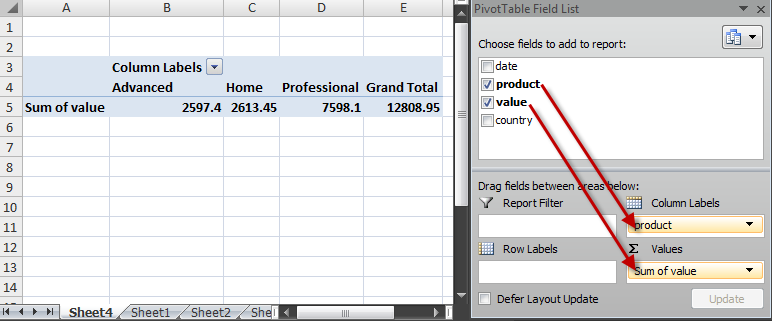
The PivotTable Field List will appear. We want to find the number of sales for each product. Drag the product field to Column labels and the value field to Values. This gives us the total value of sales by product.

pivot table 3

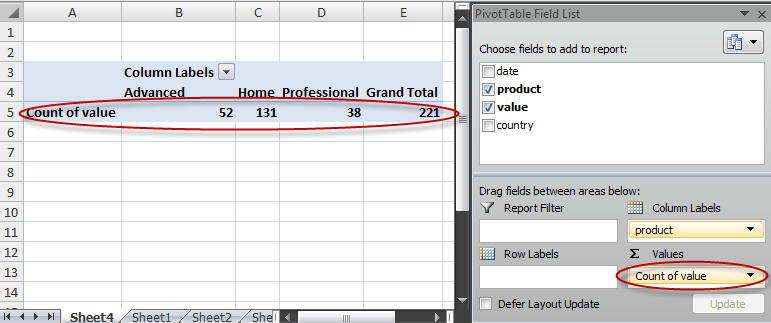
To change this to the number of sales pull down the Sum of value drop-down list and select Value Field Settings….

pivot table 4

Change Summarize value field by from Sum to Count and click OK.

pivot table 5

The number of sales of each product are now shown.

pivot table 6

Now drag the country field to Row labels. Then click on Count of value, select Value Field Settings…, change it back to Sum and click OK. The total value of sales of each product by country is now displayed.

pivot table 7

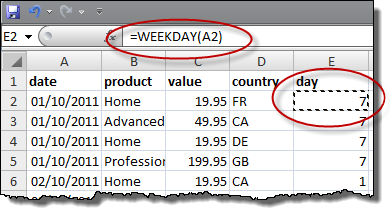
We now need to add a day of the week column. Click on Sheet 1 and add a new column as shown.

pivot table 8

Now select all the data from A1 to E222 and insert a new pivot table, as before.

pivot table 9

Drag the fields as shown to get the total value of sales of each product by day of the week.

pivot table 10

(We’ll quietly ignore the fact that the number of days aren’t divisible by 7 in the data.)

We can even display by product, day of the week and country with one more drag.

pivot table 11

Excel also supports pivot charts if you prefer your results in graphical form.

pivot chart

Obviously this is a very simple example, but pivot tables can be used to quickly analyse much larger and more complex data sets. Next time you have got some data to analyse consider whether you would be better using pivot tables or pivot charts.

*** UPDATE ***

You can also use my Hyper Plan software to create pivot tables. It is a lot simpler than the above! There is a free trial.

Promoting your software

This is a video of a “Promoting your software” talk I did at ESWC 2011. In it I discuss my experiences attempting to try every form of promotion known to man including: SEO, Google Adwords, magazine ads, affiliates, Facebook ads and hanging out in wedding forums using a female pseudonym. With real data! You can’t read the slide text in the video, but I have included the slides below.

A couple of people asked me afterwards whether anything I tried had worked. Yes! I wouldn’t have survived long as a microISV otherwise. But I didn’t really want to dwell on what had worked for me because it might not be relevant for different products with different price points in different markets. Also that isn’t the sort of information I want to give to my competitors.

Things were running a bit late due to problems with the projector, so I didn’t have time for the audience participation at the end. Projector problems are really not what you need when you are just about to do a talk to a room full of people! Many thanks to Alwin and Sytske of Collectorz for doing the video and to Dave and Aaron of Software Promotions for helping to sort out the unruly projector.

Cppcheck – A free static analyser for C and C++

I got a tip from Anna-Jayne Metcalfe of C++ and QA specialists Riverblade to check out Cppcheck, a free static analyser for C and C++. I ran >100 kLOC of PerfectTablePlan C++ through it and it picked up a few issues, including:

  • variables uninitialised in constructors
  • classes passed by value, rather than as a const reference
  • variables whose scopes could be reduced
  • methods that could be made const

It only took me a few minutes from downloading to getting results. And the results are a lot less noisy than lint. I’m impressed. PerfectTablePlan is heavily tested and I don’t think any of the issues found are the cause of bugs in PerfectTablePlan, but it shows the potential of the tool.

The documentation is here. But, on Windows, you just need to start the Cppcheck GUI (in C:\Program files\Cppcheck, they appear to be too modest to add a shortcut to your desktop), select Check>Directory… and browse to the source directory you want to check. Any issues found will then be displayed.

You can also set an editor to integrate with, in Edit>Preferences>Applications. Double clicking on an issue will then display the appropriate line in your editor of choice.

Cppdepend is available with a GUI on Windows and as a command line tool on a range of platforms. There is also an Eclipse plugin. See the sourceforge page for details on platforms and IDEs supported. You can even write your own Cppcheck rules.

Cppcheck could be a very valuable additional layer in my defence in depth approach to QA. I have added it to my checklist of things to do before each new release.

ESWC 2011

No proper post this week. I’m too busy finishing off my talk ‘Promoting your software’ for ESWC 2011 in London next weekend (19-20 Nov). I am going to talk about my experiences attempting to try every form of promotion known to man including: SEO, Google Adwords, magazine ads, affiliates, Facebook ads and hanging out in wedding forums using a female pseudonym. With audience participation! Plus real data!

There are also some other interesting looking talks. Chatting to other people in the business over coffee or beer is also invaluable. If you haven’t booked a ticket, it isn’t too late. Don’t worry if it is your first time – people are very friendly. Do come and say hello.

On the subject of conferences, the ASP is putting on ISVCon in Reno, Nevada, USA in July 2012. Being UK based it is probably further than I am prepared to fly for a conference. But I hope it is a huge success.

Losing weight with a minimum of willpower

If you are happy with your weight you can skip this post. Normal programming will be resumed soon.

We all know how to lose weight: eat less and move more. So why do so few people succeed? You only have to spend a few minutes walking around any wealthy western country to see that obesity is a huge problem. The human body is truly an incredible thing, evolved over millions of years. It is so much more than just a mere transport and fuelling system for the brain. We only get one body, it is a tragedy to neglect it.

The past is always with us

Our evolutionary past is working against us. Agriculture is less than 10,000 years old. That is only about 400 generations. A blink of an eye in evolutionary terms. While our technology and culture may have changed beyond all recognition in that time, our bodies and brains are still very similar to those of our palaeolithic ancestors. Their innate drives to eat salty, fatty and carbohydrate rich food and minimize their energy consumption helped to keep them alive on the hostile African savannah. But these ancient drives do little to help urban humans with almost unlimited access to food and increasingly sedentary lifestyles. Hence the burgeoning waist lines we see all around us today.

Tightening trousers

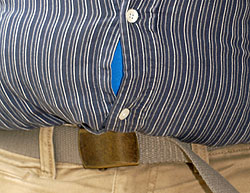
Over the last few years I had put on a few kgs. I have been spending a lot of time in front of the computer; working on my software product, doing consulting and writing this blog. Having a young child also reduced the time available for exercise. The 32 inch waist trousers I have been wearing for the last 20+ years (not the same pair, I would like to point out) were starting to feel uncomfortably tight. I either had to lose weight or go clothes shopping. Surely anything is better than clothes shopping.

But how to lose the weight? Previous attempts to lose weight have never lasted:

  • I went trekking in the Himalayas, spending 16 days walking up to the top of Mera Peak (6,476 metres). Weight loss wasn’t the goal, but the extreme exertion at high altitude meant I had the beginning of a ‘six pack’ when I got back. It didn’t last though.
  • I wrote down everything I ate on a spreadsheet and worked out the calories by weighing the food and using the calorie information on the packet or the CalorieKing website. I tried to eat less than 1800 calories a day[1]. It worked for a while, but the bookkeeping was tedious and I got bored and hungry. I gave up after a few weeks.
  • I tried the Zone Diet. Again it worked for a while, but I found the constraints (maintaining certain proportions of protein, fat and carbohydrates) tedious. I was also less than convinced by the science. I gave up after a month or two.

Success!

I decided to try a different approach. It is based on the same approach I take to my business – learn the concepts and measure the results. 8 months later I have dropped from 17.5% body fat to 13.0% body fat and lost over  6 kg (13 lb) in weight. I will spare you the before and after photos, but suffice to say that I can now easily fit into 30 inch waist trousers (damn – I still had to go clothes shopping!). And I never went hungry. I wasn’t even particularly disciplined, taking a week off here and there when I went on holiday. I won’t be appearing on the cover of a men’s fitness magazine or slimmer of the year. But I think it’s not bad for a 45 year old with a sedentary job, a distinct lack of ‘thin genes’ and a weakness for most fattening things.

I don’t claim to be an expert nutritionist or physiologist. Even if I was, the knowledge in this field seems to be constantly changing. But here is the approach that worked for me. It might work for you.

The slow carb diet

The cornerstone of my new approach was inspired by (but didn’t follow the letter of) Tim Ferriss’ slow carb diet. You should go and read his article, but the key elements are:

  • diet 6 days per week – eat lots of lean protein, beans, pulses and veggies, no high energy carbs (e.g. sugar, bread, rice, pasta, potato, fruit, beer and sugary drinks)
  • binge 1 day per week – pig out and eat whatever you like, all-you-can-eat buffet here I come!

There is more detail in his Four Hour Body book [2].

This approach makes sense in terms of our evolutionary heritage. Our hunter-gatherer ancestors wouldn’t have had access to refined carbohydrates, such as bread, and fruit would only have been available in season. They would also have regularly alternated between feast and famine.

A typical diet day’s intake for me is:

  • 2 eggs for breakfast with chilli sauce (fried with a tiny amount of oil sprayed into a non-stick pan)
  • a big salad for lunch
  • cajun style fried white fish with lots of veggies for dinner
  • several teas, coffees and glasses of water plus a glass of red wine

The binge day helps both physiologically (it presumably stops your metabolism slowing down in response to the reduced calories) and psychologically (you are never more than 6 days from eating what you want).

Pick an exercise regime you can stick with

I also increased the amount of exercise I do. The key to this was doing things I found enjoyable and a combination of routine (doing some exercises the same day every week) and variety (varying what I did on other days). I have found that a routine of capoeira, running and kickboxing pad work plus some swimming, weights and cycling for variety suits me. I average 3-4 30-60 minute exercise sessions per week.

I really enjoy capoeira, an Afro-Brazilian fusion of martial art, dance and music. It is very strenuous, but the fact that I am learning a skill (and trying to avoid getting kicked in the head) stops me thinking too much about the exertion. I also find running and weight training quite bearable when I am listening to an interesting podcast. I am lucky enough to live near a beautiful park with a lake. Running around the lake is even quite enjoyable on a sunny day. The fitter I get, the more enjoyable it becomes. Different things work for different people. People have even lost weight combining World of Warcraft with a treadmill or exercise bike. Don’t try to force yourself to do stuff you hate, you won’t stick with it.

Your body burns mostly glycogen stored in the muscles for the first 30 minutes of exercise. So you need to exercise for more than 30 minutes to start burning fat.

It takes a lot of exercise to burn off a small amount of food. About 15 minutes of running is required to burn the calories from a single slice of bread. I knew someone who was significantly overweight despite cycling 10 miles a day. It was only when he changed his diet as well that he started to lose weight.

Any form of exercise that builds muscle mass (e.g. weight training) is good, because extra muscle will increase your metabolic rate which will burn more calories.

Weigh yourself every day

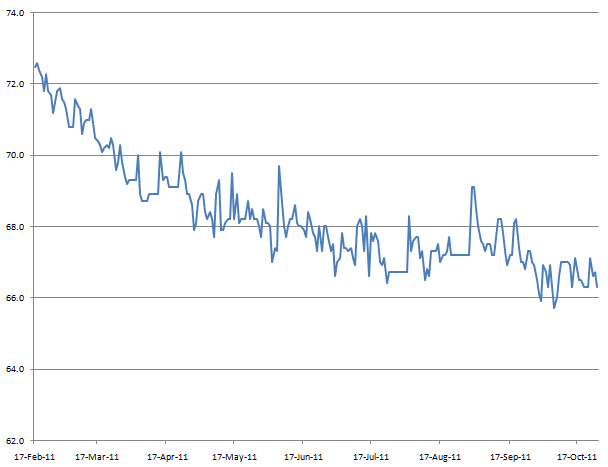
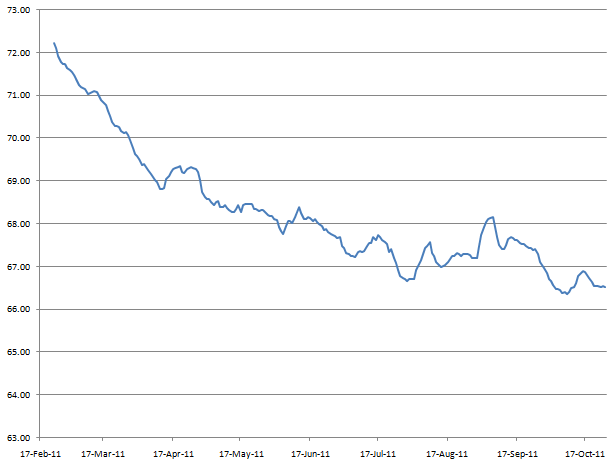
If you weigh yourself every day, you will soon see a direct correlation between weight loss and how well you stick to your diet/exercise regime. I found this daily feedback very helpful for motivation. If you only weigh yourself once a week your progress may get lost in the noise, e.g. due to the varying content of your digestive tract. I weigh myself every morning, as soon as I get out of bed. Here is a graph of my daily weight over the last 8 months:

You can see the sawtooth pattern of the weekly binge day. It is easier to see overall progress using a 7 day moving average:

Each peak was a suspension of the diet and exercise regime for holidays, birthdays and conferences.

A bit of science

Different foodstuffs vary hugely by the amount of calories per gram. You could eat 10kgs (22lbs) of green vegetables per day and not exceed your daily calorie intake (you might get a divorce though). Look at the side of the packet when you buy food, you’ll be surprised. For example, 1 gram of:

  • spinach = 0.2 cal
  • onion = 0.4 cal
  • kidney beans = 1 cal
  • bread = 3 cal
  • french fries = 3 cal
  • sugar = 4 cal

Try to avoid food where you don’t know what goes into it. For example, a lot of home delivery pizza contains vast amount of hidden salt, fat and carbs.

All calories are not equal. One would think that eating fat makes you fat. But there is increasing evidence that carbohydrates, not fat, is enemy number one when it comes to losing weight. Particularly carbohydrates with a high GI (ones that are quickly absorbed into the blood stream). Carbohydrate intake affects insulin levels, which in turn affects fat deposition. I was moderately active before and I didn’t eat excessively, but I ate a fair amount of bread, rice and potatoes. Reducing the amount of carbs has been the biggest change for me and I believe the main cause of my weight loss. Note that many ‘low fat’ foods (e.g. low fat yoghurts) contain large amounts of added sugar.

Protein makes you feel full. Studies show that x calories of protein will make you feel less hungry than x calories of carbohydrates or x calories of fat. High GI carbohydrates can even make you feel hungry (as you will know if you have ever felt starving after drinking lots of carbohydrate rich beer).

Low carb doesn’t have to be boring. Pickles, chilli sauce and balsamic vinegar liven things up without adding calories. The amusingly named Ring of Fire (‘so hot it will burn you twice’) is my favourite chilli sauce. It’s not actually that hot.

It is easy to underestimate how much you are eating. Studies show that overweight people tend to be worse at estimating their calorie consumption. I watched a TV documentary in which they asked an overweight women to work out her daily calorie intake. She calculated 1000 calories per day. Precise measurements showed it was, in fact, 3000 calories per day. The large bowl of fruit she ate every morning was 1000 calories on its own.

Smaller plates=smaller portions. Studies have shown that simply reducing the size of your plate can reduce overall calorie intake.

Starving yourself doesn’t work. Not only does it require willpower that few of us possess, but also the body simply adapts to the lower calorie intake by reducing metabolic rate. This can then cause you to put on weight if you return to your old eating habits.

Studies show that most overweight people do not have low metabolic rates. In fact, they typically have higher than average metabolic rates due to their increased mass requiring more work to maintain. If you are fat, the chances are that you are eating too much and not doing enough exercise, rather than it being due to a slow metabolism.

Watch what you drink

Watch what you drink, as well as what you eat. Drinks can contain surprisingly high amounts of calories. A single small can of cola contains around 5% of your daily energy intake. Alcoholic drinks and milkshakes can also contain a lot of calories.

Drink more water. A lot of rubbish is talked about hydration. But water does make you feel more full. So it is a good idea to have a big glass of water between and/or during meals. I find it easier to drink water if it is chilled in the fridge with a squeeze of lemon. No need to waste money on bottled water. It works even better if the water is in the food. Soup is a good way to make yourself feel full without consuming too many calories.

Food supplements

Tim Ferriss also recommends PAGG (Policosanol, Alpha lipoic acid, Garlic extract and Green tea) food supplements for weight loss. But these are about £70/$100 per month and I haven’t been able to find any peer-reviewed, double-blind trials that shows that it actually works. I won’t be spending that sort of money without some proper scientific evidence. I am not aware of any other food supplements that are proven and without side effects.

Social factors

Get your partner or house mate to diet with you. It is much harder to stick to your diet if the fridge is full of things you can’t eat. Declaring your intention to lose weight publicly can also provide extra motivation. Feel free to post your current weight and target weight in the comments. ;0)

Be realistic

Have realistic expectations about how fast you will lose weight. I came nowhere near losing the ’20 lbs. of Fat in 30 Days’ that Tim Ferriss claims. I averaged around 0.3 kgs (0.7 lbs) lost per week over the initial 4 months, and less after that. If it has taken you years to put on the weight, you are unlikely to lose it in a month or two. Despite claims to the contrary by people with books to sell.

The long term

Losing weight and keeping it off requires a long term change of lifestyle. Only time will tell if I can improve on, or even maintain, my current weight loss. I expect I will put a bit of weight back on over the winter. But I think I have found a regime that works and that I can live with. Putting this article in the public domain gives me a bit of extra incentive!

A call to action

If you need to lose some weight, then today is as good a day to start as any. If you do, it would be interesting to get some additional data for a follow-up post in a few months. Email me (andy at oryxdigital dot com) if you are interested in taking part.  You can remain anonymous, if you wish.

[1] Note that I am following the (ridiculous) convention of referring to kilo calories (kcal) of food energy as ‘calories’.

[2] It is an interesting and entertaining book. But beware that:

  • a lot of it is controversial, as you will see from the comments in Amazon
  • I find many of his claims of results of weight loss and weight gain hard to believe, and I think they certainly aren’t representative of what most people will achieve
  • experimentation is good, but self-experimentation is not as reliable as formally conducted, peer-reviewed, double-blind experimentation, especially when the author has a book to sell

Capoeira photo by HoveringDog.

13 ways to fail at commercial software

  1. Don’t bother with market research, because you just know lots of people are itching to buy your new product.
  2. Only release the product once it is perfect. However long that takes.
  3. Go into a market with very strong competition and compete with them head-on, because you only need a measly 1% of this market to get rich.
  4. Go into a market with no competition. How hard can creating a new market and educating all the potential customers be?
  5. Only think about marketing once the code is nearly complete.
  6. Write software for people who can’t or won’t buy software (e.g. 10 year olds, prisoners, Linux fanatics, people in developing countries, developers).
  7. Don’t worry about marketing, because good software sells itself.
  8. Concentrate on the technology and impressing other developers.
  9. Don’t listen to what your customers say, because you know best.
  10. Don’t worry about usability. It took you thousands of hours to write the software. Surely the customer can spend an hour or two learning to use it.
  11. Embrace bleeding-edge technology.
  12. Don’t worry about backups, because modern harddisks are very reliable.
  13. Don’t even try. Just give your software away for free.

Did I miss any?

What type of free trial should I offer for my software?

Once upon a time, the idea that you would allow people to try your software before they bought it was revolutionary. But now, thanks to the shareware movement and the ease with which software can be downloaded from the Internet, free trials are the norm for most types of off-the-shelf software. Prospective customers no longer have to rely on reviews of questionable independence or reading the packaging in a shop. They can try the software for themselves before making any commitment. This has been overwhelmingly a good thing for software users. It has also been a boon for vendors of good software.
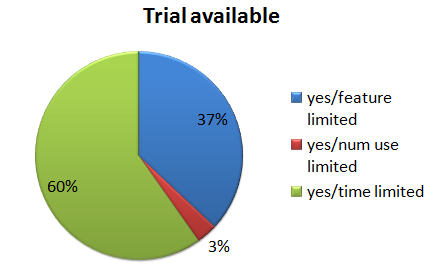
When I surveyed 92 small software product vendors in 2009, 100% of them offered a free trial.

Eric Sink says:

Every small ISV today should give its customers an opportunity to try before they buy. It is officially now absurd to do otherwise. Customers will come to your Web site and expect to find a demo download.

And that was in 2004.

So, for most software products, the question isn’t – should I have a free trial? The questions is – what sort of free trial should I have? As with everything related to marketing, it depends. There are many different approaches. Below I describe some of the more common ones.

Time-limited

Typically this takes the form of a fixed number of contiguous days of free and unrestricted use. The software then stops working  and you need to buy a licence to continue using it. The time period is often 30 days. As you can see in the pie chart above, this was the most common type of trial in my survey.

The advantage of this approach is that it allows the user to try the full functionality of the software. But it does have a number of issues:

  • The trial might expire before they have finished their evaluation.
  • It isn’t suitable for software that might only be needed for a limited time. For example, a 30 day time-limited trial wouldn’t be a good idea for my wedding seating arrangement software as a wedding is a one-off event (we hope), and people could just start the trial 30 days before their wedding.
  • You have to find some way to hide the data about the date the trial starts.
  • It is relatively easy to circumvent. Even if you hide the install date well and check for changes to the system clock a potential customer can just keep reinstalling the software inside a new virtual machine each time the trial expires.
  • Cookie expiration is an problem. For example, Google Adwords conversion tracking cookies only last a maximum of 30 days. So Adwords conversion tracking won’t count a sale on day 31, which is probably where most of your sales will happen with a 30 day trial.
  • As most sales will only happen after your trial expires, you will have to wait longer to get your money.

I have sometimes downloaded software, started to evaluate it, got distracted and then returned only to find the trial has timed out. Very frustrating and unlikely to result in a sale. So I am generally not a fan of fixed duration trials. There are a couple of ways you can try to work around this issue:

  • Only limit the amount of time they are actually actively using the software. For example, allow them 8 hours of total active usage. This shouldn’t be too hard to program. For example, stop the timer if there hasn’t been a key press or mouse click event in 2 minutes.
  • Allow them to request an extension. Then at least you have got their email address and can follow them up.

Usage-limited

In this approach you limit the number of times a certain action can be performed. For example the number of pages they can print or the number of times they can start the software. This avoids the issue of a time-limited trial which expires before the user has finished their evaluation.

Feature-limited

In this approach the trial disables an important function of the software, for example printing or saving.  The problem is that a user won’t know if this feature works properly until they buy the full version. This may put some people off.

It has the advantage that you can ship a separate trial version with features missing completely from the executable, which makes life a little harder for crackers (note that they can still get hold of the non-trial version to crack if they want to, e.g. with a stolen credit card number). But it also makes life harder for customers, as they have to install the software a second time after purchase. Personally I care more about making life easy for my paying customers.

Capacity-limited

A capacity-limited trial restricts the amount of data that can be entered. For example, a password manager might only allow you to enter 50 passwords into the trial version. This approach can be problematic when performance is important. For example, if you limit a database trial to one thousand records, how can the user test whether the search performance is adequate for a database with a million records?

Output-limited

Many products exist purely to produce some form of physical or electronic output, for example image editors and label printers. Adding a watermark, or altering the output in some other way, can be an effective way to limit a trial. But you need to make sure that the modification to the output can’t easily be removed or worked around (e.g. using screen capture). You also need to be sure the user doesn’t think the modifications in the output are due to a bug in the software.

Nagware

Nagware allows you to use the software without restrictions, but ‘nags’ you periodically to pay for it. Usually this takes the form of a window that pops up when you start or exit the software. But I once used some software that also nagged you in audio. A woman’s voice with a heavy Scottish accent no less. It got uninstalled very quickly! Nagware isn’t very effective in my experience. I never did buy WinZip. Did you? After a while you just click the ‘continue’ button without thinking about it. Little tricks, like moving the ‘continue’ button or greying out for a few seconds are just annoying. And annoying people doesn’t seem like a great start to a business relationship.

No trial

Some software has no trial, just a money back guarantee. If your software is an enterprise system that takes significant effort to configure, then this is entirely understandable. But if it is off-the-shelf, downloadable software, what are you trying to hide? On the plus side it avoids the issue of people downloading software and then never getting around to trying it. My own stats show that only some 40% of people who start a download of my software actually install and run it. Also many people won’t ask for their money back even if they don’t like your product. So you might get sales to people who wouldn’t have purchased with a trial. But do you really want these people as customers? Personally I am unlikely to buy a software with no trial, unless there is no real alternative. I assume you won’t let me try your software because it isn’t very good. I’m sure many other people feel the same way.

Hybrid trial

Hybrids of the above approaches are also possible. For example, the trial of my wedding seating arrangement software doesn’t allow you to save, print or export plans with more than 30 guests – a hybrid of the capacity-limited and feature-limited approaches. I figure that 30 guests is enough to show what the product does, but not enough to be useful for most events. Also no-one is likely to pay for event planning software for an event with 30 or fewer guests.

Conclusion

A good trial is a balancing act. You need to give prospective customers enough to show them your software could solve their problem, but not enough to actually solve their problem. But if you are too restrictive they might go to a competitor with a more relaxed trial policy. It can be tough to get the balance right or to know whether a different approach would get better results.

Obviously, the best type of trial depends very much on your product. If it is a product that is likely to be used a lot and  is going to increase in value as it is used, then you might be best offering a generous time-limited or usage-limited trial. But if it is a product that is only needed for a one-off task or a limited period of time, then a feature-limited, capacity-limited or output-limited trial probably makes more sense.

For example, most consumers will (unless they are very unlucky) only want to use disk recovery software once. So it wouldn’t make sense to offer a 30 day free trial. It would probably make more sense to offer a feature-limited trial that allows them to see what data could be recovered, but not actually allow them to do the recovery until they pay up. But if you are selling to professional disk recoverers, then a time or usage-limited trial might be appropriate.

I asked  Craig Peterson of the Beyond Compare file comparison tool about their very generous trial policy (30 non-contiguous days of use) in an interview and he said:

That goes back to competing with all the other products out there.  If someone installs two programs to evaluate, and then doesn’t have a chance to really try them out until a month later, the one that works is more likely to get the sale.  It also makes it more likely that potential customers will learn the application and start relying on it, so when it does come time to pay they’re less likely to throw out that investment and switch to another tool.

Data comparing different types of trial is hard to come by:

  • My 2009 survey didn’t show any clear difference in mean conversion rate between time and feature-limited trials (there wasn’t enough data for usage-limited trials to be worth counting):

The nagware vs feature-limited result is fairly conclusive. But, apart from that, there doesn’t seem to be much hard data to go on. Even if there was more data, it wouldn’t necessarily apply for different products in different markets. So, unless you want to program multiple types of trial and run lots of split tests (trial and error?),  you are going to have to ‘go with your gut’. It is tempting to pick the same trial model as your competitors. But remember that part of successful marketing is being different.

So there are no easy answers. But don’t just choose a 30 day time-limited trial because that is what everyone else is doing. Have a think about what fits best with your product, market and customers. Be creative.