
 Al Harberg (best known for his press release service for software vendors) has created a useful glossary of software marketing terms. Al knows a lot about marketing software. His glossary is 107 pages/53k words long and includes quotes, book review and feature articles. I particularly enjoyed some of the more tongue in cheek definitions e.g. “System requirements: A poorly cobbled statement of techie talk that software developers use to lose sales” and “Idiot customers: Clients who don’t understand every aspect of your software immediately”. If you don’t know what active voice, AIDA, astroturfing, cloaking, CPM, fast follower or purchase order mean, now is your chance to find out.
Category Archives: marketing
Is it worth advertising Mac software on Google Adwords?
I learnt a long time ago that people will happily click on totally irrelevant pay per click ads. For example, if you bid on “seating plan” I can assure you that a significant percentage of people searching for “boeing 747 seating plan” will happily click on your ad titled “wedding seating plan”. They won’t buy anything, as they aren’t interested in wedding seating plans, but you still have to pay for each click. You can stop your ad showing to these searchers by adding “boeing” and “747” as negative keywords. Problem solved.
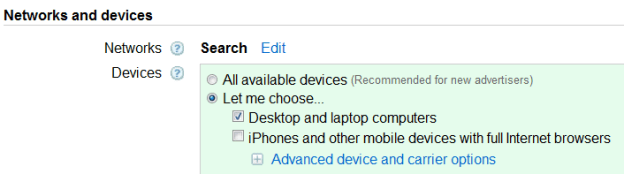
But what do you do if you are selling software that only runs on Mac OS X? The vast majority of searchers are running Windows. Indiscriminate clicks by them could quickly turn your Adwords ROI negative. In your Adwords campaign settings you can choose to only show ads on desktop computers and laptops. But you can’t choose the operating system.
As discussed above, putting “Mac” in the title is unlikely to be enough. You can’t use negative keywords, because the vast majority of Windows users searching for, say, backup software will type “backup software” not “Windows backup software”. You can just bid on searches containing keywords “Mac”, “Apple” or “OS X”, but will this be enough? My general advice to Mac only software vendors was to avoid Adwords, unless the ticket price of their software was in the hundreds of dollars. But, as my software runs on both Windows and Mac, I didn’t have any data to back this up.
Recently I got some data on Adwords clickthrough rates for a Mac only app (www.puzzlemakermac.com) by Hokua Software. They have kindly allowed me to share the data.
Initially they bid on generic keywords, such as “crossword maker” and ran ads such as the following with “Mac” displayed prominently in the title:
 The results from analytics: 60% of the people clicking on the ads were on Windows and 40% on Mac.
Then Google banned them from the word “Mac” in their ads (it is possible to get this reversed with the express permission of Apple, but I don’t know how likely they are to grant this). So they switched to “OS X” in the ad, which hasn’t been blocked (yet).
 The results from analytics: 73% of the people clicking on the ads were on Windows and 27% on Mac.
Then they restricted their bids to Mac targeted keywords such as “mac crossword maker”.
The results from analytics: 23% of the people clicking on the ads were on Windows and 73% on Mac. But there was a big drop in the number of impressions.
I think it is going to be almost impossible for anyone to get a return from Adwords when the majority of their clicks have no chance of generating a sale. So only bidding on Mac specific keywords seems to be the way to go. But there will still be a significant number of wasted clicks from Windows users. Also any Mac users who don’t use the appropriate keywords won’t see your ad. Consequently the return on time and money invested is likely to be a lot lower than Windows, cross-platform and web developers can expect. If you have a Mac only product with: a high ticket price product, well-defined keywords and limited competition, it might be worth trying Adwords. But otherwise it is probably better to wait and see if Google release OS targeting.
Of course, you could always use one of the free Adwords vouchers that Google are handing out like confetti (I get one every month in my PC Pro magazine) and try for yourself. This is how Hokua software got the results above. If you do, I would be interested to know how your results compare.
PerfectTablePlan Royal Wedding Special
 It is the Royal Wedding tomorrow and everything has gone Royal Wedding crazy here in the UK. I did send the happy couple a complimentary copy of my Perfect Table Plan software a while ago. I haven’t heard anything back, but I will be checking my support emails tomorrow morning, just in case. ;0)
I am doing my bit to cash in honour the occasion by putting the Home Edition of Perfect Table Plan on one-day discount site BitsDuJour on the big day. 51% off for 29th April only.
After the discount, BitsDuJour’s commission and support costs, I won’t be making much per sale. But I figure it might be worth it for the exposure to a different audience. Also some of the purchasers might upgrade later. My product is rather different to most of the other products featured on BitsDuJour, so it will be interesting to see how it does.
Will you, or anyone you know, be planning a seated event (wedding, charity gala, award ceremony etc) in the future? If so, you can get the 51% discount here.
Success is always one feature away
 In my consulting and various other dealings with aspiring microISVs, I notice certain recurring patterns. One of the most common is the belief that it is just one missing feature that is holding back a product from the commercial success it deserves. As soon as that feature is coded the sales are going to come pouring in! When they don’t, then maybe it was that other missing feature that our competitor has. It is a horizon that keeps receding until you run out of money or enthusiasm. But, in my experience, poor sales are almost always due to insufficient marketing. A fact that is borne out by these 13 case studies. It doesn’t matter how great your software is if no-one know about it, or if you can’t persuade them to try it when they do find out about it.
It isn’t surprising that microISVs fixate on features. MicroISVs tend to come from a programming background and learn marketing on the job (I have yet to meet a microISV who started off in marketing and taught themself programming). Features and coding are what we like to do best and it feels like ‘real work’. But all too often the warm embrace of an IDE is just an excuse to stay in our comfort zone. Of course, features are important. No features = no product. But, if you have got low traffic to your website and/or you are doing a lousy job of communicating with people that arrive at your site, then adding more features really isn’t going to help much. If you are in a hole, stop digging. Successful marketing is about being different from your competitors. You can even make a virtue of your lack of features. If you are competing against more feature-rich competitors, then emphasize the simplicity and ease-of-use of your product instead. It certainly seems to work for 37Signals.
Marketing can seem like a very alien discipline for someone from a programming background. But you can learn it like any other skill. There is loads of great information out there, for example Eric Sink’s marketing for geeks. Also, some elements of online marketing are actually quite technical with plenty of opportunites for number crunching. Analytics, A/B testing and Adwords will give you more data than you know what to do with. This can give programmers a considerable advantage over people from a more traditional marketing background, many of whom don’t seem to be able to handle anything more complicated than a 2×2 matrix. You don’t have to be a marketing genius, you just need to be better than your competitors (in the same way that you don’t need to be able to run faster than a lion to survive a lion attack, you just need to be able to run faster than the next guy). Given that your competitors are likely to be other programmers (who are probably also not doing enough marketing) or people from a marketing background (who don’t really understand software and are probably more interested in long lunches) that may not be as hard as you think.
A small experiment with LinkedIn ads
 LinkedIn.com (the B2B equivalent of Facebook) supports Google style pay per click ads. So I decided to run some ads for my seating planner software as an experiment. Here is a brief summary of my (very brief) experiences.
The good news
LinkedIn ads can be laser targeted. You can specify who you want to see your ad based on their job function, company, gender, age group, country and (best of all) the LinkedIn groups they belong to. I targeted 10,102 LinkedIn members who live in wealthy English speaking countries, belong to various LinkedIn groups related to event planning and have appropriate job titles. The campaign was quite painless to set up. It probably took me less than 10 minutes in total and I started getting impressions within an hour or so.
The bad news
The minimum allowed CPC (cost per click) was $2. Ouch. I know from extensive experience with Google Adwords that there is no way I can get a return on that.
The minimum allow CPM (cost per thousand impressions) was $3. If the CTR (click through rate) is around 1% (about what you might expect from Google search ads) this is $0.30 per click. Possibly profitable. If the CTR is around 0.1% (about what you might expect from Facebook ads) this is $3 per click. No better than the CPC bidding. Given that LinkedIn is more similar to Facebook than Google search, I expected the latter. I decided to spend a few dollars to find out. The results are below (click to enlarge):
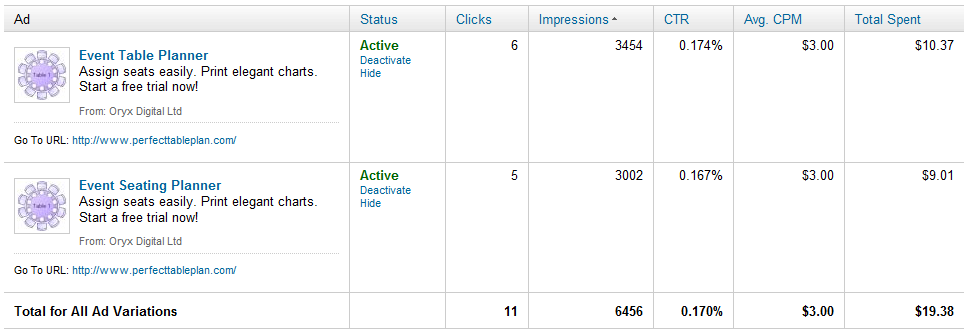
So, with an average 0.17% CTR, I ended up spending $1.76 per click. Given my average transaction value and a realistic conversion rate I know that I can’t make any return on this. Also the CTR is likely to drop the more often people see the ad. So I stopped the experiment after less than 24 hours, before I wasted any more time or money. As far as I can tell (based on my own cookie tracking – LinkedIn ads don’t have their own conversion tracking) I didn’t make any sales. But that is hardly surprising given the small number of clicks.
Summary
Obviously $19.38 is a tiny amount to spend, but I think it told me what I needed to know about LinkedIn ads. Unless they reduce their CPC or CPM bid prices by an order of magnitude there is no way I can make a return. Of course, if you are selling a product where the average lifetime value of a customer is hundreds or thousands of dollars, the numbers might work out quite differently for you.
Related posts:
Does the world *really* need yet another Twitter client, RSS reader, ToDo list or backup application?
 My heart sinks every time I hear a would-be-entrepreneur announcing they have written yet another Twitter client, RSS reader, ToDo list or backup application. Haven’t we got enough of those already? There are more than 1,900 Twitter apps already (possibly a lot more). Somebody probably released another one while I was writing this post. We have passed the Twitter app event horizon, where it is probably quicker to write your own custom app than it is to try and work out if any of the existing apps fulfils your requirements.
Even if you have done something radically new, interesting and different in one of these markets, how are you ever going to get noticed amongst thousands of more established competitors? Wouldn’t it be better to find a market that is currently under-served by software? It may be less fashionable than writing software for other techies, but it will probably contribute more to the sum of human happiness and be a lot more profitable.
There must be thousands of niches where there is a real need for software, but limited competition. You just need to open your eyes to the bigger world around you. It may mean having to learn about an unfamiliar domain. But it is generally much easier for a software developer to learn some domain knowledge about, say, butterfly collecting, than it is for the average butterfly collector to learn to create a software product. Next time you are talking to a non-techie about their job or hobbies, just ask them “Do you use software for that?” and “Is it any good?”. The ideal answers you are looking for are “Yes” (if there are existing software packages, there is probably a market) and “No” (maybe you can do better).
Start Small, Stay Small: A Developer’s Guide To Launching a Startup
 I recently read ‘Start small, stay small: A developer’s guide to launching a startup’ by Rob Walling. The preface states:
“This book is aimed at developers who want to launch their startup with no outside funding. It’s for companies started by real developers solving real pain points using desktop, web and mobile applications.”
Many of you are probably already familiar with Rob’s work, including: a blog, a podcast and the micropreneur academy. Rob’s approach has been to develop a portfolio of niche websites as a solo founder (for example ApprenticeLinemanJobs.com), funding it with his own capital and outsourcing work where appropriate. The intention being to have a business that produces a decent income, but allows the founder a flexible lifestyle. He uses the portmanteau ‘micropreneur’ to refer to this approach. It is not a term I care for, with its awkward shunting together of Greek and French. But I guess it is no worse than ‘microISV’. He develops on these themes in the book, with a particular emphasis on the early phases (as implied by the title).
The chapter headings are:
- The chasm between developer and entrepreneur
- Why niches are the name of the game
- Your product
- Bulding a killer sales website
- Startup marketing
- Virtual assistants and outsourcing
- Grow it or start over
As with Rob’s blog and podcast, there is plenty of insight and actionable information based on real experience. Some of the writing is taken straight from the blog, but I believe most of it is new. There are links to useful online tools, some of which I hadn’t come across before. It even includes some of that rarest of commodities – real data. He also dispells a few myths – for example: that creating a software product is a quick and easy way to riches and that Facebook and Twitter are all the marketing you need.
The book is particularly strong on market research – a subject I haven’t seen covered much in the context of small software companies. He includes a step-by-step methodology for measuring market size. It also covers other useful subjects such as: pricing, choosing web vs desktop vs mobile vs plug-in, website design, SEO, mailing lists and buying and selling websites. The paper version of the book is 202 pages long. There isn’t a lot of unecessary waffling or padding, so you are getting a fair amount of information for your money. An index might have been useful. Perhaps for the next edition?
While the book will have most benefit for those first starting out, I think even experienced software entrepreneurs will probably find some of it useful. The book is available in paper, electronic and audio formats from $19 at www.startupbook.net. Given its niche market, I think this is good value.
Full disclosure: I recieved a free (paper) copy of the book from the author.
Eventcountdown.com
 I have just launched at new website at eventcountdown.com. This website contains free countdown clocks, for both Windows and web, to allow you to count down the days, hours, minutes and seconds to any event. It can be a wedding, a birthday or a major cultural or sporting event. Are your children wondering how many days, hours, minutes and seconds it is to Christmas ? Wonder no more! You can also use it to count up from an event e.g. giving up smoking or Perl.
 web countdown clock for Mac, iPad, iPhone and Android

The hope is that a significant number of people interested in planning events will go to evencountdown.com for a free clock and a small percentage will click through to PerfectTablePlan.com and buy my software. I have no idea how successful this will be. I certainly don’t expect a quick payback on the investment. But hopefully it will pay for itself in a few years, and then anything after that is pure profit.
This project has also been a small scale experiment in outsourcing that might lead on to greater things.
- The web design and CSS/HTML coding was done by Sergey Pozhilov of μISVStyle.
- The Windows countdown clock was done by Milan Marusinec of VectorGraphica.
- The Javascript for the web countdown clock was done by Paul Kossowski of Dolphin Futures.
They all did a great job and the total cost was less than I would have paid for a couple of ads in event industry newsletters (which I tried recently, with fairly miserable results).
I have quite a few ideas about how I can improve eventcountdown.com, but I wanted to get something out there ASAP. After all if you aren’t embarassed by v1.0 you didn’t release it early enough. I would be interested to hear any feedback. Backlinks to eventcountdown.com would also be very welcome. ;0)
milan@crossgl.com
Advertising your software on Facebook (=Fail)
 Facebook previously didn’t allow the advertising of downloadable software. Someone told me that they had relaxed this policy, so I checked their guidelines. Sure enough they have removed the offending line in their guidelines that used to say:
No ad is permitted to contain or link, whether directly or indirectly, to a site that contains software downloads, freeware, or shareware.
It says in their guidelines that downloadable software that does naughty things such as “sneaks onto a user’s system and performs activities hidden to the user” is not allowed, which is fair enough (see section 14 of their ad guidelines for the details).
Woohoo! As part of my ongoing project to try every legitimate form of promotion known to man, I can try advertising my seating planner software to, for example:
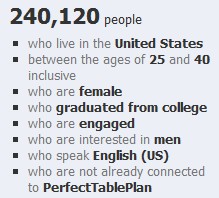
I ran 5 different ads over a couple of weeks. For example:
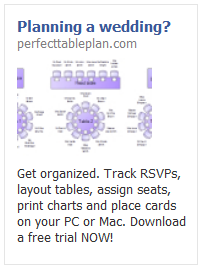 Trying to fit an attention grabbing and informative ad into the very limited strapline and image size was challenging. But I didn’t spend too long agonizing over the ‘creative’ (image and text), as this was just a feasibility study. The biggest problem was the minimum bid prices. Facebook was recommending I bid at least £0.40 per click. Given that the majority of my customers buy a single licence for £19.95 and typical conversion rates for clicks are around 1%, I would be likely to lose money if I bid £0.20 or more (especially when you consider ecommerce fees and support). I bid £0.10, but got no impressions at all. I bid £0.20 as an experiment and got a reasonable number of impressions. As soon as I dropped the bid to £0.15 the impressions slowed to a trickle.
Here are the stats from my experiments, as reported by Facebook:
| Impressions: | 357,366 |
| Clicks: | 310 |
| Click through rate: | 0.087% |
| Total cost: | £46.60 |
| Average cost per click: | £0.15 |
| Average cost per 1000 impressions: | £0.13 |
Any of you who are used to Google Adwords might be surprised how low the CTR is. But apparently this is quite a reasonable CTR for Facebook. This isn’t too surprising when you consider that people are on Facebook to socialise, rather than to search for stuff.
Of course, the most important metric is the profit. So how many licences did I sell? According to my own cookie tracking: zero. Zilch, nada, nothing, not one. Cookie tracking isn’t 100% reliable, but it seems that a 1% conversion rate might be highly optimistic for a facebook ad. Advertising a £19.95 product on Facebook to people who might be planning to get married obviously wasn’t going to be profitable given my price point, the minimum bid prices and low conversion rate. So I created a new ad to try to target a more focussed demographic, who might convert better and perhaps buy one of the more expensive versions of my product. Ad number 6 was disallowed one minute after it had been approved.

Eh? This ad was very similar to the previous 5 approved ads and for the same product. Their email said:
The content advertised by this ad is restricted per section 5 of Facebook’s Advertising Guidelines. Restricted content includes, but is not limited to: 1. Downloadable products that may affect the user’s computer or browser performance in unexpected or undesirable ways; 2. Get rich quick and other money making opportunities that offer compensation for little or no investment, including “work from home” opportunities positioned as alternatives to part-time or full-time employment or promises of monetary gain with no strings attached. 3. “Free” offers that require users to complete several hidden steps or make additional purchases in order to receive the promised product. We reserve the right to determine what advertising we accept, and will not allow the creation of any further Facebook Ads of this type. Ads for this product, service or site should not be resubmitted.
I didn’t feel my ad/product violated any of those criteria. It was clear in the ad that only the trial was free (not the product) and it doesn’t do anything nasty or sneaky. I emailed them for clarification. Here is the response:
Hi Andy,
Thanks for your email. Please note that we don’t accept ads for downloadable products through our self-service advertising channel. We reserve the right to determine what advertising we accept, and will not allow the creation of any further Facebook Ads for this product.
In order to maintain legitimacy of the products and services promoted on Facebook, ads for downloadable or installable products are only permitted through a direct sales partnership with Facebook. At this time, we’re only able to provide this service to a small set of qualified advertisers.
We’re committed to providing high-quality support for all of our advertisers, and we’ll keep you and your business in mind for the future growth of our ads product. In the meantime, please continue to email us here with any questions you may have and we’ll be happy to answer them for you.
If you have any further questions about why your ad was disapproved for Restricted Content, please refer to our Help Center about downloads at:
http://www.facebook.com/help/?faq=18665
Thanks,
Gloria
Online Sales Operations
So apparently, they still don’t accept advertising for downloadable software, unless you are an approved partner, because it ‘may affect the user’s computer’ (even if it doesn’t ). This wasn’t at all clear in their guidelines and they let me run 5 ads before they enforced it (these ads are still running BTW). Thanks Facebook, I like you less with every passing day (and I didn’t like you much to start with). At least I got enough data to show that I was unlikely to ever get a return on advertising a £20/$30 product. I also console myself with the fact that PerfectTablePlan is doing better financially than Facebook (after 7 years and with 500 million users Facebook are finally cash flow positive, but nowhere near recouping the estimated one billion dollars in venture capital) and my product will hopefully still be selling profitably after Facebook has been buried by the ‘next great thing’ that comes along so regularly in the world of social media.
App stores set to dominate future software sales?
 Following the success of the iPhone app store (over 6 billion downloads to date), app stores are becoming more and more of a feature of the software landscape. In case you missed it, Apple announced yesterday that there will be an App Store for Macs ‘within 90 days’. In summary:
- The Mac app store will be tightly integrated with Mac OS X, including automatic install and update.
- There will be restrictions on technology, for example Java apps will not be allowed.
- Apple will keep 30% of any revenue from sales.
- $99/year subscription for developers.
- Developers will still be able to sell their software outside the App store.
It is easy to see why Apple would want to do this:
- A potentially huge new revenue stream from third party Mac software sales.
- They get even more control over the customer experience.
And this could have advantages for Mac users:
- Simpler payment and installation.
- Screening out of low quality apps and malware.
And potential advantages for Mac developers:
- Mac users might buy more software if it is easier to do so.
- One main channel to concentrate your marketing efforts on.
- Some of the boring infrastructure of selling software (licensing, shopping cart etc) can be taken care of by Apple.
But the disadvantages are all too obvious:
- Your app could be rejected outright. And you won’t know until you submit it for approval. Apple are judge, jury and executioner. The iPhone app store has been infamous its capricious and opaque approval process.
- 30% is a huge chunk of revenue. Typical payment processors take 5-10% of revenue. Where the new app store cannibalises existing sales (and it is hard to see that it won’t) vendors will lose 20-25% of existing sales revenues.
- New apps and updates will be delayed by days or weeks as they go through the app store approval process.
- A single centralised app store is likely to make it harder for niche/long-tail apps to make any sort of living. Certainly this is what seems to be happening in the iPhone App store.
- Apple are control freaks and have traditionally taken a rather heavy handed approach with developers, including the liberal use of NDAs. The app store will give them even more control.
And worse might follow:
- Apple makes a lot of their money from selling over-priced hardware. It may be in their interest to drive software prices down so they can sell more hardware. $5 is considered expensive in the iPhone App Store.
- This could be the first step to making Mac OS X a closed system, like iPhone, where only Apple approved apps can be installed.
I guess they can’t piss off developers too much – a computer without third party applications isn’t going to be very attractive to customers. But I am finding it hard to work up any enthusiasm for a Mac app store. If it is successful I can either be in the store and give up a lot of freedom and cannibalize exisiting sales at a much lower margin, or stay out and be shut out of a large chunk of the market. It isn’t an attractive choice. As my app is written in C++/Qt, rather than Objective-C/Cocoa, I am not even sure that it will be eligible for inclusion in the store. I could just abandon Mac OS X, but Microsoft is also rumoured to be working on their own app store (despite the failure of DigitalLocker). That is a truly terrifying prospect given the awfulness of their ‘Works with Vista’ approval process (I speak from personal experience).
Suddenly web apps are looking more interesting.

