Twice this week, I have come across embarrassingly bad data.
The first instance is the UK government’s fuel finder data. This is a downloadable CSV file of fuel station locations and prices from around the UK. A potentially very useful database, especially during the current conflict in the Middle East. A customer suggested it as a possible practice dataset for my data wrangling and visualization software, Easy Data Transform . So I had a quick look and spotted some glaring errors within a few minutes.
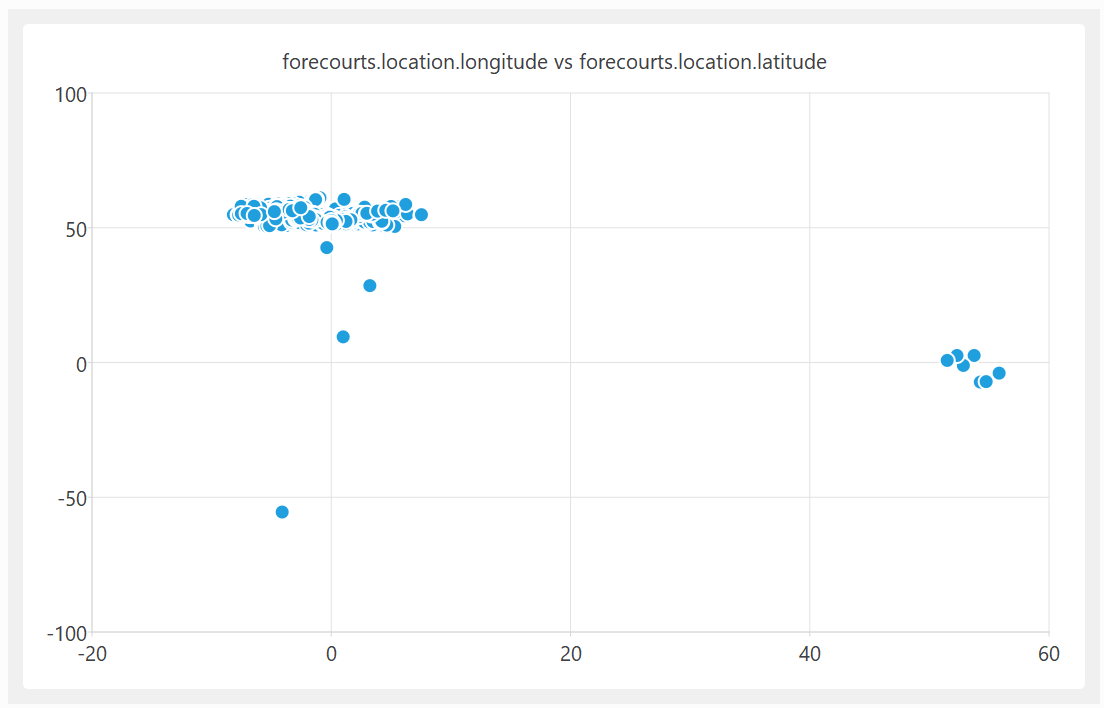
A quick plot of the latitude and longitude shows some clear outliers:
On further investigation, some of these UK fuel stations are apparently located in the Indian and South Atlantic oceans. In at least one case, it looks like they got the latitude and longitude the wrong way around.
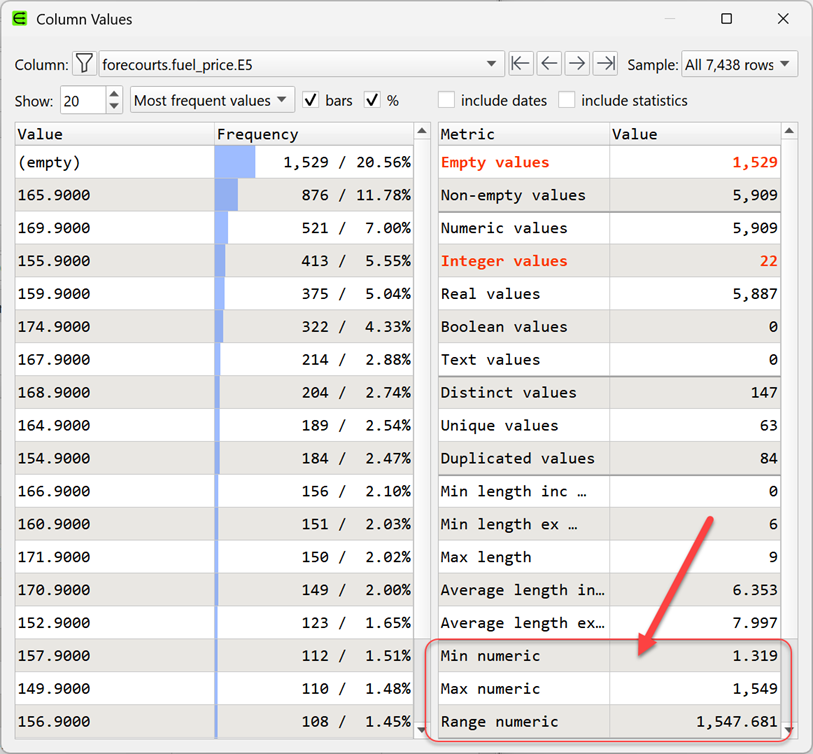
A quick look at the fuel price columns also shows some major issues:
The ratio between the most expensive and cheapest fuel (per litre) is 1538:1. Clearly wrong.
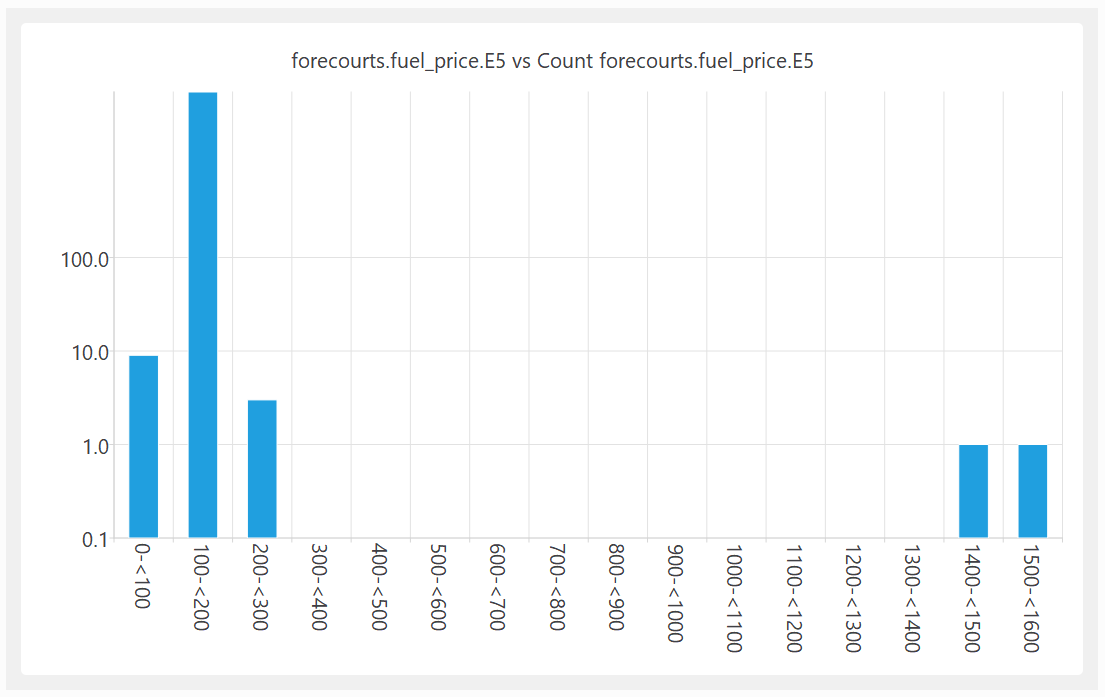
Shown as a histogram with a logarithmic Y axis:
I am guessing that the reason for this bad data is that the fuel stations are submitting their own data and, humans being humans, they make mistakes. But then the government is publishing the data without even the most basic checks. That just isn’t good enough.
I reported the problem on 22-Mar-2026. They acknowledge my email on 24-Mar-2026 (“Thank you for sharing this, we have passed this on to the technical team to have a look at.”). The CSV file published on 29-Mar-2026 still has the garbage data.
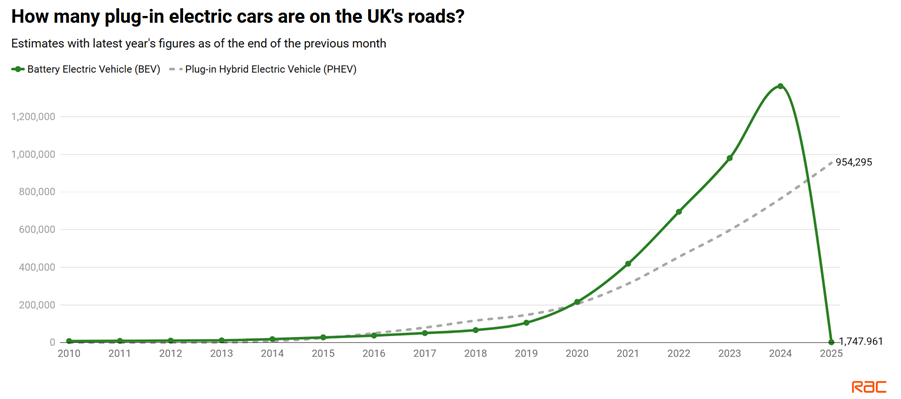
The second instance is a report on electric cars from UK motoring organization, the RAC. The first graph in the article is this:
Did the number of Battery Electric Vehicles on the UK’s roads suddeny drop from ~1.4 million in 2024 to ~0.0017 million in 2025? What happened to those ~1.4 million vehicles? I’m guessing that someone got their thousands and millions mixed up. But then they published the report with this glaring error. Did anyone mathematically literate even check this graph?
Lousy data undermines trust in institutions and can lead to bad decisions. I fear we are heading for a future where LLMs generate data, which people don’t bother to properly check. This data is then used train LLMs. The error is then much harder to spot once it is served back without the original source by LLMs. A slop-apocalypse.
Authors should have their work proof read, programmers should test their code and data people should do basic data validation. Let’s take some pride in our work.
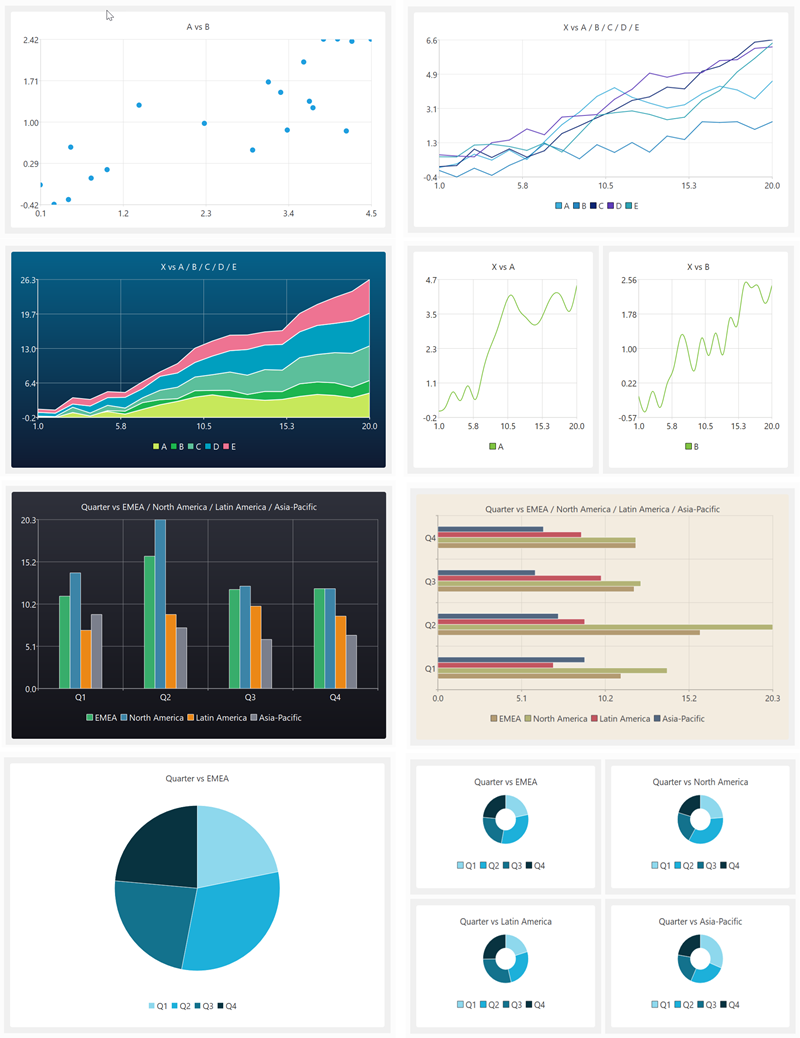
My data wrangling product, Easy Data Transform, got a major upgrade yesterday, with the addition of data visualization capabilities. Here are some examples of what it can produce in a few clicks:
You can see this new visualization feature in action in the video below:
(Likes and subscribes help me with the YouTube algorithm and are much appreciated)
Human brains are highly developed for visual processing. But data is often messy and in the wrong form for visualization. So data wrangling and visualization, tightly integrated together, is a powerful combination. It was a lot of work, but it makes Easy Data Transform a much more complete, end-to-end, solution. No more pasting data into Excel to get a chart!
At the same time, I have segmented Easy Data Transform into 2 products: Easy Data Transform Core Edition (data wrangling, one-time fee $99) and Easy Data Transform Advanced Edition (data wrangling+visualization, one-time fee $198). The Advanced Edition is a paid upgrade from the original product. Optional, of course. I sweetened the deal with a time-limited discount for existing customers who want to upgrade to Advanced Edition. The response from Easy Data Transform customers has been very positive.
Have you got some messy data, you want to turn into insights? Why not give Easy Data Transform Advanced Edition a try? It:
Runs natively on Windows and Mac.
Is drag and drop (no syntax to remember).
Does not store your precious data on someone else’s server.
Is deterministic and will not hallucinate!
Can process millions of rows in seconds.
Can create re-usable templates for repeatable processes.
You can download a free trial here. And you can get 15% off Easy Data Transform Advanced Edition until 17-Jul-2026 using this discount link.
I am always on the lookout for cost and time effective ways that I can market my software products. Previously, I have had quite a lot of success with Google Adwords Pay Per Click ads. However, the law of shitty clickthroughs means that advertising platforms generally get less and less profitable (for the advertisers) over time. And Google Adwords is a case study of that law in action. As Reddit is a less mature advertising platform, I thought it might still offer opportunities for a decent return. So I decided to experiment with advertising my data munging software, Easy Data Transform, on Reddit.
[By the way, I understand that nobody goes to Reddit because they want to see ads. But commercial products need to market themselves to survive, and Reddit probably wouldn’t exist without ads. Yay capitalism.]
Setup
The basic process to get started with Reddit Ads is:
Sign up for a Reddit Ads account.
Enter your details and credit card number.
Create a campaign.
Create one or more ad groups for your campaign. Choose a bid for each ad group, which countries you want it shown in and who you want it shown to.
Create one or more ads for each group.
Add the Reddit tracking pixel to every page of your website.
Set up conversion goals.
All pretty standard stuff for anyone who has used Google Adwords. The twist with Reddit is that you can advertise to communities (sub-Reddits), rather than based on search keywords. For example, Easy Data Transform is a much better tool for most data wrangling tasks than Excel, so I can bid to show ads targeted at Excel users in communities such as: reddit.com/r/excel/ and reddit.com/r/ExcelTips/.
Like Adwords, there are various ways to bid. I don’t want the advertising platform to set the bid prices for me (because I’m not insane), so I opted for fixed price bids of between $0.20 and $0.40 per click. Some of the ad groups suggested much higher bids than that. For example, the suggested bid for my Excel ad group is $0.79 to $4.79 per click!
However, Easy Data Transform is only a one time payment of $99. Paying more than $0.40 per click is unlikely to be profitable for me, especially when you factor in support costs. So that is the maximum I was prepared to bid. Also, the suggested bids are just the ad platform trying to push up the bid price. Something that anyone who has used Google Adwords will be all too familiar with. I was still able to get clicks, bidding significantly less than the recommended minimum.
I also set a daily maximum for each ad group, just in case I had messed up and added a zero in a bid somewhere.
I created multiple ads for each ad group, with a range of different text and images specific to the communities targeted. Here are some of the ones I ran in the Excel ad group:
I didn’t try to use edgy images or memes, because that isn’t really my style. There is an option to turn comments on below ads. As Reddit users are generally not well-disposed to ads, I didn’t try turning this on.
Based on hard-won experience with Google Adwords, I only set my ads to run in wealthy countries. I also restricted my ads to people on desktop devices as Easy Data Transform only runs on the desktop.
When Easy Data Transform is installed, it opens a page on my website with some instructions. So I used this to set up the Reddit conversion tracking to count the number of times a click ended up with a successful install of either the Windows or Mac version of Easy Data Transform.
I monitored the performance of the ads and disabled those that has poor click through or conversion rates and made variants of the more successful ones. Darwinian evolution for ads. I ended up creating 70 ads across 15 ad groups, targeting 50 communities.
I wasted an hour trying to get Reddit to recognize that I had installed their tracking pixel. But, overall, I found the Reddit Ads relatively simple to setup and monitor. Especially compared to the byzantine monstrosity that Google Adwords has become.
Reddit advertises a deal where you can get $500 of free ads.
But the link was broken when I clicked on it. Someone else I spoke to said they had tried to find out more, but gave up when they found out you had to have a phone call with a sales person at Reddit.
Results
I ran my experiment from 08-Jul-2025 to 31-Jul-2025. These are the stats, according to reddit.
Spend
$851.04
Impressions
490,478
Clicks
3,585
Windows installs
177
Mac installs
63
Total installs
240
Click Through Rate
0.73%
Cost Per Click
$0.24
Click to install conversion rate
6.59%
Cost Per Install
$3.55
I generally reckon that somewhere around 10% of people who install are going on to buy. So $3.55 per install would mean around $35.50 cost per sale, which is reasonable for a $99 sale. So that all looks quite encouraging.
But, comparing the Reddit number to the numbers I get from Google Analytics and my web logs, I think the Reddit numbers are dubious. At best. In a week when Reddit says it sent me 1174 clicks, Google Analytics says I received 590 referrals from Reddit and my web log says I received 639 referrals from Reddit. Some of the difference may be due to comparing sessions with clicks, time zones etc. But it looks fishy.
The discrepancy is even greater if you look at conversions. The total installs per week reported by Google Analytics and my web logs didn’t go up anything like you would expect from looking at the Reddit conversion numbers. If you dig a bit further, you find that Reddit uses ‘modeled conversions‘ to:
“Gain a more complete view of your ads performance with modeled conversions, which leverages machine learning to bridge attribution gaps caused by signal loss.”
Uh huh. Sounds suspiciously like ‘making shit up’.
And then there are the sales. Or lack of. I don’t have detailed tracking of exactly where every sale comes from. But I estimate that my $851 outlay on ads resulted in between $0 and $400 in additional sales. Which is not good, given that I don’t have VC money to burn. Especially when you factor in the time taken to run this experiment.
The top 5 countries for spend were:
Italy
Spain
France
Germany
Singapore
The US only accounted for 0.28% of impressions, 13 clicks and $3.81 in spend. Presumably because the US market is more competitive, and I wasn’t bidding enough to get my ads shown.
You can look at various breakdowns by country, community, device etc. This is helpful. But some of the breakdowns make no sense. For example, it says that 41% of the click throughs from people reading Mac-related communities were from Windows PCs. That sounds very unlikely!
But the worst is still to come. Feast your eyes on this Google Analytics data from my website:
Average engaged time per active user (seconds)
Engaged sessions per active user
Google / organic
33
0.75
Successfulsoftware.net / referral
31
0.74
Youtube.com / referral
27
0.86
Chatgpt.com / referral
24
0.69
Google / CPC
16
0.65
Reddit / referral
8
0.25
8 seconds! That is the mean, not the median. Yikes. And 75% of the sessions didn’t result in any meaningful engagement. This makes me wonder if the majority of the Reddit clicks are accidental.
I had intended to spend $1000 on this experiment, but the results were sufficiently horrible that I stopped before then.
If I had spent a lot of time tweaking the ad images and text, landing pages, communities and countries, then I could probably have improved things a bit. But I doubt I could ever get a worthwhile return on my time and money.
If the lifetime value of a sale is a lot more than $99 for you, or your product is a good fit for Reddit, then Reddit Ads might be worth trying. But be sure not to take any Reddit numbers at face value.
Bearing in mind that I am a developer and NOT A LAWYER, it is my understanding that if:
You host a discussion forum.
and
You, or any of your users, are based in the UK.
Then the UK government considers you subject to the UK Online Safety Act. Even if your forum is about hamsters. Failing to comply could get you a fine of up to £18 million or 10% of the company’s global revenue, whichever is greater.
That got your attention, didn’t it?
How can you be subject to UK law if you don’t have a presence in the UK? Good question. Are they going to extradite you or grab you if you come to the UK on holiday? I have no idea. Isn’t it all a bit over the top for a small customer forum? I think so. What if every country starts trying to apply their laws to citizens in other countries? Bigger yachts for the partners in law companies, I guess.
If you are outside the UK, you will have to make your own decision about whether to care about this law. But I am based in the UK. So I definitely need to care about it – even though my Discourse forum is a highly moderated, technical forum about data cleaning, transformation and analysis, with no porn, violence or gambling content.
There are hundreds of pages of guidance about this new law, which covers massive companies, such as Google and PornHub, as well as my little company. But my understanding is that the minimum a forum owner needs to do is:
Have an online safety policy
Assess the likelihood of children accessing your site
Assess the risk of harmful content
Take appropriate measure based on the above
Regularly update your assessments
Depending on your assessment and the type of content, you may need age verification checks or other measures. I assess that my data wrangling forum is not attractive to children and very unlikely to have harmful content, so I have not gone through the massive ball-ache of adding age verification.
For good measure, I have also disabled the ability of customers to direct message each other. As that is something I can’t moderate and don’t want to be responsible for.
This is 2025, so I generated my online safety policy and assessments with some help from Microsoft CoPilot. Feel free to use them for some inspiration if you need to generate your own policy. But please don’t copy them word-for-word.
Incidentally, generating documents that none of my customers will ever read seems the perfect use case for LLMs.
I really hope I don’t get forced to add age verification. I would rather shut down the forum.
Visual programming tools (also called ‘no-code’ or ‘low-code’) have been getting a lot of press recently. This, in turn, has generated a lot of discussion about whether visual or text based programming (coding) is ‘best’. As someone who uses text programming (C++) to create a visual programming data wrangling tool (Easy Data Transform) I have some skin in this game and have thought about it quite a bit.
At some level, everything is visual. Text is still visual (glyphs). By visual programming here I specifically mean software that allows you to program using nodes (boxes) and vertexes (arrows), laid out on a virtual canvas using drag and drop.
A famous example of this sort of drag and drop visual programming is Yahoo Pipes:
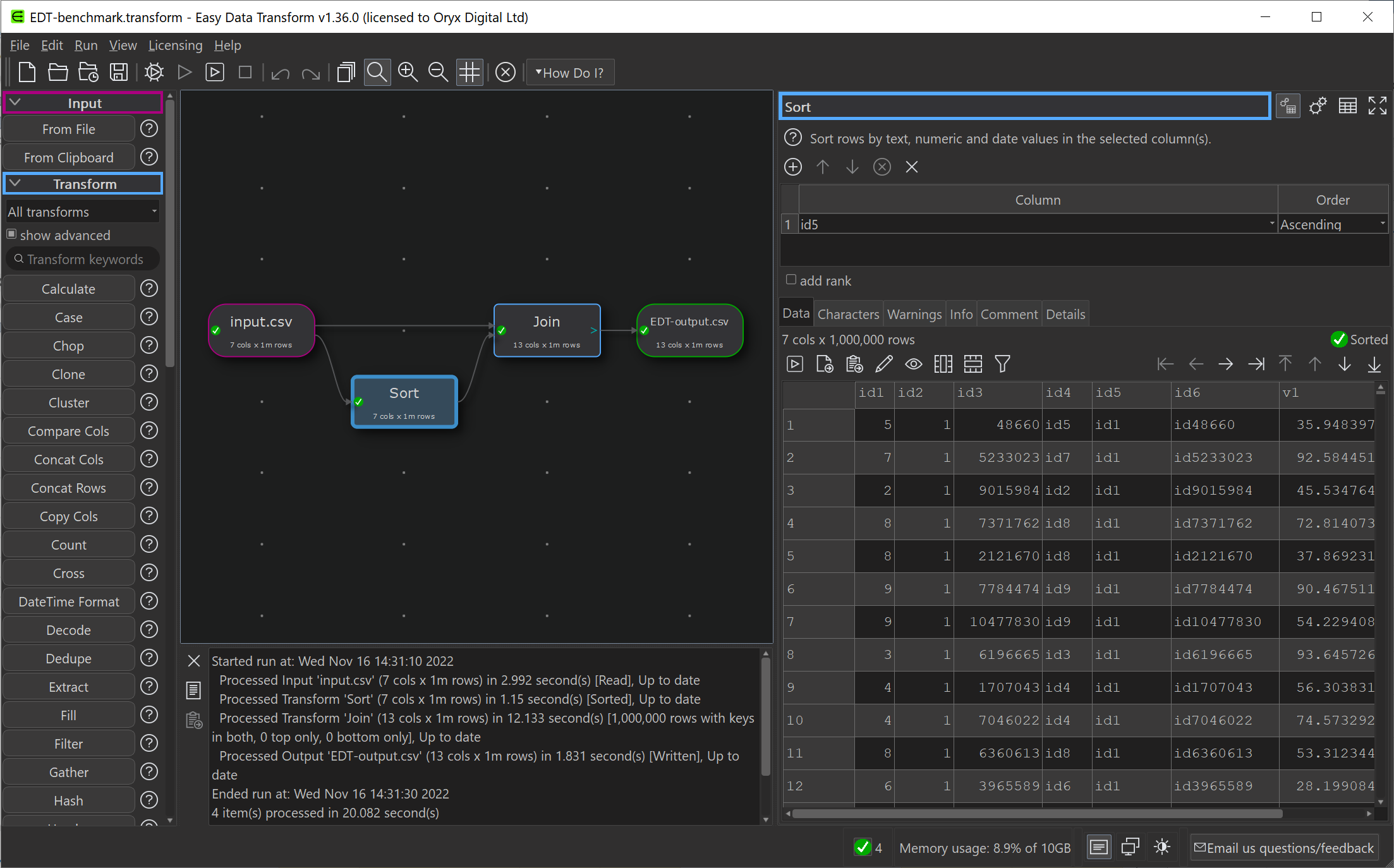
But there are many others, including my own Easy Data Transform:
Note that I’m not talking about Excel, Scratch or drag and drop GUI designers. Although some of the discussion might apply to them.
By text programming, I mean mainstream programming languages such as Python, Javascript or C++, and associated tools. Here is the QtCreator Interactive Development Environment (IDE) that I use to write C++ in, to create Easy Data Transform:
The advantages of visual programming are:
Intuitive. Humans are very visual creatures. A lot of our brain is given over to visual processing and our visual processing bandwidth is high. Look at pretty much any whiteboard, at any company, and there is a good chance you will see boxes and arrows. Even in non-techie companies.
Quicker to get started. Drag and drop tools can allow you to start solving problems in minutes.
Higher level abstractions. Which means you can work faster (assuming they are the right abstractions).
Less hidden state. The connections between nodes are shown on screen, rather than you having to build an internal model in your own memory.
Less configuration. The system components work together without modification.
No syntax to remember. Which means it is less arcane for people who aren’t experienced programmers.
Less run-time errors, because the system generally won’t let you do anything invalid. You don’t have to worry about getting function names or parameter ordering and types right.
Immediate feedback on every action. No need to compile and run.
The advantages of text programming are:
Denser representation of information.
Greater flexibility. Easier to do things like looping and recursion.
Better tooling. There is a vast ecosystem of tools for manipulating text, such as editors and version control systems.
Less lock-in. You can generally move your C++ or Python code from one IDE to another without much problem.
More opportunities for optimization. Because you have lower-level access there is more scope to optimize speed and/or memory as required.
The advantages and disadvantages of each are two sides of the same coin. A higher level of abstraction makes things simpler, but also reduces the expressiveness and flexibility. The explicit showing of connections can make things clearer, but can also increase on-screen clutter.
The typical complaints you hear online about visual programming systems are:
It makes 95% of things easy and 5% of things impossible
Visual programming systems are not as flexible. However many visual programming systems will let you drop down into text programming, when required, to implement that additional 5%.
Jokes aside, I think this hybrid approach does a lot to combine the strengths of both approaches.
It doesn’t scale to complex systems
Managing complex systems has been much improved over the years in text programming, using techniques such as hierarchy and encapsulation. But there is no reason these same techniques can’t also be applied to visual programming.
It isn’t high enough performance
The creators of a visual programming system are making a lot of design decisions for you. If you need to tune a system for high performance on a particular problem, then you probably need the low level control that text based programming allows. But with most problems you probably don’t care if it takes a few extra seconds to run, if you can do the programming in a fraction of the time. Also, a lot of visual programming systems are pretty fast. Easy Data Transform can join 2 one million row datasets on a laptop in ~5 seconds, which is faster than base R.
I’m sure we’ve all seen examples of spaghetti diagrams. But you can also create horrible spaghetti code with text programming. Also, being able to immediately see that a visual program has been sloppily constructed might serve as a useful cue.
If you are careful to layout your nodes, you can keep things manageable (ravioli, rather than spaghetti). But it starts to become tricky when you have 50+ nodes with a moderate to high degree of connectivity, especially if there is no support for hierarchy (nodes within nodes).
Automatic layout of graphs for easier comprehension (e.g. to minimize line crossings) is hard (NP-complete, in the same class of problems as the ‘travelling salesman’).
No support for versioning
It is possible to version visual programming tools if they store the information in a text based file (e.g XML). Trying to diff raw XML isn’t ideal, but some visual based programming tools do have built-in diff and merge tools.
It isn’t searchable
There is no reason why visual programming tools should not be searchable.
Too much mousing
Professional programmers love their keyboard shortcuts. But there is no reason why visual programming tools can’t also make good use of keyboard shortcuts.
Vendor lock-in
Many visual programming tools are proprietary, which means the cost can be high for switching from one to another. So, if you are going to invest time and/or money heavily in a visual programming tool, take time to make a good choice and consider how you could move away from it if you need to. If you are doing quick and dirty one-offs to solve a particular problem that you don’t need to solve again, then this doesn’t really matter.
‘No code’ just means ‘someone else’s code’
If you are using Python+Pandas or R instead of Easy Data Transform, then you are also balancing on top of an enormous pile of someone else’s code.
We are experts, we don’t need no stinkin drag and drop
If you are an experienced text programmer, then you aren’t really the target market for these tools. Easy Data Transform is aimed at the analyst or business guy trying to wrangle a motley collection of Excel and CSV files, not the professional data scientist who dreams in R or Pandas. However even a professional code jockey might find visual tools faster for some jobs.
Both visual and text programming have their places. Visual programming is excellent for exploratory work and prototyping. Text based programming is almost always a better choice for experts creating production systems where performance is important. When I want to analyse some sales data, I use Easy Data Transform. But when I work on Easy Data Transform itself, I use C++.
Text programming is more mature than visual programming. FORTRAN appeared in the 1950s. Applications with graphical user interfaces only started becoming mainstream in the 1980s. Some of the shortcomings with visual programming reflect it’s relative lack of maturity and I think we can expect to see continued improvements in the tooling associated with visual programming.
Visual programming works best in specific domains, such as:
3d graphics and animations
image processing
audio processing
game design
data wrangling
These domains tend to have:
A single, well defined data type. Such as a table of data (dataframe) for data wrangling.
Well defined abstractions. Such as join, to merge 2 tables of data using a common key column.
A relatively straightforward control flow. Typically a step-by-step pipeline, without loops, recursion or complex control flow.
Visual programming has been much less successful when applied to generic programming, where you need lots of different data types, a wide range of abstractions and potentially complex control flow.
I’ve been a professional software developer since 1987. People (mostly in marketing) have talked about replacing code and programmers with point and click tools for much of that time. That is clearly not going to happen. Text programming is the best approach for some kinds of problems and will remain so for the foreseeable future. But domain-specific visual programming can be very powerful and has a much lower barrier to entry. Visual programming empowers people to do things that might be out of their reach with text programming and might never get done if they have to wait for the IT department to do it.
So, unsurprisingly, the answer to ‘which is better?’ is very much ‘it depends’. Both have their place and neither is going away.
Winterfest 2023 is on. Loads of quality software for Mac and Windows from independent vendors, at a discount. This includes my own Easy Data Transform and Hyper Plan, which are on sale with a 25% discount.
This sounds like a question a programmer might ask after one medicinal cigarette too many. The computer science equivalent of “what is the sounds of one hand clapping?”. But it is a question I have to decide the answer to.
I am adding indexOf() and lastIndexOf() operations to the Calculate transform of my data wrangling (ETL) software (Easy Data Transform). This will allow users to find the offset of one string inside another, counting from the start or the end of the string. Easy Data Transform is written in C++ and uses the Qt QString class for strings. There are indexOf() and lastIndexOf() methods for QString, so I thought this would be an easy job to wrap that functionality. Maybe 15 minutes to program it, write a test case and document it.
Obviously it wasn’t that easy, otherwise I couldn’t be writing this blog post.
First of all, what is the index of “a” in “abc”? 0, obviously. QString( “abc” ).indexOf( “a” ) returns 0. Duh. Well only if you are a (non-Fortran) programmer. Ask a non-programmer (such as my wife) and they will say: 1, obviously. It is the first character. Duh. Excel FIND( “a”, “abc” ) returns 1.
Ok, most of my customers, aren’t programmers. I can use 1 based indexing.
But then things get more tricky.
What is the index of an empty string in “abc”? 1 maybe, using 1-based indexing or maybe empty is not a valid value to pass.
What is the index of an empty string in an empty string? Hmm. I guess the empty string does contain an empty string, but at what index? 1 maybe, using 1-based indexing, except there isn’t a first position in the string. Again, maybe empty is not a valid value to pass.
I looked at the Qt C++ QString, Javascript string and Excel FIND() function for answers. But they each give different answers and some of them aren’t even internally consistent. This is a simple comparison of the first index or last index of text v1 in text v2 in each (Excel doesn’t have an equivalent of lastIndexOf() that I am aware of):
Changing these to make the all the valid results 1-based and setting invalid results to -1, for easy comparison:
So:
Javascript disagrees with C++ QString and Excel on whether the first index of an empty string in an empty string is valid.
Javascript disagrees with C++ QString on whether the last index of an empty string in a non-empty string is the index of the last character or 1 after the last character.
C++ QString thinks the first index of an empty string in an empty string is the first character, but the last index of an empty string in an empty string is invalid.
It seems surprisingly difficult to come up with something intuitive and consistent! I think I am probably going to return an error message if either or both values are empty. This seems to me to be the only unambiguous and consistent approach.
I could return a 0 for a non-match or when one or both values are empty, but I think it is important to return different results in these 2 different cases. Also, not found and invalid feel qualitatively different to a calculated index to me, so shouldn’t be just another number. What do you think?
*** Update 14-Dec-2023 ***
I’ve been around the houses a bit more following feedback on this blog, the Easy Data Transform forum and hacker news and this what I have decided:
IndexOf() v1 in v2:
v1
v2
IndexOf(v1,v2)
1
aba
aba
1
a
a
1
a
aba
1
x
y
world
hello world
7
This is the same as Excel FIND() and differs from Javascript indexOf() (ignoring the difference in 0 or 1 based indexing) only for “”.indexOf(“”) which returns -1 in Javascript.
LastIndexOf() v1 in v2:
v1
v2
LastIndexOf(v1,v2)
1
aba
aba
4
a
a
1
a
aba
3
x
y
world
hello world
7
This differs from Javascript lastIndexOf() (ignoring difference in 0 or 1 based indexing) only for “”.indexOf(“”) which returns -1 in Javascript.
Conceptually the index is the 1-based index of the first (IndexOf) or last (LastIndexOf) position where, if the V1 is removed from the found position, it would have to be re-inserted in order to revert to V2. Thanks to layer8 on Hacker News for clarifying this.
Javascript and C++ QString return an integer and both use -1 as a placeholder value. But Easy Data Transform is returning a string (that can be interpreted as a number, depending on the transform) so we aren’t bound to using a numeric value. So I have left it blank where there is no valid result.
Now I’ve spent enough time down this rabbit hole and need to get on with something else! If you don’t like it you can always add an If with Calculate or use a Javascript transform to get the result you prefer.
*** Update 15-Dec-2023 ***
Quite a bit of debate on this topic on Hacker News.
Easy Data Transform and Hyper Plan Professional edition are both on sale for 25% off at Winterfest 2022. So now might be a good time to give them a try (both have free trials). There is also some other great products from other small vendors on sale, including Tinderbox, Scrivener and Devonthink. Some of the software is Mac only, but Easy Data Transform and Hyper Plan are available for both Mac and Windows (one license covers both OSs).
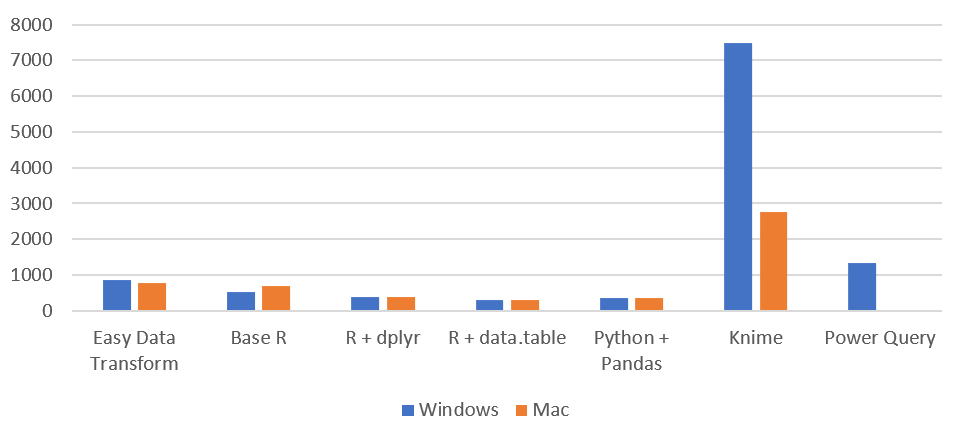
I have been gradually improving my data wrangling tool, Easy Data Transform, putting out 70 public releases since 2019. While the product’s emphasis is on ease of use, rather than pure performance, I have been trying to make it fast as well, so it can cope with the multi-million row datasets customers like to throw at it. To see how I was doing, I did a simple benchmark of the most recent version of Easy Data Transform (v1.37.0) against several other desktop data wrangling tools. The benchmark did a read, sort, join and write of a 1 million row CSV file. I did the benchmarking on my Windows development PC and my Mac M1 laptop.
Here is an overview of the results:
Time by task (seconds), on Windows without Power Query (smaller is better):
I have left Excel Power Query off this graph, as it is so slow you can hardly see the other bars when it is included!
Time by task (seconds) on Mac (smaller is better):
Memory usage (MB), Windows vs Mac (smaller is better):
So Easy Data Transform is nearly as fast as it’s nearest competitor, Knime, on Windows and a fair bit faster on an M1 Mac. It is also uses a lot less memory than Knime. However we have got some way to go to catch up with the Pandas library for Python and the data.table package for R, when it comes to raw performance. Hopefully I can get nearer to their performance in time. I was forbidden from including benchmarks for Tableau Prep and Alteryx by their licensing terms, which seems unnecessarily restrictive.
Looking at just the Easy Data Transform results, it is interesting to notice that a newish Macbook Air M1 laptop is significantly faster than a desktop AMD Ryzen 7 desktop PC from a few years ago.











 Successful Software