Tag Archives: software

The art, science and ethics of software box shots

Perfect Table planI have recently revamped the PerfectTablePlan payment pages. I asked Andrew Gibson of 3d-box-shot.com to create an image of the PerfectTablePlan packaging, using the existing artwork. I was very impressed with the result. The image is much cleaner and more aesthetically pleasing than I could have achieved by photographing the physical packaging. But I am much less keen on the practice of using box shots of software where is no box (i.e. download only). It seems disingenuous, at best.  Andrew kindly agreed to write a guest article for this blog with an insider’s view on the art, science and ethics of software box shots.

Almost every time the subject of box shots is raised in any sort of software marketing forum, opinion seems to split diametrically in two opposing camps. The first group don’t see any ethical problem with displaying a box shot for a “download only” product. The typical argument used in favour of box shots is that it makes a product appear more tangible to consumers. They can see what you’re selling without having to read about it. It removes any doubt that the site they are looking at has software to sell and, when used effectively, can add an air of professionalism to a site. Finally, there’s a widely held belief that because of this, displaying a box shot can improve conversion rates.

In contrast, the opposing group believe that displaying a box shot for a “download only” product is ethically wrong and fundamentally dishonest. They maintain that customers would complain about not receiving a physical package in the post that’s identical in every respect to the “bogus” box shot displayed on the website. I run my own Micro ISV, selling amongst other applications, a product called 3D Box Shot. As a result, you might be inclined to think that I fall into the first camp. However, I’m actually quite ambivalent about the issue. I use box shots on some of my sites and have never received a single complaint from a customer about them not receiving a physical product in the mail. However, consumers in different markets don’t all behave the same way, which is why advice that works for some ISV’s can be commercial suicide for others. I’m entirely willing to accept that in some markets, some customers may indeed complain about not receiving a physical product. I just haven’t experienced this first-hand.

It’s worth noting that existing users of your product can often be persuaded to purchase additional copies to give as gifts. They may not even make this connection themselves, so why not put the thought in their heads? Send a festive email offering to ship additional physical copies of your products (gift wrapped) to friends and relatives. Add something like the following to your site to make the point visually:

selling-software-as-a-gift

click for a larger image

It’s often stated that adding a box shot to your site can dramatically improve conversion rates for your products. It may come as a surprise to learn that I’m not convinced that this is true in all cases. Generally speaking a box shot isn’t some sort of magic bullet that will transform your sales overnight. However, if it is an integrated part of your marketing strategy then it can make a real difference.

So how do you go about integrating a box shot into your marketing strategy? From a design perspective you can integrate a box design by keeping everything visually consistent. Use your company and product logo on the box and clearly display your website URL as well. This will help to increase the marketing potential of your box shot.

One less obvious method is to add you box shot to the image for your PAD Screenshot. Most download sites are worse than useless when it comes to driving traffic to your site. So instead of thinking of the screenshot referenced in your PAD file as just a screenshot, think of it as a blank advertising canvass that thousand of download sites are happy to display for you free of charge…

PAD-Screenshot-replacement

click for a larger image

Using this method, you can attract visitors to your site even from low quality download sites that don’t even supply a link back to your website.

So how do you get a box shot designed? As a designer I have a fairly unique approach to software box design. I treat a design as a conceptual puzzle than needs to be solved in order to create an effective cover. The criteria I use are simple. Someone needs to be able to look at the box shot and immediately understand what the product is and does. If a box doesn’t meet this challenge, then it isn’t doing it’s job. It’s normally possible to create an effective visual metaphor for a product that explains visually what it’s all about. Here are some examples of the sort of designs I’m talking about:

Example-Designs

click for a larger image

Trends in box design can change. Not so long ago lots of people were asking for Windows Vista Style boxes, but as it became more apparent that Windows Vista was destined to be seen in the same light as Windows ME, this requirement has tailed off. Nowadays the vast majority of design jobs that I do are for DVD cases, both virtual box shots and full print insert designs.

If you’re artistically talented and have access to a good quality image editing tool like Adobe Photoshop and have an easy means of transforming your 2D designs into a 3D Box, then you may well be able to create an effective looking box shot yourself.  However, once you consider the time this takes, hiring a designer seems a lot more reasonable. Since I design boxes commercially, I’ve acquired a lot of design resources including hundreds of royalty free vector images and a library of stock photography. I can draw on these resources when I’m creating a box design. This lets me develop designs quickly through the draft stage through towards the final design. However, as an experience box designer, I still find it challenging and rewarding work. But it is very time consuming.

If you’re determined to “do it yourself” then bear the following points in mind:

  1. The box shot needs to visually show what your product is and does. Show your design to someone that’s never seen your product and ask them to tell you what your product does. If they can’t do this, then your design isn’t up to the job.
  2. Make sure your website address is clearly visible on the box shot. If you ship a physical package you’ll have no way of controlling where it ends up. The box itself can drive traffic to your website. You don’t have to slap it on the front of the box, just make sure it’s there and can be seen.
  3. Try to design a cover that fits with the look and feel of your website. Use the same (or at least, non conflicting) colour scheme as your site and try to use the same fonts. This will prevent your box shot from standing out on your site like a sore thumb.
  4. Never use more than three different fonts in your design. Unless you are selling a font management application, this is sure way to spoil any design.
  5. Design so that text is still visible when the box is reduced to a 250 x 250 thumbnail. If the text is legible at this size on your design, then unless the design carries the message all by itself, the box won’t work very well as a marketing tool.
Perfect-Tableplan white background

click for a larger image

The image above was created in a rendering application at very high resolution. It took around 6 hours to complete on a dual core system. The resulting image is big enough to be used in print ads, or can easily be resized for use on the web.

Andrew Gibson is the head developer and lead designer for www.3d-box-shot.com, provider of box shots, packaging design, e-book covers and more. Box shot images from scratch start at $100. Box shots images from existing artwork can be created for as little as $25. All the images in this article were created by them. The original PerfectTablePlan packaging was designed by Nicola and Adrian Metcalfe.

The Web Startup Success Guide

startup_success_guideBob Walsh has followed up his excellent MicroISV: From Vision to Reality book with The Web Startup Success Guide. While the first book is aimed squarely at at developers of desktop software, the second is aimed more at web-based start-ups. I have to confess, I haven’t had time to read my review copy of the accompanying e-book yet (I’m moving house, moving office and putting out a major new software release). But I see from the contents it includes chapters on:

  • the idea
  • choosing a platforms
  • tools
  • fund raising
  • social media
  • getting the message across

And interviews with

  • Dharmesh Shah
  • Eric Sink
  • Joel Spolsky
  • Pamela Slim
  • Guy Kawasaki
  • …and others

If it is anything like as good as Bob’s MicroISV book, it will be worth a read by anyone doing (or thinking of doing) a web-based start-up. It is currently $19.79 on Amazon.com. You can also buy the e-book from Apress. Here are some reviews from people that have actually read it:

Neil Davidson

Willie Faler

Ten mistakes microISVs make

Here is a video of the “Ten mistakes microISVs make” talk I gave at the Software Industry Conference 2009 in Boston. Total duration: 27 minutes.

The slides aren’t terribly easy to read, due to the resizing and compression of the video. But you can also download the paper and slides:

A big thank you to Alwin and Sytske of collectorz.com for doing the video. You can read Alwin’s excellent software marketing blog at alwinhoogerdijk.com.

Feel free to embed this video, as long as you include a credit and a link back to this blog.

How many of these mistakes have you made? How many are you still making?

Consulting testimonial: Reserviz

Working as a micro-ISV needs lots of different skills, but no-one can have all of them. When you’re developing a software product for your independent venture, it’s easy to lose sight of some issues, just because there are so many of them to cover, and so few hours in a day. I realised that to help me re-focus and prioritise the key tasks after the code was complete needed the catalyst of a fresh pair of eyes, to verify or change the plans I had. Simply chatting to a knowledgeable professional made all the difference to perspective and priorities. I was expecting that from Andy Brice, as I’d read about his work with other micro-ISVs. What I wasn’t expecting was his breadth of business knowledge as well as his technical knowledge. Being able to discuss business objectives, markets, pricing, promotion as well as SEO and coding was a great punctuation point in the development of the Reserviz online service, and it helped me develop a much more focussed set of priorities to complete the initial launch period. Don’t expect from Andy a glib confirmation that everything you’ve done is fine – he’ll give you an honest assessment, and then help you work out a plan. Think of Andy as the Swiss Army Knife you need in your toolbox!

Mike Gorman, www.Reserviz.com

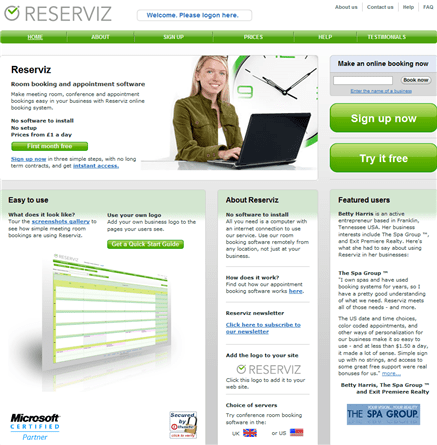
reserviz appointment and room booking

I have been doing some consulting for Mike Gorman of Quartile Software on Reserviz. Reserviz is an online service for booking rooms, people and other resources. I have primarily been helping Mike with positioning (deciding which vertical markets to focus on), online marketing (including SEO and Google Adwords) and testing the usability of the website. It was a slight departure for me, as most of my experience is with desktop apps. But it just proved that the vast majority of what is true for the marketing and usability of desktop apps also applies to web apps.

I think Reserviz has a very attractive website with a nice balance between simplicity and flexibility. If you know anyone who is still using a tatty old appointment book? Tell them to checkout Reserviz for simple online appointment and resource booking (first month free!).

The truth about conversion ratios for downloadable software

conversion funnel?Overview

An anonymous survey of software vendors shows that the average sale to visit ratio is very close to the much quoted “industry average” of 1%. However the data shows large variations between products and across different sectors (e.g. Windows vs Mac OS X).

The data

The data set comprises 92 valid survey responses to an 8 question survey in April 2009. The survey was advertised through a request on this blog, posts on  BOS, ASP, MACSB, OISV and BOSnetwork forums and emails to the author’s contacts. The results are inevitably biased towards small software vendors, due to the places where the survey was advertised. As the survey was anonymous it is impossible to verify the accuracy of the data. However it is unlikely that many vendors would have completed a survey that wasn’t anonymous.

The survey consisted of 3 compulsory questions (unique visits, downloads and sales over a given timeframe) and 5 optional questions (the time frame of the data, primary market, primary OS, licence price and trial type). One record had 0 visits (an iPod app), another had 0 downloads (presumably a web app) and a few had numbers that I didn’t consider statistically valid for some purposes (e.g. <500 visits per month or <3 sales transactions per month).  I did the best I could with the data available, ignoring obvious outliers in some cases.

The data set comprises a total of:

  • 8.1 million unique website visits
  • 2.2 million downloads
  • 110 thousand sales transactions

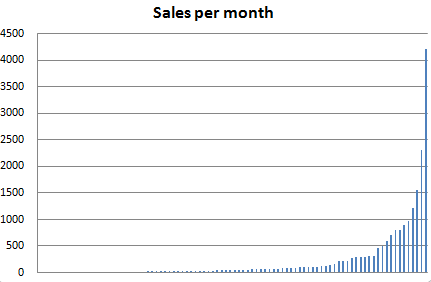
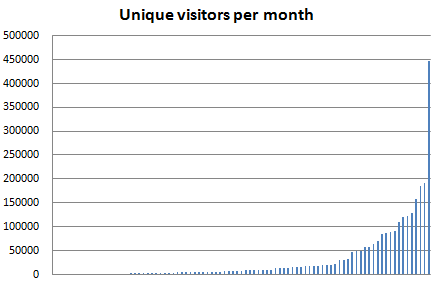
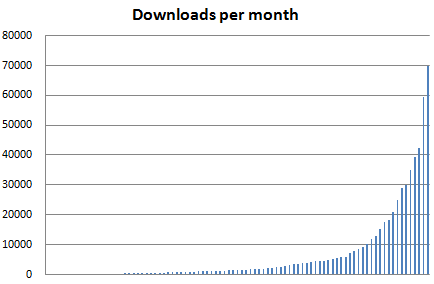
Where a time frame for the results was given it is possible to work out the range of visitors, downloads and sales per month.
metrics_all_visitors

metrics_all_downloads

metrics_all_sales

Interestingly the distribution of monthly visits, downloads and sales across the different products all follow the Pareto 80:20 power law quite closely:

  • 22% of the products account for 80% of the visits
  • 21% of the products account for 80% of the downloads
  • 19% of the products account for 80% of the sales

This gives me some faith that the data is reasonably accurate and representative of the industry as a whole.

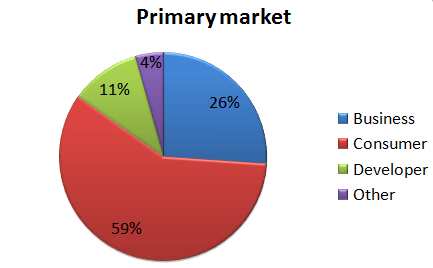
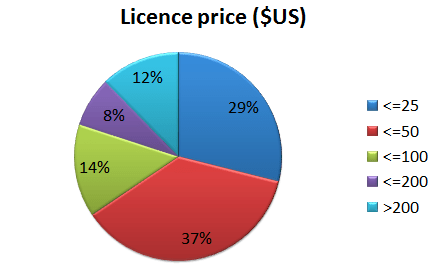
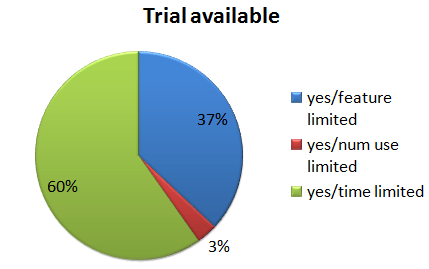
The data is broken down by OS, market, price and trial type as follows:
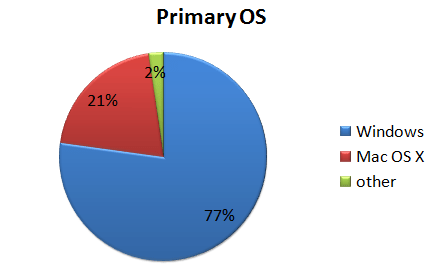
metrics_all_os

metrics_all_market

metrics_all_price1

metrics_all_trial

Analysis

The average (mean) ratio of downloads:visits across all products is 28%. 50% of products are in the range 12.1% to 35.3%.
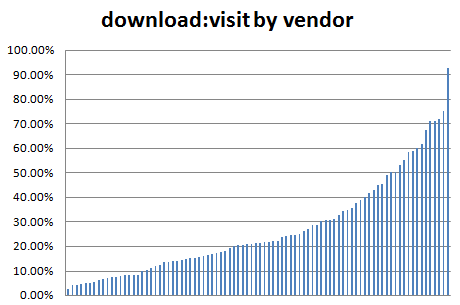
metrics_download_visit_ratio

I am surprised at how high the average ratio is. This could partly be due to products that receive a high percentage of downloads from download sites, without the downloader ever visiting the product site. Conversely sites where visitors make frequent returns after purchase (e.g. to read forums) will have a lower downloads:visits ratio.

The average ratio of sales:downloads across all products is 4.5%. 50% of products are in the range 1.3% to 6.4%.
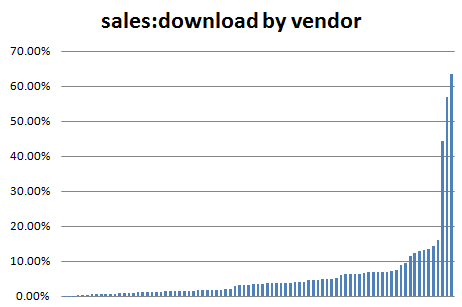
metrics_sale_download_ratio

The average sales:downloads ratio is noticeably lower than the average downloads:visits ratio. The sales:downloads ratio is noticeably skewed on the right of the graph – a sales:downloads ratio >20% seems very high.

The (logarithmic) scatter plots below show that the downloads:sales ratio varies a lot more than visits:downloads ratio.
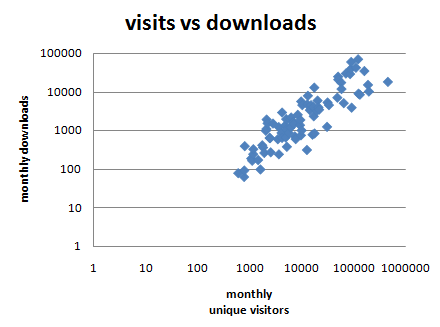
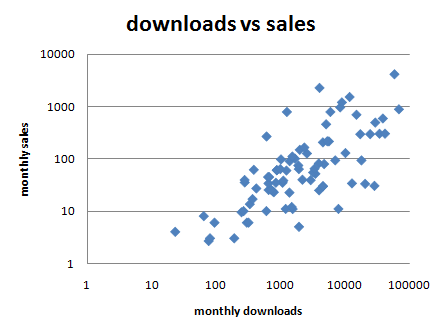
metrics_visits_vs_downloads

metrics_downloads_vs_salesThe average (mean) sales:visits ratio of all products is 1.16%[1]. However one of the product ratios is an obvious outlier at 13.94% (see below). With this outlier removed the average sales:visits conversion ratio across all the products is 0.99%. 50% of products are in the range 0.28% to 1.39%.
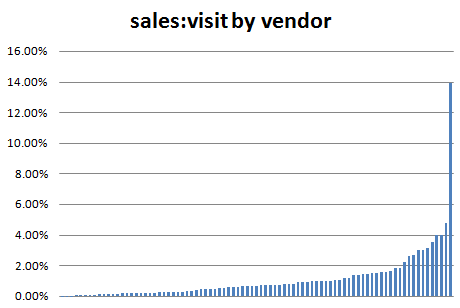
metrics_sale_visit_ratio

0.99% is suspiciously close to the mythical ‘industry average’ of 1%. But I haven’t (consciously) massaged the results to get this figure.

You can work out how you compare to this data set using the red (cumulative) graph in the histogram below. For example, if your product sales:visits ratio is 1.5%, then it is higher than approximately 80% of the products in the data set.
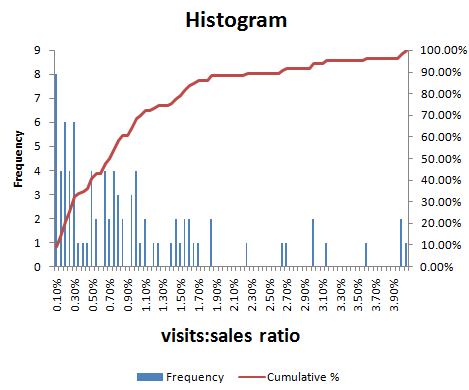
conversion-ratio-distribution2

We can also look at how the ratios vary across sectors. Surprisingly the average Mac product conversion ratio is more than 4 times the Windows product conversion ratio.
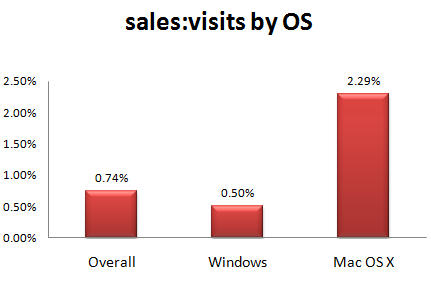
metrics_sale_visit_ratio_by_os1Even if we try to compare like for like, and only compare consumer products selling for <= $50, the ratios are still 2.27% for Mac and 0.51% for Windows. Possible reasons for this large disparity include:

  • Mac owners more ready to spend money.
  • There is less competition in the Mac software market.
  • Mac vendors have a higher percentage of purchasers  who never visit their site due to higher quality of Mac download sites.
  • It is a statistical blip (there are a lot less Mac products in the survey).

My own experience with selling a cross-platform product (Perfect Table Plan) on Windows and Mac OS X is that the Mac sales:visits ratio is approximately double that for Windows.

The sales:visits ratio is similar for business and consumer products, with developer products lagging behind. However there are too few developer products in the data set to draw any real conclusions.
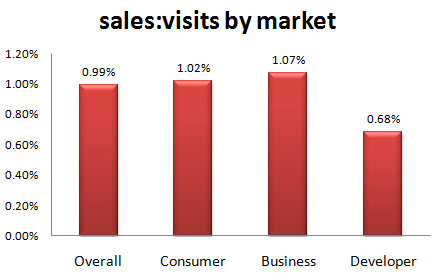
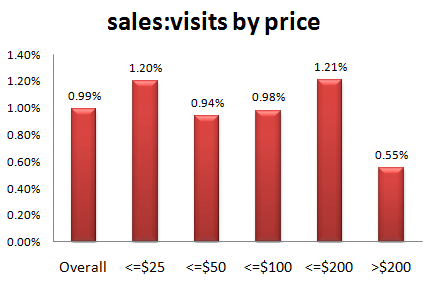
metrics_sale_visit_ratio_by_market1The sales:visits ratio does vary across the price range. However there are too few products with price >$50 in the data set to draw any real conclusions.
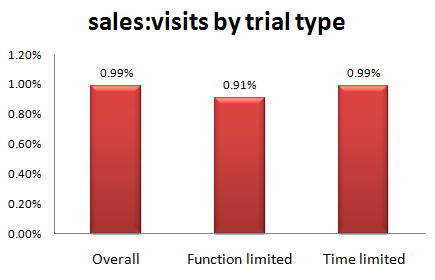
metrics_sale_visit_ratio_by_price2The sales:visits ratio does not seem to vary significantly by trial type. There were insufficient ‘number of use’ trial products to include them.
metrics_sale_visit_ratio_by_trial1

Conclusion

One has to be careful about drawing conclusions from a relatively small and unverifiable data set. However the results certainly seem to support the much-quoted “industry standard” sales:visits conversion ratio of 1%. But there are huge variations between products.

The fact that the sales:downloads ratio is both lower on average and more variable than the downloads:visitors ratio implies that getting people to download is the easy bit and converting the download to a sale is a tougher challenge.

The average sales:visits conversion ratio is noticeably higher for Mac OS X products than Windows products. This is supported by anecdotal evidence and the author’s own experience with a cross-platform product. However the number of Mac respondents to the survey is too small for the result to be stated with any great confidence. Also remember that the Mac market is still a lot smaller than the Windows market before you rush off to start learning Cocoa and Objective-C.

These ratios can be useful for a number of purposes, including: identifying a bottleneck in your conversion funnel (is your downloads:visitors ratio low compared to other products?); estimating how much traffic you might need for a viable business; or estimating how much you can afford to bid on Google Adwords. And it is useful to track how these ratios change over time (I track mine on a monthly basis). But make sure you compare like with like if you are comparing your ratios with other products. For example, a 10% sales:downloads ratio might be achievable for a niche business product, but unrealistic for a casual game. And remember that these ratios are only one part of a bigger picture. There are other, more important, metrics. Profitability for a start.

The data set is available here:

Raw data (some invalid records deleted), CSV format

Processed data, Excel XLSX format

Feel free to publish your own analysis. Thank you to everyone that took part in the survey.

[1] Calculating the mean of all the ratios probably isn’t the way a proper statistician would do it. But anything more seems overkill given the limited size and unverifiable nature of the data set.


GraphicDesignerToolbox

I launched my product a year ago, but so far haven’t had much luck selling it. I desperately needed advice from a person that could take a look at my situation and help figure out what’s wrong and how to move on. Andy Brice has been through all this and knew exactly what I was struggling with.

Simon Strandgaard, www.GraphicDesignerToolbox.com

gdt-screenshot

GraphicDesignerToolbox is a Mac OS X application for creating computer generated graphics. It allows users to snap together generative and filter blocks to create a vast range of different types of images, without any drawing or programming. It is an impressively slick and well engineered piece of software. But sales were unsatisfactory. I did some consulting for the author, Simon Strandgaard, focussed on improving the marketing and the user’s initial experience of the product. As a result he has made a lot of changes, including:

  • Re-thought the product positioning, marketing message and target customer.
  • Renamed the application to GraphicDesignerToolbox (from the less descriptive ToolboxApp).
  • Moved the website from ToolboxApp.com to GraphicDesignerToolbox.com.
  • Commissioned a new application icon.
  • Completely rewritten the website.
  • Improved the initial user experience with a quick tour and easy to load samples.
  • Improved the product documentation.
  • Changed the trial model.
  • Increased the price.
  • Released version 1.0.

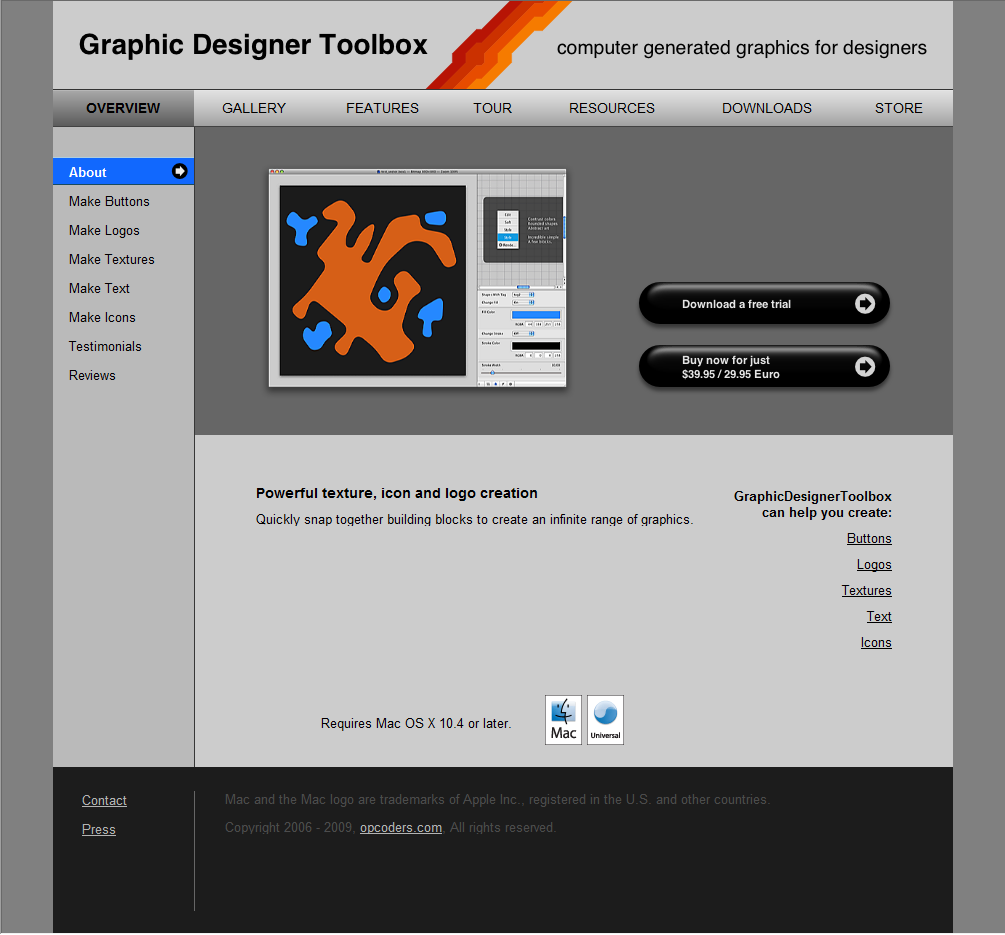
You can see captures of old and new versions of the website below:

toolboxapp_cropped1

Old home page - click to enlarge

graphicdesignertoolbox

New home page - click to enlarge

It is has been very rewarding to see the product and marketing improve so much in just three months. Especially as someone else was doing all the hard work! I think the changes are a huge improvement all round and I wish Simon and GraphicDesignerToolbox every success. v1.0 was released today and Simon tells me he has sold as many licences today as in the previous 5 months.

If you have a Mac you can head over to GraphicDesignerToolbox.com and download the trial.

The two types of reseller

resellersIn theory, the Internet allows customers to find products without the need for middlemen (unless you count Google). In reality, the age of full disintermediation has not yet arrived, and perhaps never will. Middlemen are still important. One of the more important types of middlemen for a software vendor is the reseller. However it is important to realise that there are two completely different types of reseller. One can be very useful to you as a software vendor, the other is generally a pain in the backside. They should be treated accordingly.

Value added resellers

A value added reseller buys your product and then resells it to their customers. Usually they will buy from you at a discount and resell to their customer at full price, pocketing the difference. Typically a reseller will expect between 25-50% discount depending on a range of factors including what services they provide (e.g. localisation and support), the price of the product  and volumes sold. Often the discounts are on a sliding scale, with the discount increasing with sales volume. This type of reseller can add value for you and the cusomer in various ways. They may:

  • have expertise in markets that you don’t
  • be able to reach markets that you can’t, due to barriers of language, culture or geography
  • localise your product and marketing materials
  • provide first level support.
  • sell your software as part of a package including other services, software and/or hardware.

However there are a few things you have to look out for:

  • You don’t want to end up competing directly against your own resellers in existing markets.
  • Resellers may undercut you on price.
  • Beware of offering any sort of exclusivity.
  • Customers may sign up as resellers just to get a discount for a single purchase.

You can try to avoid direct competition with resellers by only picking resellers in different markets. You may also be able to specify certain terms and conditions, for example that they can’t bid against you on certain phrases in Google Adwords. But, depending on the law where you live, you can’t tell a reseller what to charge the customer. For example, under UK law, this is considered  ‘price fixing’ and is illegal. So make sure you charge a reseller a percentage of your recommended price, not a percentage of their sale price, to make price cutting less attractive. For example, if your product retails for $50, charge the retailer X% of $50. Not X% of what they sell for. Otherwise they could undercut you by selling for $30, and still make a profit, or even give your software away for free.

Resellers will often ask for exclusivity. Exclusivity can provide extra motivation to the reseller (a reseller won’t want to put a lot of effort into marketing your software if you can pull the plug at any time for no reason), but what if the reseller loses interest in your product?  It happens. You could be left in a very bad position unless you can terminate the agreement. So you should agree some sort of minimum volume of sales for a reseller to retain exclusivity.

Offering a sliding scale discount with no discount for the first purchase will discourage customers from trying to take advantage of reseller discounts.

Value subtracted resellers

The other type of middleman that call themself a reseller are really just acting as outsourced purchasing for your customer. They buy your software on the customer’s behalf so that the poor darlings in the customer’s accounts department only get a single invoice for software sales per month, instead of one per vendor. They don’t add any value at all as far the vendor is concerned.  In fact they just make the vendor’s life more difficult by getting between the vendor and the real customer. I had one reseller of this type who, after some twenty emails exchanged, failed to workout how to buy my software from my website. How dim can you be that you can’t click a ‘buy now’ button and fill in a few details when that is what you do for a living? Hence I call them ‘value subtracted resellers’.

This type of reseller will often ask for a discount. Don’t give it to them. The real customer has probably already instructed them to buy your product, so a discount won’t help to close the sale. Also the reseller might pocket the discount instead of passing it on to the customer. If anything, charge them more.

T-shirt update

I’ve have just made the first payout of royalties from T-shirt sales. $106.20 of Zazzle royalties were split evenly between Sightsavers and JaipurFoot. Patrick McKenzie has also made a very generous additional donation as he promised on his blog.

Sales dropped off rapidly after Xmas, so I am probably going to leave programmer-tshirts.com ticking over until Xmas 2009. Thanks again to everyone that bought T-shirts or helped with the publicity. Special thanks to Patrick for setting up the programmer-tshirts.com site on his server.

NB/ You can still buy T-shirts!

Marketing your software through affiliates

affiliate marketingThe idea of paying someone for sending you business has been around for a long time. Affiliate marketing is just a new, Internet-based, take on it. An affiliate sends traffic to your website and is paid a commission on each sale.  For software this commission will typically be in the range 20-50% of the sale price (although commissions of 75% or more aren’t unheard of). Commission is usually calculated by using cookies to track the number of successful sales (‘conversions’) due to each affiliate.

In theory you can set up your own affiliate commission tracking system, but affiliates would have to trust that your system is honest. It would also involve quite a bit of wheel reinventing. Consequently most vendors use affiliate marketing systems administered by third parties such as shareasale, clickbank or commission junction. Payment processors, such as Avangate and e-junkie, also have their own affiliate marketing systems.

It sounds great. The affiliates are doing marketing for you and you only pay them when you make a sale. How can you possibly lose? In fact there are quite a few potential downsides:

  • You may end up paying commission on sales through affiliates that would otherwise have come to you direct.
  • Affiliates won’t be happy if there is any way to purchase where they don’t get their commission (‘leaks’). This might mean you may not be able to offer some forms of payment, such as cheque or credit card over the phone.
  • You will be competing against your affiliates for search engine ranking.
  • Somebody who wants to buy several copies of your software could sign up as an affiliate to get the commission on their own purchase. You then have to pay commission, but get no additional sales.
  • Affiliates may compete against you in PPC ads, driving up the cost of your ads.
  • Even though you make less on the sale, you still have the full cost of supporting the customer.
  • Some affiliates operate at the shadier end of the market and may resort to various dodgy, or even criminal, practises to get their commission, including:
    • Spam.
    • Annoying pop-up ads.
    • Cookie stuffing.
    • Misrepresenting your product.
    • Adware.
    • Buying your product with a stolen credit card.

You maybe be able to prevent some of the above abuses with appropriate terms and conditions. ( I should also point out, in the interest of fairness, that there are various ways that the affiliate might lose out on commission that is rightfully theirs. For example customers who block cookies and even fraud by vendors.)

Drawing up agreements, recruiting affiliates, providing them with marketing materials, doing the accounts and paying your affiliates all takes time. You can automate quite a lot of it, but it still takes time to set-up the system, answer questions, keep everything running smoothly and check that affiliates are behaving themselves. Time that you could be spending doing other more lucrative and interesting things. As always, there is no such thing as a free lunch.

Joel Spolsky has been an outspoken critic of affiliate marketing:

We did an affiliate program, and found it to be a big waste of time. It generated only a trickle of sales; most of the people in the affiliate program would have linked to us anyway; probably 80% of the affiliates just became affiliates to get a kickback on the one item they bought for themselves or their job.

Affiliate links only works well for mega retail sites like Amazon, where an affiliate has a chance of making a reasonable amount of money.

Our affiliate program was one of those cases where we learned that time spent improving our product pays off many times as much as time spent dinking around with so-called clever marketing schemes.

Don’t waste your time. Move on. Do something to make your product better and Just Say No.

Joel Spolsky on the Business of Software Forum

I am inclined to agree with Joel. Hard data isn’t easy to come by. But, from reading around and talking to other vendors, it seems that very few of them are getting more than 5% of their sales through affiliates. I did have a home-rolled affiliate program for Perfect Table Plan, but I shut it down because the number of sales just wasn’t worth the administration overhead. Some of the affiliates never sold a single licence. I might be more successful if I used a more automated affiliate marketing system and put more effort into recruiting higher calibre affiliates, but I still don’t think it would be the best use of my time.

I have heard that there are ‘super affiliates’ with mythical powers to drive serious sales. But these people, if they really exist, get to pick and choose amongst thousands of products to market. They are going to pick mass-market products with a proven track record and they are going to want a big commission percentage. And how do you tell who is a super affiliate and who is a wannabe? They all talk a good game.

Affiliate marketing is big business, with estimated sales of over £2 billion in the UK alone in 2006. But I suspect a lot of it is from selling ‘get rich quick’ schemes, gambling and porn – not software. Particularly not software from small companies and microISVs. Obviously a lot depends on your product and market. Perhaps if you are selling mass market software (e.g. back-up utilites or virus scanners) and you have dedicated marketing staff, it might be worth your while to run an affiliate program. But make sure you automate as much of the system as possible and be realistic about the results.

Charity T-shirts for programmers – update

tshirt41 T-shirts sold so far. I intend to make the first payout to SightSavers and Jaipur Foot once most of that commission has cleared. Thanks to everyone that purchased a T-shirt and to all the bloggers that helped to publicise it. Special thanks to Patrick McKenzie for setting up a dedicated site on his server. We intend to leave the site up for the foreseeable future in the hope of getting more sales through organic search.

If you have any good ideas for a T-shirt design I could use, feel free to email them to me. Or, if you have the artistic skills I lack, I would love some help with designs.

If you haven’t already bought a T-shirt – now is the time! Zazzle currently has an inauguration weekend sale – a $4.40 discount for all T-shirts for the next 2 days. Just use code 440SHIRTSALE when you purchase from the Zazzle shop.